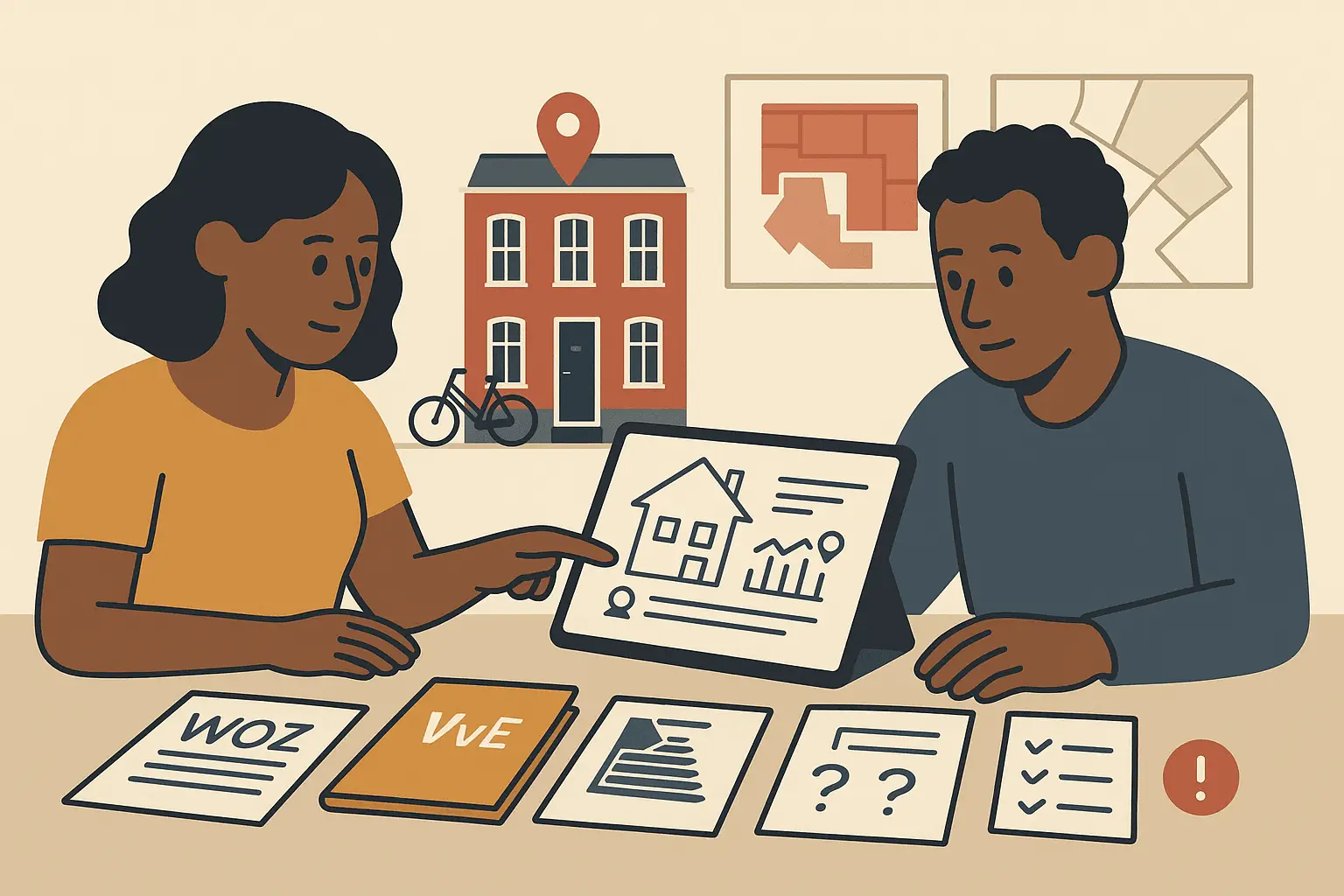
When to walk away from a Dutch property

Buying a house in the Netherlands often moves quickly. You view a property, receive a bid deadline, and have to decide whether to offer, overbid, add conditions, or stop.
The hardest question is not always “How much should I bid?” It is often: “Do I understand enough to bid at all?”
If you are searching for when to walk away house Netherlands, the practical answer is this: walk away when an important risk cannot be understood, priced, or protected with conditions before you make your offer.
Have an address in mind? Check a Dutch property before you bid. Huisscan can turn one Dutch address and uploaded documents into a clear pre-bid report with available property data, risk signals, document analysis, and buyer questions.
The simple rule: only bid on risks you understand
A walk-away decision does not mean the property is “bad”. It means the risk does not fit your budget, your timeline, or your tolerance.
Before bidding, ask three questions:
Can I understand the risk?
Do I have the documents, data, and answers needed?Can I price the risk?
Can I estimate the impact on renovation costs, monthly costs, resale, or financing?Can I protect myself with conditions?
For example, with a financing condition (voorbehoud financiering) or building inspection condition (voorbehoud bouwkundige keuring), if accepted by the seller.
If the answer is “no” to all three, walking away can be the clearest decision.
Walk-away signals to take seriously
Not every warning sign is a deal-breaker. Some issues can be handled with a lower bid, extra research, or a condition in the offer.
But the signals below should make you pause before bidding.
| Signal | Why it matters in the Netherlands | Sensible pre-bid response |
|---|---|---|
| Key documents are missing or delayed | You may be asked to bid without knowing the legal, technical, or financial position | Ask for the documents first. If pressure continues, consider walking away |
| Seller refuses a building inspection | Especially relevant for older homes, visible cracks, moisture, roof issues, or foundation concerns | Add an inspection condition or do not bid |
| Unclear or expensive erfpacht | Erfpacht means leasehold: you own the building but pay for use of the land. Future ground rent can affect affordability and resale | Request the leasehold terms and ask a qualified adviser or notary to review |
| Weak or inactive VvE | For apartments, the Vereniging van Eigenaars manages shared maintenance. Low reserves or no maintenance plan can lead to extra contributions | Review VvE documents before bidding |
| Floor area or layout does not match records | Differences between brochure, BAG data, floor plans, or actual layout can affect value and mortgage appraisal | Ask for a NEN 2580 measurement report and clarify the discrepancy |
| Extension, dormer, attic room, or garden building is unclear | Some works may need permits or may not match the permitted use | Ask for permit information or check the municipal planning context |
| Strong risk-shifting clauses | Clauses such as ouderdomsclausule, asbestclausule, or niet-bewoningsclausule can reduce what the seller is promising | Understand the clause before bidding. Ask a professional if unsure |
| The bid only works if everything goes perfectly | Tight financing, no repair budget, or relying on optimistic resale assumptions leaves little room for surprises | Lower the bid, add conditions, or walk away |
A common pre-bid mistake is treating every unknown as “normal in this market”. Some uncertainty is normal. Blind risk is not.
Dutch documents and terms that often reveal the risk
When buying a Dutch property, the most useful information is often already in the documents. The challenge is knowing what to look for.
Important documents and terms include:
Verkoopbrochure
The sales brochure. Useful, but not enough on its own.Vragenlijst
A property questionnaire, often completed by the seller. It may mention defects, renovations, disputes, leaks, asbestos, foundation issues, or neighbourhood matters.Lijst van zaken
The list of items included or excluded from the sale, such as curtains, appliances, flooring, or garden items.Meetrapport / NEN 2580
A measurement report using the Dutch measurement standard. Helpful if the advertised square metres seem uncertain.Kadaster
The Dutch land registry. It can show parcel information, registered rights, and ownership context. A notary remains responsible for the legal transfer checks.BAG
The official register for addresses and buildings. It can help verify basic object data such as function, year of construction, and registered surface area.WOZ-waarde
Municipal tax valuation. It is not the same as market value, but it can provide context.Energielabel
The official energy label. It can affect comfort, future renovation plans, and running costs.VvE documents
For apartments, ask for the splitsingsakte deed of division, regulations, service charges, reserve fund information, meeting minutes, and MJOP — the multi-year maintenance plan.Erfpacht documents
Leasehold terms, ground rent (canon), whether payments are bought off (afgekocht), and future revision moments.Bestemmingsplan / omgevingsplan
Planning rules for the location. These can affect permitted use, extensions, business use, rentals, or future nearby development.Koopakte clauses
The draft purchase agreement may contain clauses that shift risk to the buyer. Do not treat these as routine until you understand them.
Dutch law and practice include both seller disclosure duties and buyer investigation responsibilities. In plain English: the seller must not hide known relevant issues, but you are also expected to ask questions and investigate. For a serious risk, get answers in writing.
How a risk should affect your bid, conditions, or decision
A risk does not automatically mean “do not buy”. It can lead to one of three decisions.
1. Bid, but adjust the price
If the risk is clear and reasonably priced, you may still bid.
Example: the VvE minutes show planned roof maintenance and your share is understandable. That may justify a lower bid or a larger savings buffer.
2. Bid with conditions
If the risk needs confirmation, a condition may help.
Common examples are:
- financing condition
- building inspection condition
- condition linked to document review
- condition linked to valuation or mortgage approval, if relevant
Whether a seller accepts these conditions depends on the situation. Do not remove a condition simply because other buyers might. If you need it, it matters.
3. Walk away
Walking away is sensible when the risk is large, unclear, and cannot be protected.
Example: an older house shows cracks and sloping floors, the seller will not allow inspection, and there is local foundation risk. You may not be able to price that risk responsibly before bidding.
The key is not to be scared of every issue. The key is to avoid making a binding financial decision based on missing information.
Practical checklist before you bid
Use this checklist before submitting your final offer.
Property and data
- Address, floor level, storage, parking, and outdoor space match the brochure
- Living area is supported by a measurement report or explained clearly
- BAG, brochure, floor plan, and viewing impressions do not show major inconsistencies
- Energy label is known
- Recent renovations are documented where relevant
Legal and ownership signals
- Ownership situation is clear
- Leasehold (erfpacht) is understood, if applicable
- Any rights of way, shared access, or unusual restrictions are known
- The intended use matches planning rules as far as you can check
Building condition
- Visible cracks, moisture, roof issues, window frames, floors, and installation age have been considered
- You know whether you want a building inspection
- Older-property clauses are understood
- Possible asbestos, foundation, or soil issues have been checked where relevant
Apartment and VvE
- VvE service charges are known
- Reserve fund and planned maintenance are reviewed
- MJOP is available or absence is explained
- Recent meeting minutes do not show unresolved major disputes or costs
- Rules for renting, pets, renovations, or use are acceptable to you
Finance and bid structure
- Your bid fits your budget, including buyer costs and renovation buffer
- You understand the risk of a lower mortgage valuation
- You know which conditions you need
- Transfer date, deposit or bank guarantee requirements, and included items are clear
- Important answers from the selling agent are confirmed in writing
Walk-away test
Consider walking away if:
- you are being asked to waive a condition you genuinely need
- essential documents are not available before the bid deadline
- the seller refuses reasonable checks
- the deal only works if repair costs, valuation, and financing all go perfectly
- a professional adviser says further investigation is needed, but the seller will not allow time
- you feel you are bidding because of pressure, not because the risk is clear
Questions to ask the selling agent before you bid
The selling agent represents the seller. That does not mean you should distrust everything, but it does mean you should ask direct questions and request written answers.
Useful questions include:
- Can you provide the seller’s questionnaire, list of items, measurement report, and draft purchase agreement?
- Are there known issues with foundation, moisture, roof, façade, windows, sewage, or installations?
- Has any building inspection already been done?
- Is a building inspection condition acceptable?
- Are there clauses such as ouderdomsclausule, asbestclausule, or niet-bewoningsclausule?
- For an apartment: can you provide the VvE minutes, MJOP, reserve information, and service charge details?
- Are there planned VvE contributions or expected maintenance cost increases?
- Is the property on leasehold land? If yes, what are the current and future conditions?
- Have extensions, dormers, attic conversions, or structural changes been permitted?
- Are there known disputes with neighbours, the VvE, municipality, or contractors?
- What bid conditions and transfer date are important to the seller?
- Can your answers be confirmed by email?
If the answers are vague, that does not always mean something is wrong. But vague answers are not enough for a high-risk bid.
What Huisscan can help you check
Huisscan is designed as a practical pre-bid property check Netherlands buyers can use before making an offer.
With one Dutch address and uploaded documents, a Huisscan pre-bid report can help you review:
- available Dutch property data for the address
- basic object details and possible inconsistencies
- energy label and building-age context
- leasehold, VvE, or apartment-related signals where visible from the documents
- clauses and warnings in uploaded documents
- possible risk themes to discuss with the selling agent
- practical buyer questions before bidding
You can upload documents such as the sales brochure, questionnaire, VvE papers, draft purchase agreement, measurement report, or other seller-provided files. Huisscan helps turn them into a clearer overview: what is known, what looks uncertain, and what to ask next.
Huisscan does not replace a notary, mortgage advisor, appraiser, building inspector, lawyer, or buyer agent. It helps you prepare better questions and make a calmer pre-bid decision.
FAQ: when to walk away house Netherlands
Should I walk away if the seller refuses a building inspection?
Not always, but it is a serious signal. If the property is older, visibly defective, or located in an area where foundation or moisture issues are common, refusing an inspection can make the risk hard to price. You can ask for an inspection condition. If that is not accepted and the risk is material, walking away may be sensible.
Is overbidding a reason to walk away?
Overbidding is not automatically wrong. It becomes a problem when the bid no longer fits your financing, valuation risk, or repair budget. If you need a mortgage, remember that the lender may look at appraised value, not only your accepted bid. Ask your mortgage advisor before stretching.
Is erfpacht a deal-breaker?
No. Many Dutch homes are on leasehold land. The issue is whether the leasehold terms are clear and affordable. Walk away, pause, or lower your bid if future ground rent, revision dates, or buy-off terms are unclear and cannot be checked before bidding.
Are VvE problems enough to stop a purchase?
Sometimes. A healthy VvE can make apartment ownership more predictable. A weak VvE with low reserves, no maintenance plan, overdue repairs, or disputes can create future costs. Review the documents before bidding and ask questions if anything is unclear.
Can I rely on verbal statements from the selling agent?
For important points, ask for written confirmation. Verbal comments during a viewing can be misunderstood or incomplete, especially if Dutch is not your first language. Documents and written answers are easier to review with your adviser.
Can Huisscan tell me exactly what to bid?
No. Your bid depends on budget, competition, financing, and personal preference. Huisscan can help you check Dutch property data, analyse documents, identify property risks Netherlands buyers should consider, and prepare better questions before you decide.
Check the address before you bid.