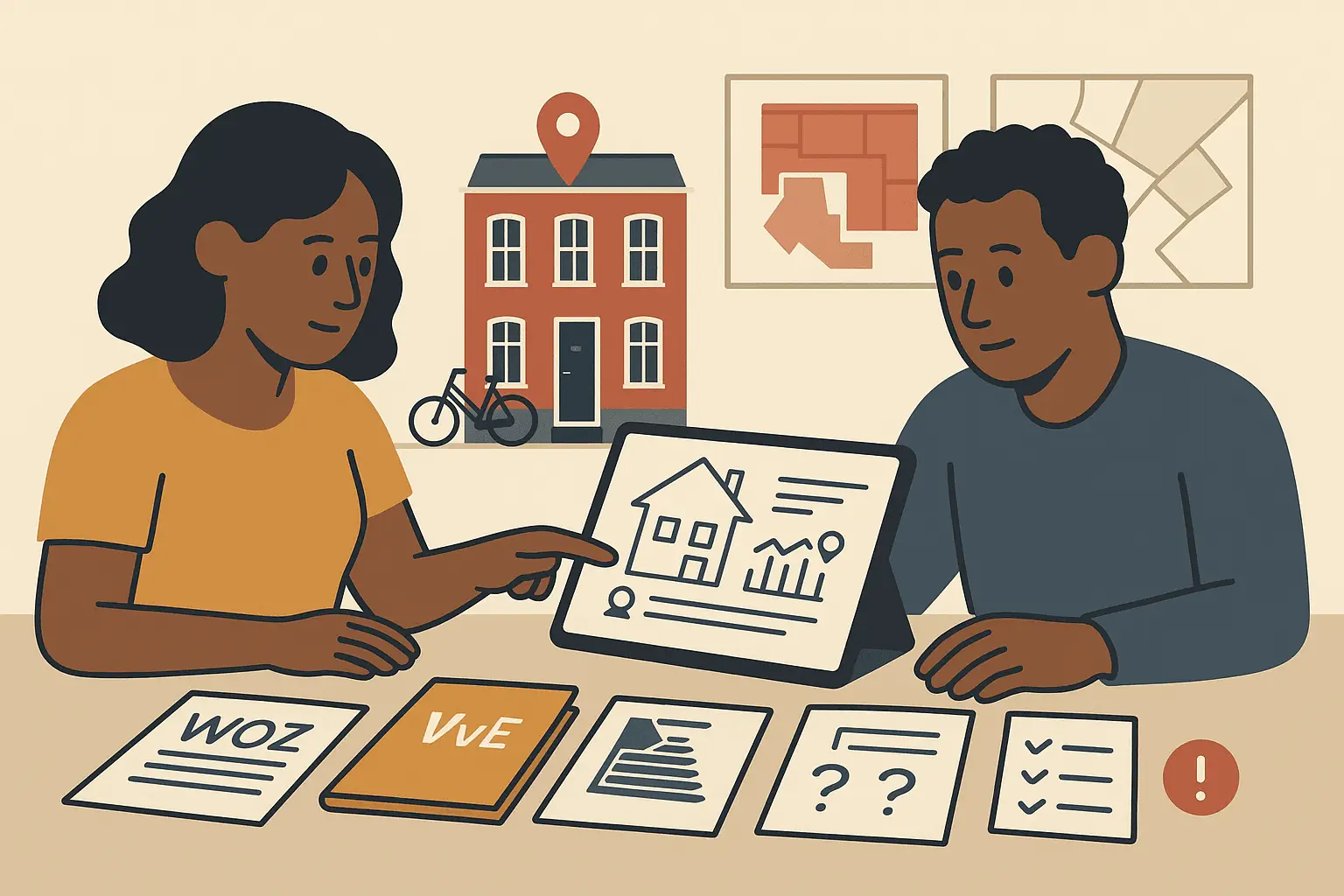
How to use Huisscan before making an offer

You have found a Dutch property you like. The viewing went well, the selling agent is asking for bids soon, and you need to decide quickly: what should you offer, which conditions should you include, and are there risks you have not checked yet?
That is where a pre-bid check helps. Dutch property data is spread across listings, public registers, municipal information, VvE documents, agent questionnaires, and inspection reports. Huisscan helps you bring that information together before you bid, so the decision is less rushed and more concrete.
Preparing an offer? Use Huisscan to check a Dutch property before you bid. Enter one address and upload the documents you have to create a clear pre-bid report with available property data, risk signals, document analysis, and buyer questions.
Why use Huisscan before making an offer in the Netherlands?
When you are buying a house in the Netherlands, the pressure often starts before you have complete information. You may have a brochure, a Funda listing, a short viewing, and a deadline for your bid. But important details can sit in separate documents or Dutch-language terms that are not easy to interpret.
A Huisscan pre-bid report is designed to support one practical question:
“Do I understand this property well enough to place this bid, with these conditions?”
It can help you spot points that may affect:
- your maximum bid;
- whether you add conditions, such as a financing or building inspection condition;
- which questions you ask the selling agent;
- whether you need a specialist opinion before bidding;
- or whether the uncertainty is too high and you should walk away.
Huisscan is not a replacement for a notary, mortgage advisor, appraiser, building inspector, lawyer, or tax advisor. It is a pre-bid intelligence tool: it helps you organise the available information and ask better questions before you commit to an offer strategy.
Step 1: Start with the address, not the asking price
The asking price is only one part of the decision. Before you focus on the bid amount, start with the address and basic property facts.
With one Dutch address, Huisscan can help structure available Dutch property data such as:
- BAG data: official address and building information, such as construction year and property function where available.
- Kadaster-related information: land registry context, such as plot or apartment rights where available.
- WOZ value: the municipal tax valuation. This is useful context, but it is not the same as market value or an appraisal.
- Energy label: the official energy performance label if available.
- Zoning or planning context: Dutch terms such as bestemmingsplan or omgevingsplan relate to what is allowed in an area.
- Monument or protected status: a rijksmonument, municipal monument, or protected cityscape can affect renovation options.
- Environmental and location signals: for example soil information, water-related context, noise, or nearby land use where data is available.
For expats, this is especially helpful because many Dutch property risks are hidden behind local terms. For example:
- Erfpacht means leasehold. You may own the building or apartment right, but not the land in the usual freehold way.
- VvE means homeowners’ association for apartments. The VvE manages shared parts, such as the roof, façade, stairwell, lift, and reserve fund.
- Splitsingsakte is the deed that divides a building into apartment rights.
- MJOP means long-term maintenance plan.
- Bouwkundige keuring means building inspection.
Understanding these terms before bidding can change your next step.
Step 2: Add the sales documents you already have
A listing alone is rarely enough. The most useful pre-bid checks often come from comparing the public data with the documents supplied by the selling agent.
Upload the documents you have, such as:
- the sales brochure;
- the Funda listing or property description;
- floor plans;
- the vragenlijst or seller questionnaire;
- the lijst van zaken, which explains what is included or excluded in the sale;
- energy label information;
- building inspection reports, if available;
- renovation invoices or permit information;
- for apartments: VvE documents, annual accounts, meeting minutes, house rules, insurance details, reserve fund information, and the MJOP;
- for leasehold: erfpacht conditions, canon information, or conversion documents if supplied.
Huisscan can then help identify missing documents, inconsistencies, and points to clarify. For example:
- The listing says “recently renovated”, but the documents do not show permits or invoices.
- The floor area in the brochure differs from another source.
- The VvE has planned maintenance, but the reserve fund looks limited.
- The seller questionnaire mentions moisture, foundation, asbestos, or neighbour issues.
- The property is advertised as move-in ready, but the energy label or building age suggests future investment.
These signals do not automatically mean “do not bid”. They mean: ask sharper questions before you decide your price and conditions.
What Huisscan can help you check
A Huisscan before making an offer in the Netherlands is most useful when you use it as a structured pre-bid property check. It can help you review the following areas.
1. Property identity and basic facts
Huisscan helps check whether the address, building type, construction year, use, and available area information appear consistent. If something does not line up, you can ask the selling agent for clarification before bidding.
2. Ownership context and Dutch property terms
Where available, Huisscan can flag terms and documents that matter for ownership, such as apartment rights, leasehold, shared ownership elements, or references to easements. These points may need interpretation by a notary or legal professional, but identifying them early helps you avoid surprises.
3. Apartment and VvE risks
For apartments, the VvE can be just as important as the apartment itself. Huisscan can help review supplied VvE documents for signals such as:
- planned maintenance;
- reserve fund information;
- recent or repeated issues in meeting minutes;
- service charges;
- insurance;
- major upcoming decisions;
- missing documents.
A nice apartment in a weak or unclear VvE may require a different bid strategy than the same apartment in a well-documented building.
4. Building age, maintenance, and renovation signals
Huisscan is not a building inspection. It cannot see behind walls or inspect foundations. But it can help connect the construction year, documents, seller disclosures, and renovation claims.
Useful questions may include:
- Is the roof mentioned in the documents?
- Are there signs of moisture or leakage?
- Are older materials, such as asbestos-risk materials, mentioned?
- Has structural work been documented?
- Are permits or completion documents available for major changes?
- Is a building inspection condition sensible?
5. Energy and sustainability context
The Dutch energy label can influence comfort, monthly costs, and future renovation plans. Huisscan can help you consider the label alongside building age, heating type, insulation notes, and document claims.
For example, a lower energy label does not automatically make a property a bad purchase. But it may affect your budget, renovation priorities, or mortgage conversation.
6. Location, zoning, and environmental signals
Huisscan can help surface available signals around the property and its surroundings, such as zoning context, protected status, soil information, water-related context, or nearby functions.
This is useful before bidding because location risks are not always visible during a viewing. A street can feel quiet on a Saturday morning, while planning documents or maps may show relevant context you want to understand.
7. Document analysis and buyer questions
One of the most practical outputs is a list of better buyer questions. Instead of asking “Is everything okay with the house?”, you can ask:
- “The seller questionnaire mentions moisture in the past. What caused it and what was repaired?”
- “Can you share the latest VvE meeting minutes and reserve fund position?”
- “Is the extension covered by a permit or other documentation?”
- “What exactly is included in the sale according to the lijst van zaken?”
- “Are there any known foundation reports or neighbourhood-level foundation concerns?”
That is the difference between a general viewing and a targeted pre-bid check.
Practical checklist before you place a bid
Use this checklist before submitting your offer.
Property basics
- Address checked against available official data.
- Construction year and property type understood.
- Living area and floor plans reviewed.
- Plot, apartment right, or ownership structure checked where available.
- WOZ value used only as context, not as market value.
Legal and ownership context
- Checked for leasehold (erfpacht) signals.
- Checked whether the property is an apartment with a VvE.
- Looked for references to easements, shared access, or restrictions.
- Asked a notary or legal professional about unclear legal documents if needed.
Building and maintenance
- Seller questionnaire reviewed.
- Building age and renovation claims compared with documents.
- Moisture, roof, foundation, asbestos-risk, or structural comments noted.
- Decided whether a building inspection condition is needed.
- Future maintenance costs considered in your maximum bid.
Apartment and VvE
- VvE annual accounts reviewed.
- Service charges understood.
- Reserve fund and MJOP checked.
- Recent meeting minutes reviewed.
- Planned major maintenance or disputes noted.
Energy and running costs
- Energy label checked.
- Heating system and insulation notes reviewed.
- Possible upgrade costs considered.
- Mortgage advisor asked about any relevant financing options or limits.
Bid strategy
- Maximum price decided before emotional pressure takes over.
- Conditions chosen, such as financing or inspection, where appropriate.
- Missing information translated into questions or bid conditions.
- Walk-away point defined.
Turn the Huisscan pre-bid report into a better offer
The goal is not to collect data for its own sake. The goal is to make a clearer decision before you bid.
A Huisscan pre-bid report can help you choose between four practical actions:
1. Bid with more confidence
If the documents are complete, the property facts are consistent, and no major risk signals appear, you may decide to proceed with your planned offer. That does not remove all risk, but it gives you a more structured basis for the bid.
2. Adjust your maximum price
If Huisscan highlights likely future costs or uncertainty, you may decide to lower your maximum bid. Examples include unclear VvE maintenance, a poor energy label, outdated installations, or missing renovation documentation.
3. Add or strengthen conditions
If a risk is important but still manageable, you may decide to include conditions in your bid. Common Dutch terms include:
- financieringsvoorbehoud: financing condition;
- bouwkundig voorbehoud: building inspection condition;
- document-related conditions, where appropriate and properly worded.
Ask your buyer agent, mortgage advisor, notary, or legal professional how to formulate conditions correctly for your situation.
4. Pause or walk away
Sometimes the best pre-bid decision is not to bid. If important information is missing, the seller will not answer reasonable questions, or the risk does not fit your budget, walking away can be a rational decision.
Questions to ask before you bid
Use the Huisscan findings to ask specific questions. Here are examples you can adapt.
Questions for the selling agent
- Can you share the latest seller questionnaire and lijst van zaken?
- Are there any known defects, disputes, leaks, foundation issues, or neighbour issues?
- Have renovations been done with permits or other documentation?
- Are there recent inspection reports?
- Why is the seller moving?
- What is the bidding process and when will offers be reviewed?
Questions for apartments
- Can you share the latest VvE annual accounts, meeting minutes, MJOP, and house rules?
- Are there planned increases in service charges?
- Is major maintenance planned for the roof, façade, balconies, lift, or shared installations?
- Are there unpaid contributions or disputes within the VvE?
- Is the VvE active and properly insured?
Questions for older houses
- Is there any known foundation information?
- Are there signs of moisture, wood rot, or structural movement?
- Has the roof been replaced or repaired?
- Are older materials, such as asbestos-risk materials, mentioned?
- Have electrical, plumbing, or heating systems been updated?
Questions for your own advisors
- Does this risk affect my mortgage options or monthly budget?
- Should I add a financing or building inspection condition?
- Do I need a building inspector, appraiser, notary, or legal review before proceeding?
- Does the property still fit my maximum budget after likely repairs or upgrades?
FAQ
Can Huisscan tell me exactly what to bid?
No. Huisscan does not replace an appraiser, buyer agent, or your own price strategy. It helps you understand available property data, document signals, and risks before you decide your bid.
Is Huisscan useful for expats buying a house in the Netherlands?
Yes. Dutch property documents contain terms such as VvE, erfpacht, splitsingsakte, MJOP, WOZ, and bouwkundige keuring. Huisscan helps explain and structure these points in plain English so you can ask better pre-bid questions.
What documents should I upload before making an offer?
Upload the brochure, floor plans, seller questionnaire, lijst van zaken, energy label, inspection reports, renovation documents, and any VvE or leasehold documents you have. If you do not have them, use the report to see what to request from the selling agent.
Does Huisscan replace a building inspection or notary?
No. Huisscan is a pre-bid property check for the Netherlands. It supports decision-making, but it does not replace professional building, legal, mortgage, appraisal, tax, or notarial advice.
What if Huisscan finds a risk signal?
A risk signal is not automatically a reason to stop. It is a reason to ask a better question, request a document, speak to a professional, adjust your bid, add a condition, or walk away if the uncertainty is too high.
Can I use Huisscan for both houses and apartments?
Yes. For houses, Huisscan can help review property facts, location signals, building age, maintenance clues, and documents. For apartments, it can also help you focus on VvE documents, shared maintenance, service charges, and building-level risks.
Check the address before you bid.