
How to explain property risk to clients
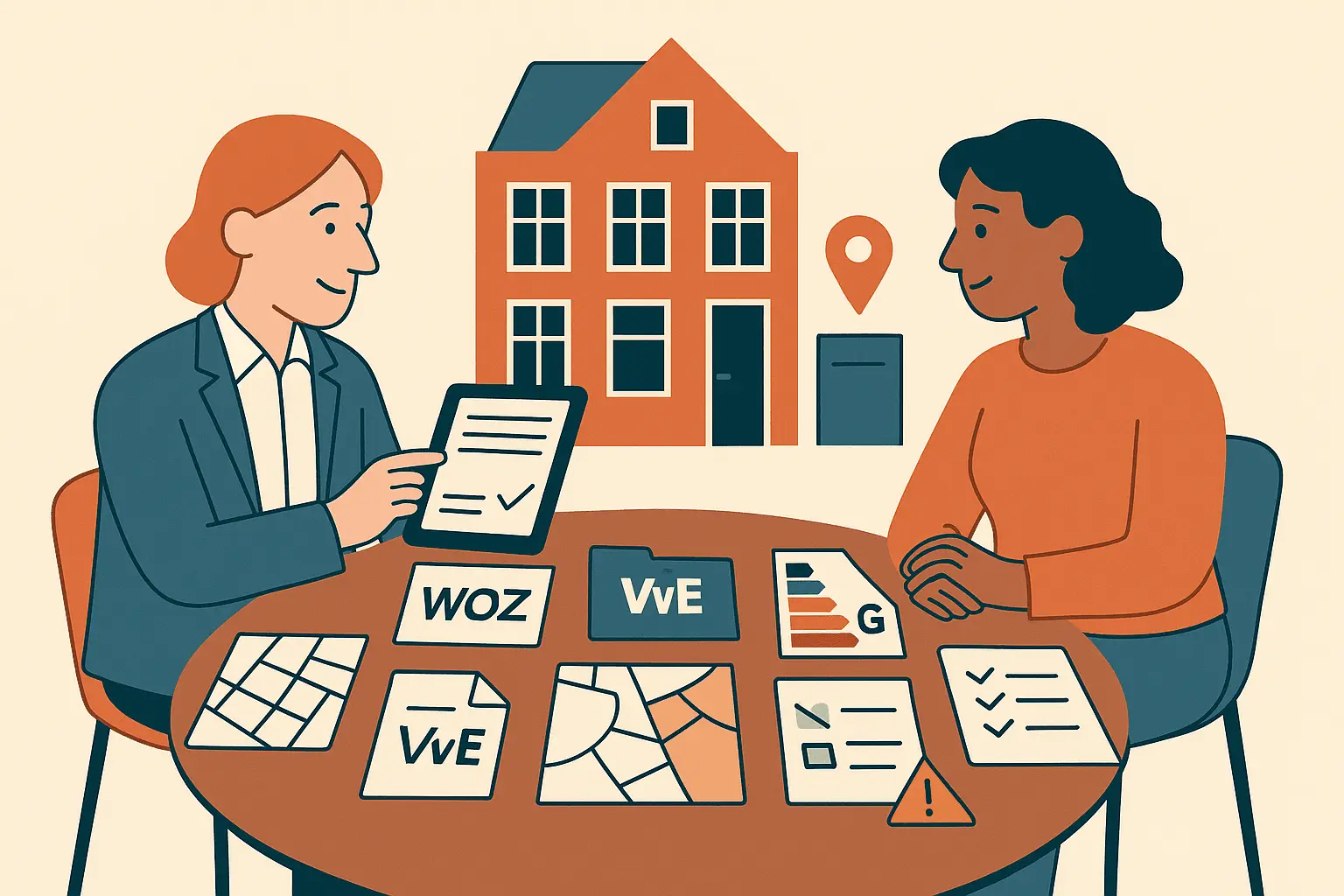
A buyer often asks about risk at the least comfortable moment: after a good viewing, just before the bid deadline. The home looks right, the market feels competitive, and the documents are full of Dutch terms such as erfpacht, VvE, splitsingsakte, vragenlijst and omgevingsplan.
The real question is not only: “Is this property risky?”
It is: “Should we bid, how much, under which conditions, or should we walk away?”
For advisors, buyer agents and mortgage professionals, the goal is to explain property risk to home buyers in a way that leads to a clearer pre-bid decision. For buyers and expats, the same approach helps you ask better questions before making an offer.
Considering a specific Dutch address? Huisscan helps you check a Dutch property before you bid. Turn one address and uploaded documents into a clear pre-bid report with available Dutch property data, risk signals, document analysis and buyer questions.
Property risk is not the same as a property problem
A risk signal does not automatically mean a property is bad. It means there is something that may affect the buyer’s cost, use, financing, timing or legal position.
A calm explanation separates three things:
- Fact — what the document or data source actually says.
- Uncertainty — what is still unknown.
- Decision impact — what the buyer should do before bidding.
For example:
- “The VvE minutes mention future façade work” is a fact.
- “We do not yet know whether extra owner contributions are expected” is the uncertainty.
- “Ask for the MJOP, latest minutes and reserve position before setting the bid” is the decision impact.
This keeps the conversation practical. You are not trying to scare the buyer. You are helping them decide whether the risk is acceptable, should change the price, needs a condition, or requires expert review.
Use a simple model: signal, impact, next question
A useful way to explain property risk to clients is to translate every signal into one buyer question.
| Risk signal | Possible impact | Pre-bid question to ask |
|---|---|---|
| The property has erfpacht | Leasehold can involve ground rent, conditions and future changes | What are the leasehold terms, payments and review dates? Ask a notary or qualified advisor to review them. |
| The home is part of a VvE | Apartment owners share costs and decisions | Is the VvE financially healthy? Are major works planned? Is there a recent MJOP and reserve fund? |
| The brochure and public data differ | Surface area, year of construction or use may need clarification | Is there a NEN 2580 measurement report or explanation from the selling agent? |
| Renovations are mentioned but permits are unclear | Could affect legality, resale, insurance or financing questions | Were permits required and obtained? Check with the municipality where relevant. |
| Older building with foundation or moisture signals | Possible repair costs or specialist inspection need | Is there a building report, foundation information or reason to include a building inspection condition? |
| Low energy label or limited insulation | May affect comfort, energy costs and renovation plans | What improvements are possible, allowed and financially realistic? |
| VvE minutes mention disputes or arrears | Could affect governance and future costs | Are there unresolved legal, financial or maintenance issues? |
The point is not to produce a perfect yes/no answer. The point is to make the next step clear before the buyer commits.
Dutch property risks that deserve a pre-bid conversation
When buying a house in the Netherlands, the most relevant risks often sit in Dutch documents and public registers. These are the areas buyers and advisors should discuss before bidding.
Ownership, land and cadastral information
The Kadaster is the Dutch Land Registry. It helps identify what is being sold, such as the parcel, apartment right or registered ownership structure. It may also point to rights or restrictions that need review.
Terms to know:
- Erfpacht — leasehold. The buyer may own the home or apartment right, but the land is subject to leasehold conditions.
- Erfdienstbaarheid — easement, such as a right of way.
- Kettingbeding — a chain clause that may pass obligations to future owners.
These issues are often not deal-breakers, but they should be understood before bidding.
Apartment and VvE risks
For apartments, the VvE (Vereniging van Eigenaars) manages shared parts of the building, such as the roof, façade, foundations, entrance, lift and insurance.
Important documents include:
- Splitsingsakte — division deed describing apartment rights and shared parts.
- Splitsingsreglement — rules for owners.
- MJOP — multi-year maintenance plan.
- Recent annual accounts, budget and meeting minutes.
A low monthly service charge may look attractive, but the more important question is whether the VvE has planned and funded necessary maintenance.
Building condition and maintenance
Dutch homes vary widely by period, soil type and construction method. Older homes may need extra attention for:
- foundations (fundering);
- moisture and ventilation;
- roof and façade condition;
- timber rot;
- asbestos-containing materials in older building components;
- outdated electrical, heating or plumbing systems.
A document review is not the same as a building inspection. If the signal is material, the buyer should consider a qualified building inspector.
Energy label and renovation limits
The energielabel gives an official indication of energy performance. It can affect comfort, expected improvement costs and renovation priorities.
Before bidding, buyers should ask:
- What insulation is already present?
- What heating system is used?
- Are there VvE or monument restrictions on upgrades?
- Are future improvements technically and financially realistic?
Current subsidy, tax and financing rules can change, so buyers should check up-to-date rules or ask a qualified professional.
Municipal plans, permits and restrictions
The omgevingsplan sets local rules for use and building possibilities. Some people still refer to the older term bestemmingsplan. These rules matter if the buyer wants to extend, split, rent out, change use or renovate.
Also check for:
- monument status, such as rijksmonument or gemeentelijk monument;
- protected city or village view (beschermd stadsgezicht);
- known permit history where available;
- local environmental or noise restrictions.
If a buyer’s plan depends on future permission, that uncertainty should be discussed before bidding.
Environmental and location signals
Dutch property risks Netherlands buyers often overlook include soil, water and surroundings.
Examples:
- possible soil contamination from former industrial use;
- groundwater or flood-related information;
- noise from roads, rail or airports;
- nearby development plans.
These signals do not always mean “do not buy”. They mean: check whether the issue affects enjoyment, insurance, renovation plans, value or resale.
How advisors can explain risk calmly to home buyers
A good risk conversation is structured, not emotional. Use plain language and connect each risk to a decision.
A helpful script is:
“Here is what we know.”
Refer to the document, register or data point.“Here is what we do not know yet.”
Be clear about uncertainty.“Here is why it could matter.”
Link it to price, costs, use, financing, maintenance or resale.“Here are the next questions.”
Decide who should answer: selling agent, VvE, municipality, inspector, mortgage advisor, notary or another specialist.“Here are the bid options.”
Bid normally, lower the bid, add conditions, request more documents, or walk away.
For example, avoid saying:
“This VvE is risky.”
Say:
“The VvE documents mention roof work, but the budget and timing are not clear. Before bidding, ask whether a decision has been made, whether the reserve is sufficient, and whether owners may face an extra contribution. If we do not get answers, this should affect the maximum bid or the conditions.”
This is especially useful for expats, who may not know which Dutch risks are normal and which require further review.
Practical checklist before making an offer
Use this checklist for a pre-bid property check in the Netherlands.
- Confirm the exact address, apartment right or parcel being sold.
- Compare the brochure with available Dutch property data, such as BAG and Kadaster information.
- Check the stated living area and ask for a NEN 2580 measurement report if relevant.
- Read the seller’s questionnaire (vragenlijst) for defects, disputes, renovations, asbestos or neighbour issues.
- Review the lijst van zaken to see what is included or excluded.
- For apartments, review VvE documents: minutes, budget, annual accounts, MJOP and reserve fund.
- Check whether the property has erfpacht, easements or other registered restrictions.
- Look at the energy label, heating system, insulation and realistic upgrade options.
- Check municipal rules if you plan to extend, renovate, rent out or change the property’s use.
- Identify building-condition signals that may require a qualified inspection.
- Write down unanswered questions for the selling agent, VvE, municipality or specialist.
- Decide how each issue affects the bid: price, conditions, timing or decision to stop.
If a key answer is missing before the bid deadline, do not ignore it. Decide whether the uncertainty is acceptable, should reduce the bid, or should be covered by a condition drafted with professional help.
What Huisscan can help you check
Huisscan is designed as a practical discussion aid before an offer. It helps buyers and advisors check Dutch property before bidding by turning one address and uploaded documents into a clear pre-bid report.
A Huisscan pre-bid report can help you:
- organise available Dutch property data for one address;
- highlight risk signals from public and uploaded information;
- analyse documents such as the brochure, seller questionnaire, energy label, VvE documents, leasehold information or other sales files;
- explain Dutch property terms in plain English;
- compare key facts where data is available;
- generate buyer questions for the selling agent, VvE, municipality, inspector, mortgage advisor or notary;
- use the report as an agenda for a client conversation.
Huisscan supports decision-making. It does not replace a building inspection, valuation, mortgage advice, legal review, tax advice or notarial advice. When a finding could materially affect the buyer, involve the right professional before bidding.
FAQ
What does property risk mean when buying a house in the Netherlands?
Property risk means uncertainty that could affect the buyer’s costs, use, financing, legal position, maintenance obligations or resale. It can come from the building itself, the land, VvE documents, leasehold, permits, municipal rules or missing information.
How do you explain property risk to home buyers without scaring them?
Separate facts from assumptions. Say what the document shows, what is still unknown, why it matters, and what question should be answered before bidding. Focus on the decision: bid, adjust price, add conditions, ask for expert review or walk away.
Which Dutch documents should buyers check before bidding?
Useful documents often include the sales brochure, seller questionnaire, lijst van zaken, energy label, Kadaster information, VvE documents for apartments, leasehold documents if applicable, and any available building or permit information.
Is a risk signal always a reason not to bid?
No. Many risk signals are normal in Dutch property purchases. The important question is whether the risk is understood, priced correctly, covered by a condition, or serious enough to stop.
Can Huisscan replace a buyer agent, notary or building inspector?
No. Huisscan helps organise available property data, analyse uploaded documents and create better buyer questions. It is a pre-bid intelligence tool, not a replacement for professional legal, notarial, mortgage, valuation or building advice.
How can expats use a pre-bid property check Netherlands report?
Expats can use the report to understand Dutch terms, identify missing information and prepare questions before making an offer. It helps turn unfamiliar documents into a clearer conversation with an advisor, buyer agent or other professional.
Check the address before you bid.


