
What to check before bidding on a house in the Netherlands
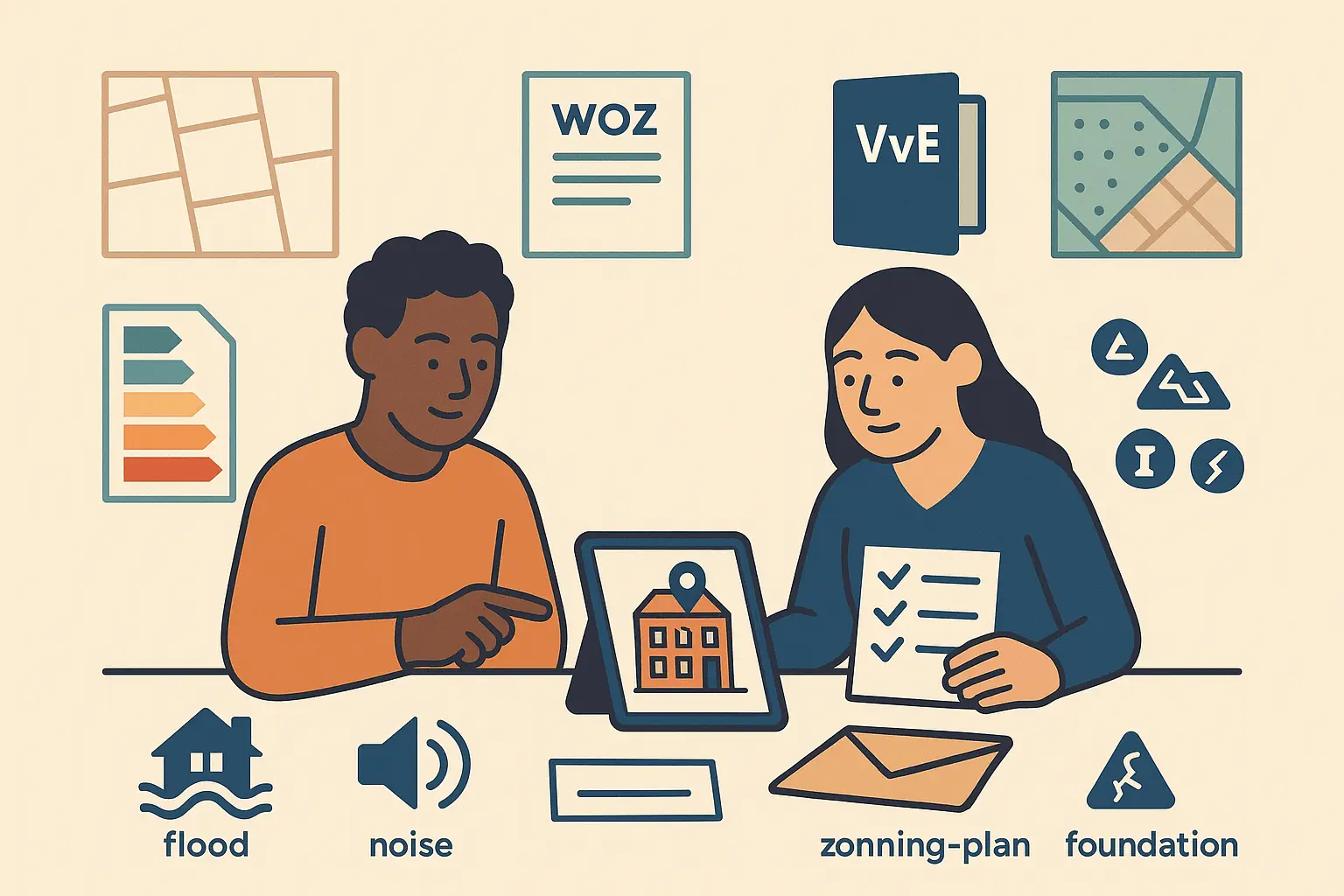
You found a Dutch property you like. The viewing went well, the deadline for bids is coming up, and now you need to decide: how much should you offer, and under what conditions?
The risk is not only “paying too much”. It is bidding before you understand the address, ownership situation, building signals, apartment documents, surroundings, and questions that could affect your budget or your willingness to proceed.
This guide explains what to check before bidding on a house in the Netherlands, in plain English. Use it to make one clearer pre-bid decision: bid, adjust your bid, add conditions, ask more questions, or walk away.
Found a property? Huisscan helps you check a Dutch property before you bid by turning one address into a clear pre-bid report with available property data, risk signals, document analysis, and buyer questions.
The pre-bid goal: make the offer fit the facts
A good pre-bid check is not about finding a “perfect” property. It is about reducing avoidable surprises before you make an offer.
Before bidding, try to answer three questions:
What am I actually buying?
The correct address, parcel, apartment right, surface area, parking, storage, garden rights, and legal use.What risks could affect cost or comfort?
Think about maintenance, energy performance, foundations, soil, water, noise, VvE finances, and future plans nearby.What should I do with this information?
You may decide to bid lower, include a building inspection condition, ask the selling agent for written clarification, consult a specialist, or not bid.
In the Netherlands, buyers are generally expected to do reasonable checks, while sellers and agents should disclose known relevant issues. If something matters to your decision, ask about it before bidding and keep important answers in writing. For legal, technical, mortgage, tax, or notarial questions, use a qualified professional.
Start with official data: BAG, Kadaster, WOZ and energy label
The listing is useful, but it is marketing information. Before you bid, compare it with official and semi-official sources where available.
| Check | What it means | Why it matters before bidding |
|---|---|---|
| BAG registration | The Dutch official address and building registration. BAG stands for Basisregistratie Adressen en Gebouwen. | Check whether the address exists as stated, the building use is residential, and basic data such as construction year and registered surface area make sense. |
| Kadaster property check | The Dutch land registry. It records cadastral parcels, ownership, apartment rights, and certain registered rights. | Helps you understand what is legally connected to the property: land, apartment right, storage, parking, leasehold, boundaries, or restrictions. |
| WOZ value before bidding | The municipal valuation used for local taxes. WOZ stands for Waardering Onroerende Zaken. | Useful context, but not the same as market value. It may lag behind the current market and does not replace a valuation or comparable sales analysis. |
| Energy label Netherlands house | The registered energy performance label, from A++++ to G. | Gives a first indication of insulation and energy performance. Ask what improvements were made and whether documents or invoices are available. |
| Measurement report | Often based on Dutch measurement standards such as NEN 2580. | If the listed living area is important to your bid, ask for the measurement report and compare it with BAG and the brochure. |
A small mismatch is not always a problem. But if the brochure, BAG, Kadaster, or documents tell different stories, pause and ask questions before you bid.
Example questions:
- Is the listed living area supported by a measurement report?
- Is the garden, balcony, parking space, attic room, or storage unit legally included?
- Is the property freehold or leasehold (erfpacht)?
- Are there registered rights of way, shared access, or other restrictions?
- Has the energy label been updated after renovations?
Check physical and environmental property risks in the Netherlands
Some risks are visible during a viewing. Others are local, historical, or hidden in documents. You do not need to solve everything yourself, but you should know what deserves a question or specialist check.
Foundation risk
Older homes in parts of the Netherlands may have foundation issues, especially in areas with soft soil, timber piles, or changing groundwater levels. This does not mean every older house is risky. It means foundation signals should be taken seriously.
Look for:
- Cracks that continue through walls or façades
- Sloping floors
- Doors or windows that no longer close properly
- Neighbouring properties with visible settlement
- Mentions of foundation research, monitoring, or repairs
Ask the selling agent whether any foundation reports are available and whether the seller knows of foundation problems in the building or street.
Soil and contamination
Soil history can matter, especially for houses with gardens, extensions, former industrial use, or old underground tanks. Municipal and provincial sources may show known soil information, but availability differs by location.
Ask:
- Is there known soil contamination?
- Has remediation ever been carried out?
- Was there a former oil tank, workshop, dry cleaner, garage, or industrial use nearby?
Flooding, water and drainage
The Netherlands is a water-managed country. Most homes are not automatically “high risk”, but water context can still affect comfort, insurance questions, future maintenance, and buyer confidence.
Check:
- Whether the home is in a low-lying or water-sensitive area
- Local flood or water nuisance maps where available
- Basement, crawl space, or ground-floor dampness
- Drainage around extensions, gardens, and flat roofs
Noise and surroundings
Noise can come from roads, railways, trams, airports, cafés, schools, industry, or planned construction. A quiet viewing on a Tuesday morning may not show the full picture.
Before bidding:
- Visit at another time of day if possible
- Check maps for roads, rail lines, airports, and industrial zones
- Ask about insulation, glazing, and ventilation
- Look for future development plans nearby
Building age, maintenance and renovations
The older the property, the more important it is to understand maintenance. Recent renovations can be positive, but ask whether they were done properly and, where needed, with permits.
Useful questions:
- When were the roof, façade, windows, heating system, kitchen, bathroom, and electrics last updated?
- Are there signs of damp, leaks, mould, or poor ventilation?
- Are there asbestos, lead pipe, or outdated electrical concerns?
- Were extensions, dormers, roof terraces, or structural changes permitted?
If technical condition is important to your bid, consider a building inspection or a condition in your offer after speaking with your buyer agent or advisor.
Apartment? Read the VvE documents before bidding
If you buy an apartment in the Netherlands, you usually buy an apartment right and automatically become part of the VvE: Vereniging van Eigenaars, or Owners’ Association.
The VvE manages shared parts of the building, such as the roof, façade, foundation, stairwell, lift, insurance, and sometimes heating or shared outdoor space. Weak VvE finances or major planned maintenance can affect your monthly costs and future decisions.
For VvE documents when buying an apartment, ask for:
- The splitsingsakte and splitsingsreglement: the deed and rules explaining apartment rights and shared parts
- Recent VvE meeting minutes
- Annual accounts and current budget
- Reserve fund information
- The MJOP: long-term maintenance plan, if available
- Monthly service charges
- Building insurance information
- Notes on planned maintenance, disputes, arrears, loans, or special contributions
Red flags are not always deal-breakers, but they should influence your questions and bid. For example, a low monthly service charge may look attractive until you discover the roof, façade, lift, or foundation needs expensive work.
Ask before bidding:
- Are there planned increases in service charges?
- Is there a recent maintenance plan?
- Are major works expected?
- Are any owners behind on payments?
- Is the apartment allowed to be rented out, renovated, or used as you intend?
- Does the VvE have any loans or legal disputes?
Check zoning plans, permits and future surroundings
A beautiful home can still be affected by what is allowed nearby. In the Netherlands, land use and building possibilities are set through the municipal environment plan, often still referred to in practice as the bestemmingsplan or zoning plan.
For a zoning plan Netherlands property check, look at:
- The permitted use of the property: residential, mixed use, commercial, office, hospitality
- Whether nearby land may be developed
- Maximum building heights around the property
- Planned roads, rail, schools, commercial buildings, or housing projects
- Whether the property is in a protected townscape or monument area
- Whether extensions, roof terraces, dormers, or outbuildings seem permitted
This matters because your bid should reflect not only the current viewing, but also the likely future setting.
Example: if a property has an open view over an empty plot, check whether that plot can be built on. If you plan to extend the house, check whether the zoning and permit situation make that realistic before you price that future value into your offer.
A practical Dutch house bidding checklist
Use this Dutch house bidding checklist as a pre-bid property check for the Netherlands. You do not need every answer to be perfect, but you should know what is unknown.
Official identity and property data
- Exact address checked
- BAG registration reviewed
- Listed living area compared with available official data
- Measurement report requested if surface area affects your bid
- Kadaster data checked for parcel, apartment right, ownership and boundaries
- Parking, storage, garden, balcony or roof terrace rights verified
- Leasehold (erfpacht) checked if relevant
Price and value context
- Asking price compared with similar properties where possible
- WOZ value reviewed as context, not as a market value
- Renovation and maintenance budget estimated
- Energy performance and likely improvement costs considered
- Mortgage advisor consulted if financing depends on valuation, condition, or energy measures
Technical and environmental risks
- Energy label checked
- Roof, façade, windows, heating and ventilation reviewed
- Damp, mould, cracks or settlement signals noted
- Foundation risk considered for the location and building age
- Soil information checked where relevant
- Flood, drainage or water nuisance signals reviewed
- Noise sources checked at different times if possible
- Building inspection considered for older or uncertain properties
Apartment and VvE checks
- VvE documents received before bidding
- Service charges checked
- Reserve fund and annual accounts reviewed
- MJOP or maintenance planning reviewed
- Meeting minutes checked for leaks, disputes, foundation, roof, façade or lift issues
- Restrictions on renovation, rental, pets or use reviewed if relevant
Planning and legal-use questions
- Zoning or environment plan checked
- Nearby development plans reviewed
- Monument or protected-status signals checked
- Permits requested for extensions, dormers, structural changes or roof terraces
- Intended use of the property appears allowed
Questions to ask the selling agent before bidding
- Are there known defects or past insurance claims?
- Are there recent inspection, foundation, asbestos, soil or energy reports?
- Were renovations done with the required permits?
- Are there disputes with neighbours or the VvE?
- What is included in the sale: flooring, appliances, curtains, fixtures, garden items?
- Are there preferred transfer dates or conditions?
- What documents are available now, and what is still missing?
- Can important answers be confirmed in writing?
Your bidding decision
Before submitting your offer, decide:
- Your maximum bid
- Which conditions you need, if any
- Which risks you accept
- Which risks need a specialist check
- Which unanswered questions are too important to ignore
A strong bid is not only a high number. It is a bid that fits the facts you have.
What Huisscan can help you check
Huisscan is built for the moment before you bid.
With one Dutch address, Huisscan can help turn scattered information into a clear pre-bid report, including:
- Available property data for the address
- BAG, WOZ, Kadaster and other public-data context where available
- Risk signals related to the property and location
- Energy label and sustainability context
- Environmental signals such as soil, water, flood, noise or foundation indicators where data is available
- Document analysis for brochures, VvE documents, reports and other files you upload
- A practical list of buyer questions to ask before bidding
Huisscan does not replace a building inspector, appraiser, mortgage advisor, lawyer, notary, tax advisor or buyer agent. It helps you prepare better questions and make a calmer pre-bid decision.
FAQ
What should I check first before making an offer on a Dutch house?
Start with the basics: exact address, BAG registration, Kadaster information, listed surface area, WOZ value, energy label and available documents. Then check property risks such as maintenance, foundation, soil, water, noise, zoning and, for apartments, VvE documents.
Is the WOZ value useful before bidding?
Yes, but only as context. The WOZ value is a municipal tax valuation, not a current market value or a recommended bid. It may be based on older reference dates and does not fully reflect the current condition, competition, renovations or buyer demand.
What does a Kadaster property check show?
A Kadaster check can help you understand the registered property situation, such as cadastral parcel, ownership, apartment rights, boundaries and certain registered rights or restrictions. If the property includes parking, storage, garden use or leasehold, check how these are legally arranged.
Which VvE documents should I ask for when buying an apartment?
Ask for the deed of division, VvE rules, recent meeting minutes, annual accounts, budget, reserve fund information, service charges, building insurance and long-term maintenance plan if available. Pay attention to planned maintenance, arrears, disputes, loans and special contributions.
How reliable is the energy label for a Dutch house?
The energy label is a useful starting point, but it is not the full story. Ask when it was issued, what improvements were included, and whether there are invoices or reports for insulation, glazing, heating, ventilation or solar panels. Actual comfort and energy use also depend on behaviour, maintenance and layout.
Should I arrange a building inspection before bidding?
For older homes, homes with visible defects, or properties in areas with known foundation or moisture issues, a building inspection can be valuable. Whether you do it before bidding or include it as a condition depends on the bidding situation and your risk tolerance. Discuss this with a qualified inspector or buyer advisor.
Check the address before you bid.