What to ask during a Dutch house viewing
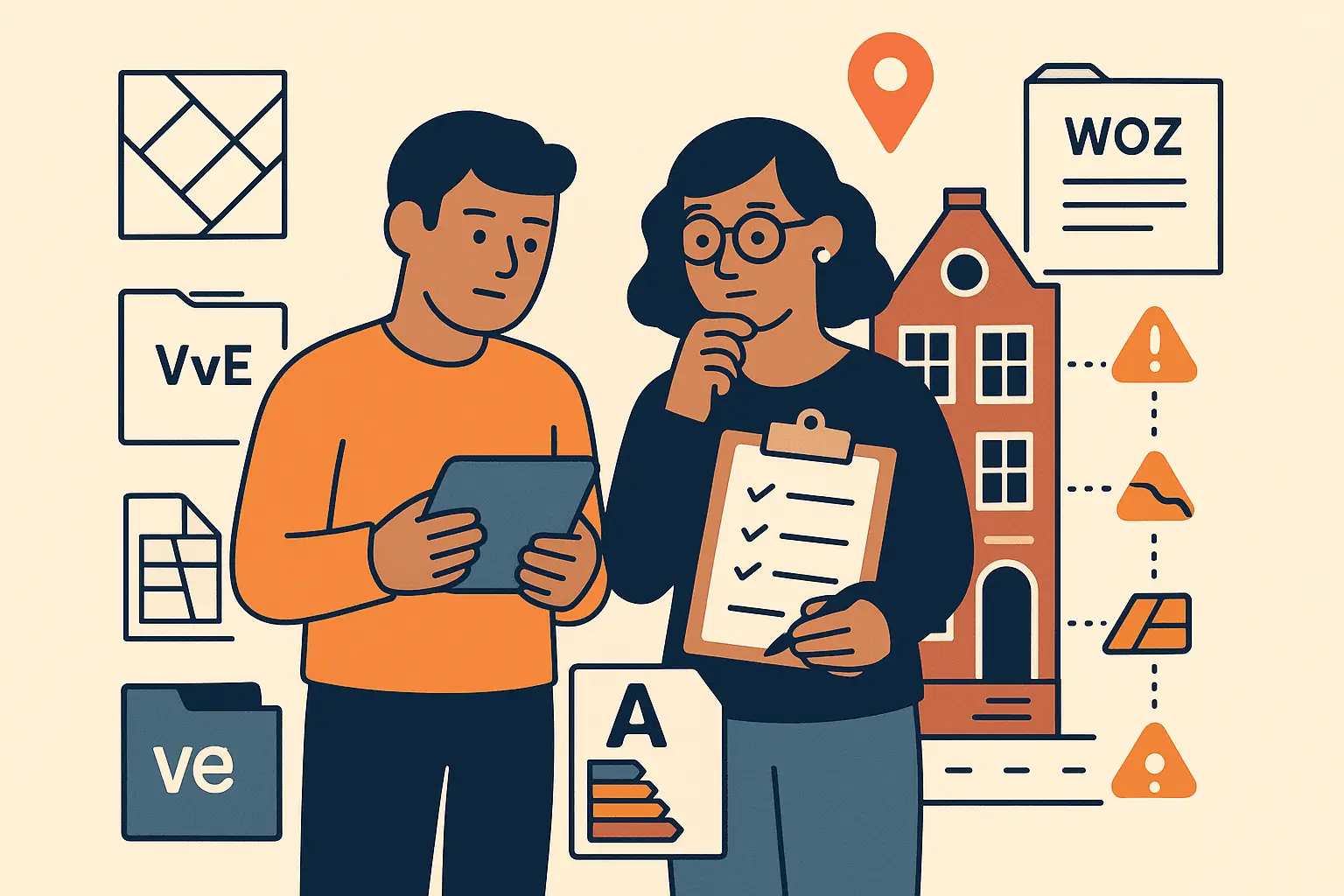
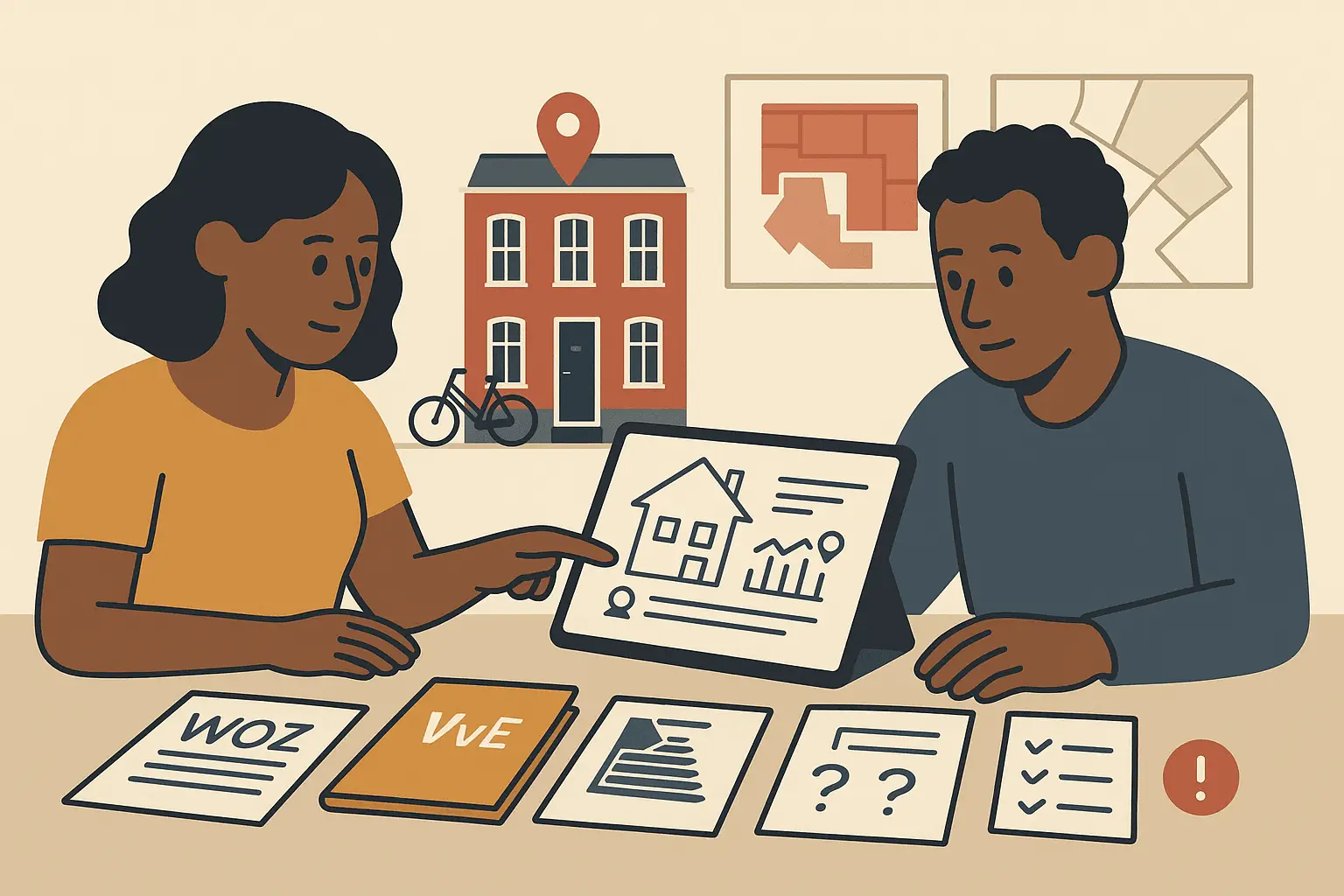
A Dutch house viewing can feel quick. You walk through the property, listen to the selling agent, and try to imagine living there. But before you bid, you need more than a good feeling.
The right questions can reveal issues that affect price, bidding conditions, renovation budget, or your decision to walk away. This is especially important when buying a house in the Netherlands, where documents, Dutch property data, and terms like VvE, erfpacht, and ontbindende voorwaarden can change the risk profile of a property.
Preparing for a viewing? Use Huisscan to check the address before you go. One Dutch address, plus any uploaded documents, can become a clear pre-bid report with available property data, risk signals, document analysis, and better buyer questions.
The goal of a Dutch house viewing is not just to look around
A viewing is your chance to test whether the listing, documents, and property condition make sense before you make an offer.
Use the appointment to:
- Check whether the property matches the listing.
- Ask about defects, maintenance, renovations, and ownership.
- Identify documents you still need before bidding.
- Decide whether to include conditions in your offer.
- Spot questions for your buyer agent, mortgage advisor, building inspector, notary, or legal advisor.
The selling agent, or verkoopmakelaar, represents the seller. They can answer questions, but they are not your advisor. If an answer matters for your bid, ask for it in writing or request supporting documents.
House viewing questions Netherlands: what to ask at the appointment
Use these house viewing questions in the Netherlands as a practical starting point.
Questions about the sale and bidding process
Ask:
- Why is the owner selling?
- How long has the property been for sale?
- Is there a bidding deadline?
- How should an offer be submitted?
- What transfer date does the seller prefer?
- Are there already other serious interested buyers?
- Are there specific conditions the seller prefers or dislikes?
- Which items are included in the sale?
Also ask for the lijst van zaken. This is the list of items that stay, go, or may be taken over separately, such as curtains, appliances, lamps, garden items, or flooring.
Questions about defects and maintenance
Ask clearly:
- Are there any known defects?
- Has there been leakage, damp, mould, or water damage?
- Are there cracks in walls, floors, or ceilings?
- Have there been foundation problems or subsidence?
- When were the roof, gutters, window frames, façade, and exterior paint last maintained?
- How old are the central heating system, heat pump, boiler, ventilation system, and electrical installation?
- Are there maintenance invoices, guarantees, or inspection reports?
For older homes, also ask about asbestos, lead pipes, old wiring, single glazing, poor ventilation, and insulation. These do not automatically mean you should not buy, but they can affect budget and risk.
Questions about renovations and permits
Renovations can add value, but only if they were done properly.
Ask:
- Which renovations were done, and when?
- Were professionals used?
- Are invoices, drawings, warranties, or permits available?
- Was any structural wall removed?
- Was the roof, dormer, extension, balcony, bathroom, kitchen, or installation changed?
- Were changes registered or approved where needed?
If the property has an extension, roof terrace, dormer, converted attic, or outbuilding, ask whether the necessary permissions are clear. If you are unsure, check with the municipality or a qualified professional before relying on it in your bid.
Questions about measurements and usable space
Dutch listings often mention gebruiksoppervlakte wonen, meaning usable living area. This may be based on a measuring standard, but you should still ask:
- Is there a measurement report?
- Is the living area measured according to a recognised method?
- Are storage, attic space, basement space, balcony, or garden house included separately?
- Does the registered data match the listing?
A few square metres can matter for price comparison, mortgage valuation, and your own use of the home.
Questions about energy and monthly costs
Ask:
- What is the current energy label?
- What insulation is present: roof, floor, wall, glass?
- Are there solar panels? Are they owned, leased, or part of another arrangement?
- What are typical monthly energy costs?
- Is there mechanical ventilation, heat recovery, district heating, a heat pump, or gas heating?
- Are major energy improvements still needed?
The energy label is useful, but it does not replace your own check. A home can have a decent label and still need costly improvements, especially if installations are old.
Questions for apartments and VvE properties
For apartments, the VvE is the homeowners’ association. It manages the shared building, such as the roof, façade, stairwell, lift, foundation, insurance, and reserves.
Ask:
- Is the VvE active?
- What are the monthly service costs?
- Is there a maintenance plan, called an MJOP?
- How much is in the reserve fund?
- Are major works planned?
- Have owners recently paid or discussed extra contributions?
- Are there disputes within the VvE?
- Are minutes, accounts, budget, insurance documents, and house rules available?
Low service costs are not always good. If the building has too little reserve, future repairs may lead to extra payments.
Questions about the land, surroundings, and restrictions
Ask:
- Is the property on private land or erfpacht?
- If there is erfpacht, what are the conditions and payments?
- Are there municipal plans nearby that may affect the property?
- Is there known soil contamination?
- Is the area sensitive to flooding, groundwater, or foundation issues?
- Are there noise sources nearby, such as roads, rail, aircraft routes, hospitality venues, or schools?
- Are there parking rights, permits, or shared access arrangements?
- Is the property a monument or in a protected area?
Erfpacht means leasehold: you may own the building, but not the land. The conditions can affect costs, financing, and future resale. Ask a notary or qualified advisor if you are unsure.
Dutch documents and terms to request before bidding
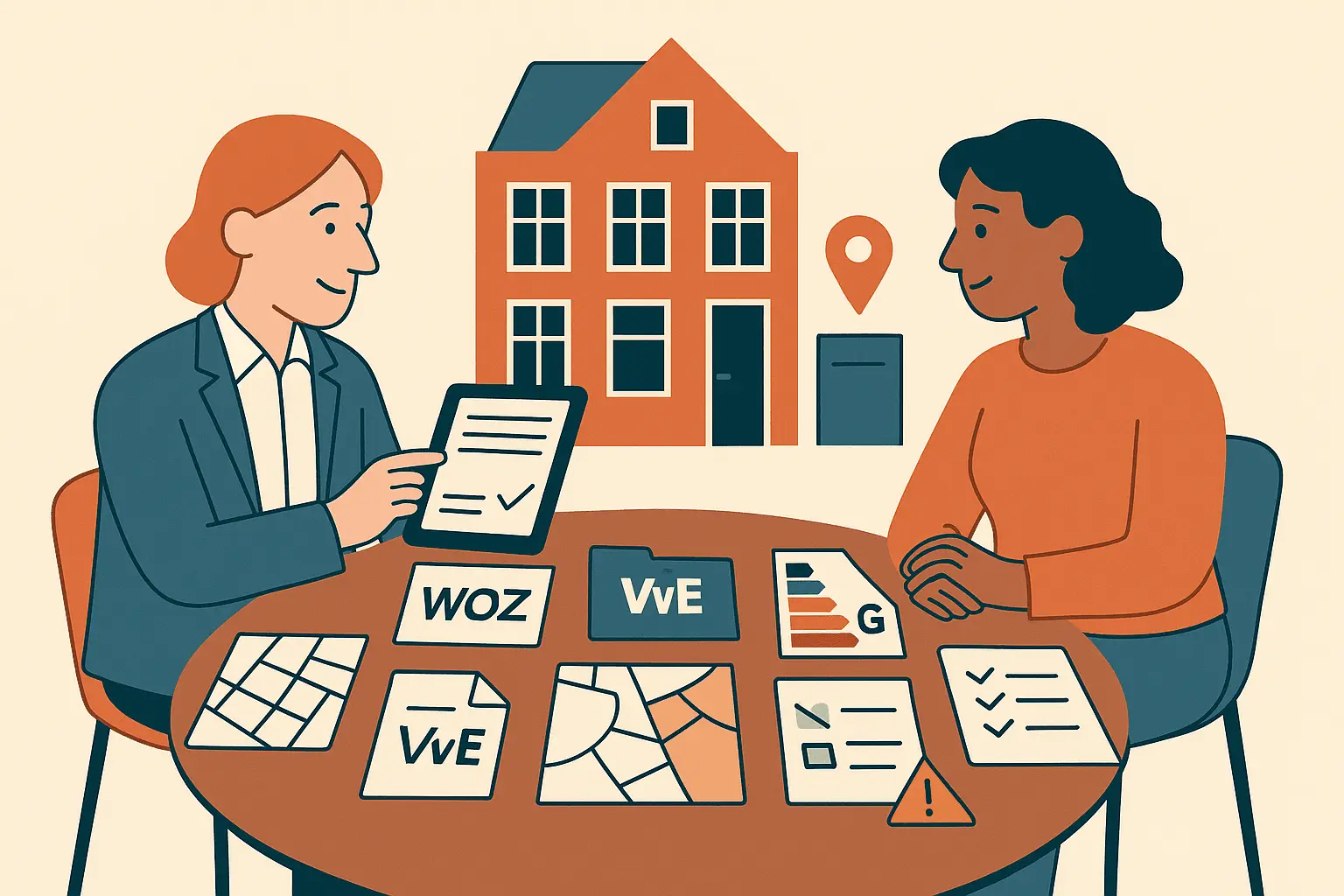
Before making an offer, try to collect the relevant documents. Not every document applies to every property, but missing information should become a buyer question.
| Document or term | Plain English meaning | Why it matters before bidding |
|---|---|---|
| Verkoopbrochure | Sales brochure | Starting point, but verify key claims. |
| Vragenlijst | Seller questionnaire | Often includes known defects, renovations, disputes, and property details. |
| Lijst van zaken | List of items included or excluded | Prevents confusion about appliances, flooring, curtains, and fixtures. |
| Meetrapport | Measurement report | Helps verify living area and compare price per square metre. |
| Energielabel | Energy performance label | Gives a first view of energy efficiency and possible upgrades. |
| Eigendomsinformatie / Kadaster | Ownership and cadastral information | Helps check parcel, ownership, and registered rights. |
| Akte van levering | Deed of transfer | May include rights, obligations, clauses, or restrictions. |
| Erfpachtvoorwaarden | Leasehold conditions | Important for costs, renewal, financing, and resale. |
| VvE documents | Apartment association documents | Shows service costs, reserves, maintenance plans, and building decisions. |
| MJOP | Multi-year maintenance plan | Indicates planned building maintenance and expected costs. |
| Splitsingsakte | Deed dividing an apartment building into units | Defines apartment rights, shared parts, and VvE rules. |
| Bestemmingsplan / omgevingsplan | Municipal spatial plan | Shows allowed use and possible planning restrictions. |
| Bouwkundig rapport | Building inspection report | Gives insight into technical condition and repair costs. |
| Ouderdomsclausule | Age clause | Often used for older homes to allocate age-related risk. |
| Asbestclausule | Asbestos clause | Relevant mainly for older properties. |
| Niet-zelfbewoningsclausule | Non-occupancy clause | Seller has not lived there, so may know less about defects. |
These documents can affect your offer price, conditions, or decision to continue. If you do not understand a clause, ask your notary, buyer agent, or legal advisor before signing.
Practical viewing checklist before you bid
Bring this checklist to the viewing and use it after the appointment.
Before the viewing
- Save the listing, asking price, living area, plot size, build year, and energy label.
- Check basic Dutch property data where available, such as Kadaster, BAG, WOZ, and energy label information.
- Read the brochure carefully and mark unclear claims.
- Prepare questions about defects, renovations, VvE, erfpacht, permits, and bidding process.
- Decide which documents you need before making an offer.
- If possible, visit the street at another time of day to check traffic, noise, parking, and surroundings.
During the viewing
- Look for cracks, damp, stains, mould, uneven floors, and strange smells.
- Open windows and doors to check frames, glazing, ventilation, and noise.
- Check the fuse box, heating system, boiler, ventilation, and visible pipework.
- Ask about roof, façade, gutters, foundation, crawl space, and drainage.
- Check storage, attic, basement, balcony, garden, shed, and parking.
- For apartments, inspect common areas: entrance, stairwell, lift, roof access, bike storage, and façade.
- Ask what maintenance is planned or overdue.
- Ask which answers can be confirmed in documents.
After the viewing
- Write down what the agent said while it is still fresh.
- Send follow-up questions by email if the answer affects your bid.
- Compare the listing with documents and available public data.
- Estimate repair, upgrade, and monthly ownership costs.
- Discuss financing, valuation, and offer conditions with your mortgage advisor or buyer agent.
- Decide whether you need a building inspection before or as part of your offer.
- Walk away if the risk is unclear and the seller will not provide enough information.
How the answers can change your offer
Good viewing questions help you decide how to bid, not just whether you like the home.
They can affect:
- Price: overdue maintenance, energy upgrades, VvE issues, erfpacht payments, or uncertain permits may justify a different bid.
- Conditions: you may want conditions such as financing approval or a building inspection. Discuss the wording and consequences with a qualified advisor.
- Timing: the seller’s preferred transfer date can make your offer more or less attractive.
- Documents: missing VvE papers, unclear ownership rights, or vague renovation history may mean you need more time before bidding.
- Walk-away decision: serious structural signals, hidden costs, or unwillingness to share documents can be a reason not to bid.
A strong offer is not always the highest offer. It is the offer you understand and can stand behind.
What Huisscan can help you check
Huisscan is built for one practical purpose: Check a Dutch property before you bid.
With one Dutch address, Huisscan can help create a pre-bid property check for the Netherlands, including:
- Available Dutch property data for the address.
- Risk signals that may need further investigation.
- Checks against uploaded documents, such as the brochure, seller questionnaire, VvE documents, deed information, or clauses.
- Clear explanations of Dutch terms in plain English.
- Possible inconsistencies or missing information to ask about.
- Tailored buyer questions to bring to the viewing or send afterwards.
- A clearer overview to discuss with your buyer agent, mortgage advisor, inspector, notary, or legal advisor.
Huisscan does not replace professional legal, building, appraisal, mortgage, tax, or notarial advice. It helps you arrive at those conversations better prepared, with the right questions before you bid.
FAQ
What are the most important questions to ask during a Dutch house viewing?
Ask about known defects, maintenance history, renovations, permits, energy performance, VvE documents if it is an apartment, erfpacht if applicable, and the bidding process. Also ask which answers can be confirmed in writing or with documents.
Should I ask for documents before making an offer?
Yes. Important documents can reveal property risks in the Netherlands that are not visible during a short viewing. Ask for the seller questionnaire, list of items, energy label, measurement report, relevant deeds or clauses, VvE documents, leasehold information, and any inspection or maintenance reports.
What should expats pay extra attention to?
Expats should ask for plain-English explanations of Dutch terms such as VvE, erfpacht, ontbindende voorwaarden, bouwkundige keuring, and ouderdomsclausule. Also check whether you understand the bidding process, financing conditions, transfer date, and legal documents before signing anything.
Can I rely on what the selling agent says?
The selling agent works for the seller. Many agents answer questions professionally, but you should still verify important points with documents, written answers, public data, or advice from your own professional. If a statement affects your bid, do not rely only on a verbal comment during the viewing.
Do I need a building inspection before bidding?
It depends on the age, condition, and complexity of the property. Older homes, visible defects, foundation concerns, roof issues, damp, or major renovations are common reasons to consider a bouwkundige keuring, meaning a building inspection. Discuss timing and offer conditions with your buyer agent or advisor.
How can Huisscan help before a viewing or bid?
Huisscan can turn one Dutch address and uploaded documents into a clear Huisscan pre-bid report with available property data, risk signals, document analysis, and buyer questions. It helps you bring better questions to the viewing and make a calmer pre-bid decision.
Check the address before you bid.