Solar panels: what buyers should check
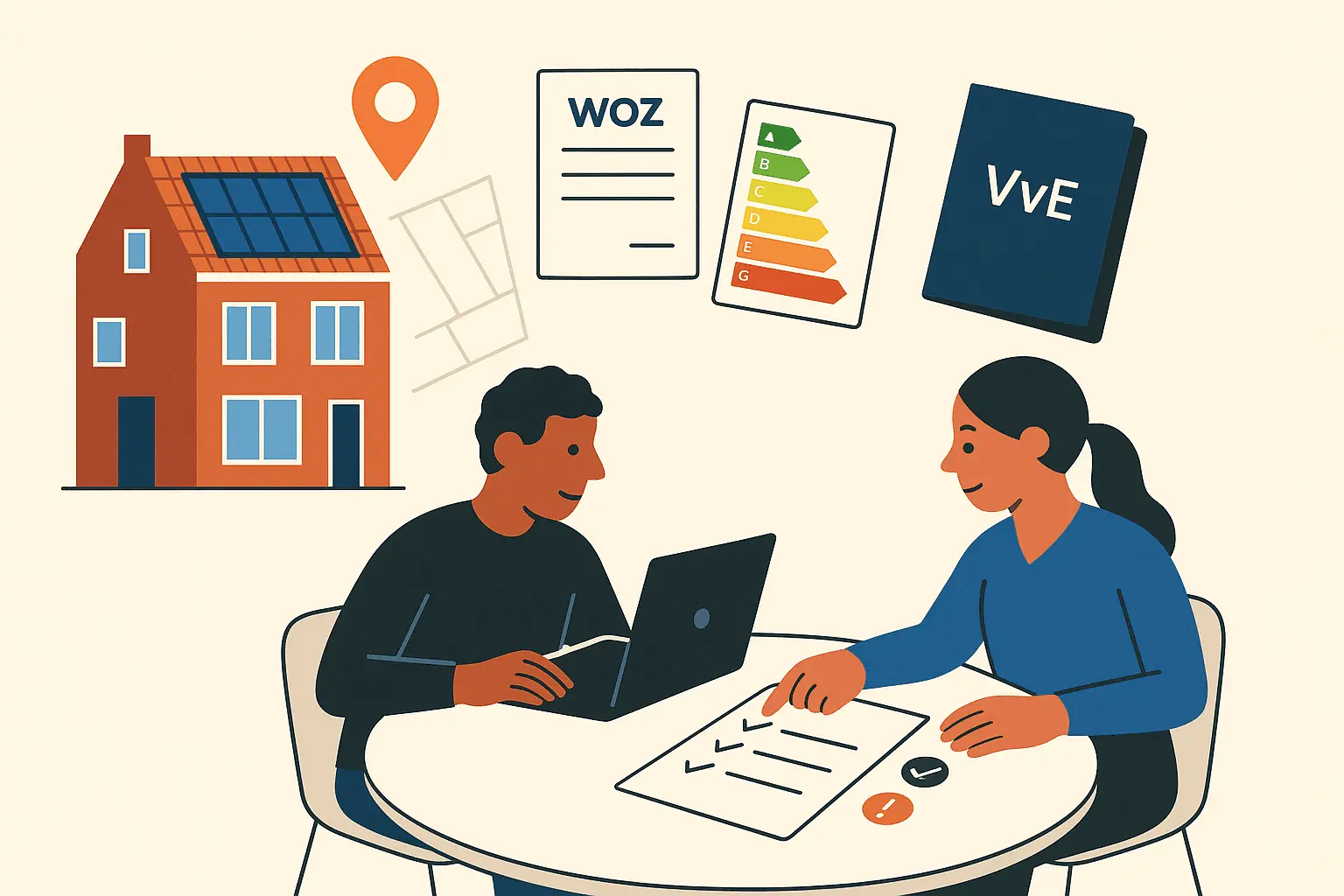
Solar panels can make a Dutch home more attractive, but the pre-bid question is not just: “Does the house have panels?” It is: who owns them, what obligations come with them, and do the documents support the value being suggested?
In Dutch listings, “12 zonnepanelen” may mean fully owned panels, leased panels, a financed system, or panels installed on a roof that soon needs work. For expats buying a house in the Netherlands, the Dutch terms can also be confusing. If your search is “solar panels house Netherlands buying”, this is the practical version: check ownership, documents, roof condition, and buyer obligations before you bid.
Planning to bid on a home with solar panels? Check a Dutch property before you bid with Huisscan. Enter one address and upload the brochure, seller questionnaire, energy label, list of items, or VvE documents. Huisscan can turn them into a clear pre-bid report with available Dutch property data, risk signals, document analysis, and better buyer questions.
Why solar panels matter before you bid
Solar panels can affect a home in several ways:
- expected electricity costs;
- the energy label;
- the attractiveness of the property;
- future maintenance costs;
- roof work planning;
- insurance or mortgage questions;
- contract obligations if the panels are leased or financed.
The risk is assuming that every solar installation has the same value. Two houses can both have 10 panels, but the pre-bid picture can be very different.
Example:
- House A has owned panels, a clear invoice, recent installation documents, working monitoring data, and a roof in good condition.
- House B has leased panels, unclear transfer terms, an older inverter, and panels on a flat roof that may need new roofing soon.
Those two situations should not lead to the same level of bidding confidence.
Check ownership first: owned, leased, financed, or VvE
Before you focus on yield or savings, check ownership. If you remember one thing from this article, make it this: do not price leased or unclear solar panels as if they are fully owned.
Common Dutch terms you may see:
| Dutch term | Plain English meaning | What to ask before bidding |
|---|---|---|
| Eigendom / gekocht | Owned by the seller | Are the panels included in the sale, and is there an invoice or proof? |
| Huur / lease | Rented or leased from a provider | What is the monthly cost, remaining term, transfer process, and buyout amount? |
| Huurkoop / koop op afbetaling | Buy-now-pay-over-time structure | Are there remaining payment obligations? Who pays them after transfer? |
| Financiering / lening | Panels paid with a loan | Is this a personal obligation of the seller, or could anything affect the buyer? |
| Opstalrecht | A third-party right connected to the roof or installation | Ask the notary or advisor to explain the consequences. |
| VvE / collectieve zonnepanelen | Apartment owners’ association or shared system | Who owns the panels, who receives the benefit, and who pays maintenance? |
For a regular house, fixed panels are often treated as part of the property, but you should not rely on assumptions. The lijst van zaken and purchase documents should clearly show whether the panels and inverter are included.
For an apartment, check the VvE carefully. The roof may be common property, even if the panels serve one apartment.
Documents and Dutch terms to request
Ask for the documents before you make your final bidding decision. If the selling agent cannot provide them, treat that as uncertainty.
Useful documents include:
- Verkoopbrochure or Funda listing text;
- Vragenlijst verkoop woning or NVM seller questionnaire;
- Lijst van zaken showing what is included or excluded;
- purchase invoice for the panels;
- installation date and installer details;
- product sheets for the panels and omvormer;
- warranty documents;
- monitoring screenshots or annual yield data;
- lease, rental, or financing contract if applicable;
- maintenance or inspection documents if available;
- energy label and label date;
- VvE minutes, permissions, MJOP, and rules for apartments;
- roof repair or roof replacement documents if panels were installed after roofing work.
Helpful Dutch terms:
- Zonnepanelen: solar panels.
- Omvormer: inverter, converting solar electricity into usable electricity.
- Micro-omvormers: micro-inverters, usually installed per panel or small group.
- Opbrengst: yield, often shown in kWh.
- Teruglevering: electricity fed back to the grid.
- Salderen / salderingsregeling: Dutch netting arrangement for produced and consumed electricity. Rules and supplier conditions can change, so check current information.
- Slimme meter: smart meter.
- Groepenkast: electrical distribution board.
- Dakbedekking: roof covering, important for flat roofs.
- Opstalverzekering: building insurance.
- MJOP: long-term maintenance plan for a VvE.
Technical checks: roof, inverter, meter, and maintenance
Solar panels are not only an energy feature. They are also a roof and electrical installation. Before bidding, check the parts that can create cost later.
Roof condition
Ask:
- What type of roof are the panels installed on?
- How old is the roof covering?
- Are there signs of leakage?
- Would panels need to be removed for future roof work?
- Who pays for removal and reinstallation if roof repairs are needed?
This is especially relevant for flat roofs with bitumen or other roof coverings. A good solar system on a roof that soon needs replacement can still become expensive.
Inverter and monitoring
The omvormer is a key part of the system. Inverters often have a different expected lifespan than the panels themselves, so ask for:
- brand and model;
- installation year;
- warranty;
- replacement history;
- monitoring access;
- any faults or outages.
If the listing gives a high expected yield but no monitoring data, ask how that number was calculated.
Electrical installation
Ask whether the system was installed on a suitable electrical group and whether any work was done in the meterkast or groepenkast. If something looks improvised or undocumented, consider asking a building inspector or electrician to look at it.
Orientation, shading, and actual use
Panel count alone does not tell you enough. Yield depends on:
- roof direction;
- roof angle;
- shading from trees, dormers, chimneys, or neighbouring buildings;
- system age;
- household electricity use;
- energy contract and feed-in conditions.
A household with an electric car, heat pump, or high daytime use may benefit differently from a household that mainly uses gas and little electricity.
Permits, monuments, and protected areas
Many standard roof installations do not require a separate permit, but there can be exceptions. Be more careful if the property is a monument, in a protected city or village view, or part of an apartment building. In those cases, ask for permissions or professional confirmation.
How solar panels can affect your bid
Solar panels can support a stronger bid if the situation is clear and positive. They can also justify caution if the ownership or technical picture is unclear.
Use your findings to decide:
- whether to include solar value in your bid;
- whether to reduce your bid for lease payments or future roof work;
- whether to ask the seller to buy out a lease before transfer;
- whether to add a condition around documentation;
- whether to ask for specialist inspection;
- whether the uncertainty is high enough to pause or walk away.
Possible pre-bid questions or conditions to discuss with your buyer agent, mortgage advisor, or notary:
- Are the solar panels and inverter included in the sale?
- Does the seller confirm that the panels are owned and free of lease or rental obligations?
- If leased, will the seller buy out the contract before transfer?
- Can the buyer review the lease, VvE, or installation documents before the offer becomes final?
- Will warranty documents, manuals, monitoring access, and installer details be transferred?
- Will the seller confirm the system is functioning at transfer, except for disclosed defects?
Do not rely only on “solar panels included” in the listing. Make the important points explicit before bidding.
Practical checklist before you make an offer
Use this checklist for a pre-bid property check Netherlands buyers can apply quickly.
Ownership and obligations
- Are the panels owned, leased, rented, financed, or shared through a VvE?
- Are the panels and inverter included in the lijst van zaken?
- Is there a lease, rental, buyout, or transfer agreement?
- Are there monthly payments or remaining obligations?
- Does your mortgage advisor need to know about any ongoing payment?
Documents
- Is there an invoice or installation proof?
- Do you have warranty documents?
- Is the installer known?
- Is there monitoring or historic yield data?
- Does the energy label include the panels, and how recent is it?
- Are VvE approvals available if the property is an apartment?
Technical condition
- How old are the panels?
- How old is the inverter?
- Is the roof in good condition?
- Could roof work require removal and reinstallation?
- Are there known defects, leaks, or electrical issues?
- Is there shading that affects yield?
Bid decision
- Does the asking price seem to assume the panels are fully owned?
- Have you adjusted for lease costs or missing documents?
- Do you need a condition in your offer?
- Do you need a building inspector, electrician, notary, or mortgage advisor to review something?
- Would you still bid the same amount if the solar benefit is lower than expected?
What Huisscan can help you check
Huisscan is built for the moment before bidding. With one address and uploaded documents, a Huisscan pre-bid report can help you structure the available information and spot questions you might otherwise miss.
For solar panels, Huisscan can help you:
- review available Dutch property data connected to the address;
- check whether the property is a house, apartment, or VvE situation;
- analyse uploaded documents for terms like zonnepanelen, lease, huur, omvormer, VvE, opstalrecht, and lijst van zaken;
- compare listing claims with the seller questionnaire and other documents;
- flag missing ownership proof or unclear obligations;
- highlight roof, VvE, energy label, or documentation risk signals where available;
- generate practical buyer questions for the selling agent, seller, VvE, inspector, mortgage advisor, or notary.
Huisscan is decision support, not a replacement for legal, building, mortgage, tax, appraisal, or notarial advice. It helps you check Dutch property before bidding by turning scattered information into a clearer set of risks and questions.
FAQ
Are solar panels always included when buying a house in the Netherlands?
Not automatically. Fixed panels may often be expected to remain, but you should check the lijst van zaken, seller questionnaire, and purchase documents. If the panels are leased or owned by a third party, the situation can be different.
How do I know if solar panels are leased?
Ask for the lease or rental contract, invoices, and seller statements. Look for Dutch terms such as huur, lease, huurkoop, maandbedrag, looptijd, and afkoopbedrag. If anything is unclear, ask your buyer agent, mortgage advisor, or notary before bidding.
Can solar panels increase the value of a Dutch home?
They can make a property more attractive, especially if they are owned, documented, working well, and reflected in the energy performance. But value depends on ownership, age, roof condition, yield, and buyer demand. Do not assume every panel adds the same amount.
Should I trust the energy label?
Use the energy label as one useful source, not the full answer. Check the label date and whether the solar panels were included in the assessment. Also ask for installation documents and actual yield data.
What should I check for an apartment with solar panels?
Check the VvE documents. The roof is often shared property. You need to know who owns the panels, who receives the electricity benefit, who pays maintenance, and whether the installation was approved by the VvE.
Can solar panels affect my mortgage or insurance?
They can raise questions if there are lease payments, unclear ownership, or installation issues. Ask your mortgage advisor about ongoing obligations and your insurer or VvE about coverage. For technical concerns, use a qualified inspector or electrician.
Solar panels can be a real advantage, but only if you understand what you are bidding on. Check the address before you bid.