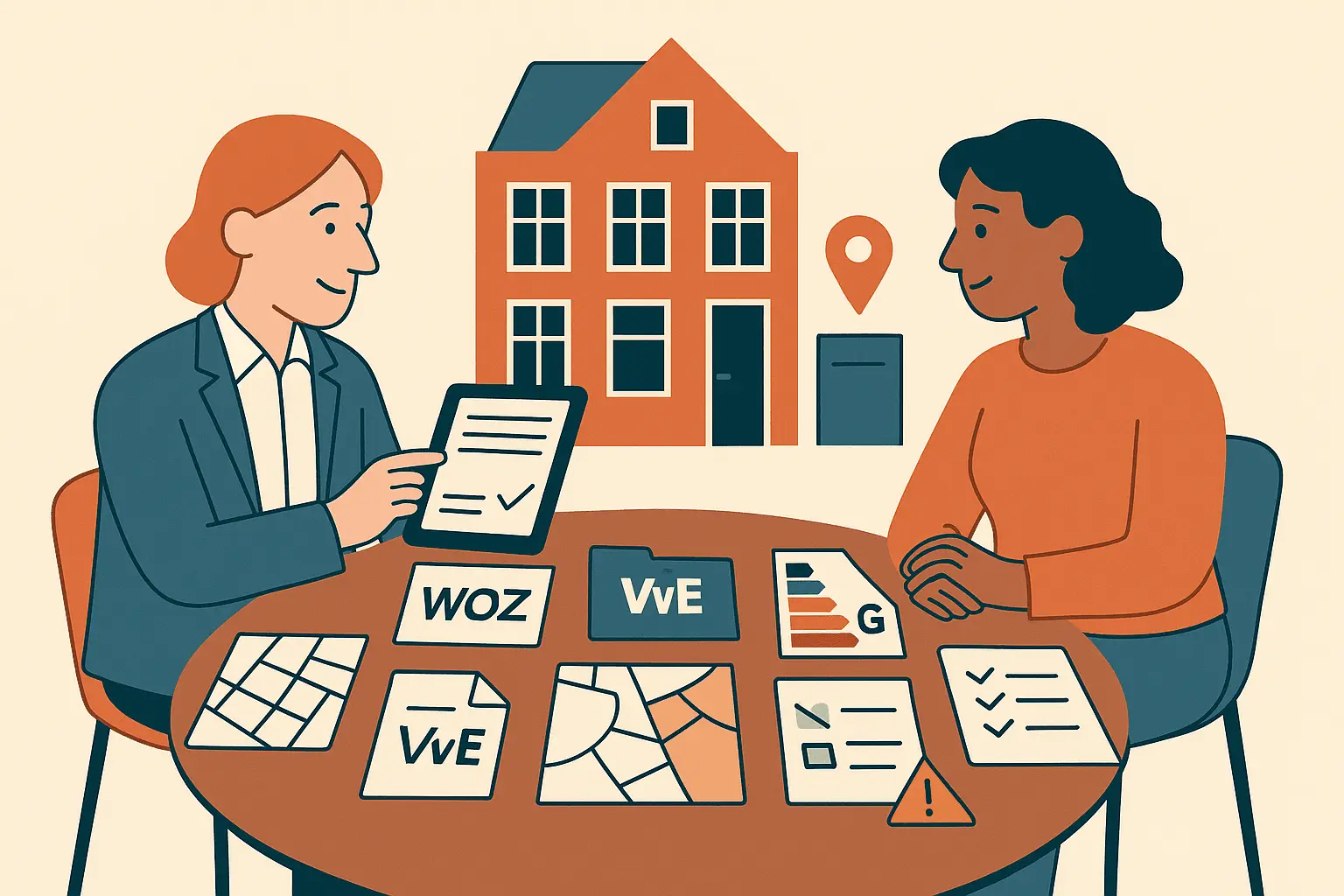
Roof terrace risks before buying

A roof terrace can make a Dutch apartment or house feel much more valuable. It can also create a real pre-bid risk if the permission, ownership, VvE approval, or construction details are unclear.
Before you bid, the key question is simple: can you safely rely on the roof terrace as part of what you are buying?
Considering a specific address with a dakterras? Huisscan helps you check a Dutch property before you bid. Enter one address, upload the brochure and available documents, and get a clear pre-bid report with property data, risk signals, document analysis, and buyer questions.
Why a roof terrace needs a separate pre-bid check
A roof terrace is not just “nice outdoor space”. In the Netherlands, a dakterras can involve several layers of permission and responsibility:
- public permission from the municipality
- private permission from the VvE or co-owners
- structural safety and roof waterproofing
- neighbour privacy and nuisance issues
- valuation differences between living area and outdoor area
The risk is not that every roof terrace is a problem. The risk is bidding as if it is fully permitted and secure, while the documents do not prove that.
Common warning signs include:
- the seller says “it was already there when I bought it”
- the listing mentions a roof terrace, but the documents do not
- there is no permit number, drawing, or municipal approval
- the VvE documents mention roof leaks or terrace disputes
- the terrace is accessed through a hatch or roof structure that is not shown on drawings
For anyone buying a house in the Netherlands, especially expats, this is where Dutch paperwork matters.
Permit risk: is the dakterras actually allowed?
The main Dutch term to know is omgevingsvergunning. This is the environmental/building permit that may be needed for changes to a property. Older documents may use terms such as bouwvergunning or refer to previous permit systems.
A roof terrace may require permission because it can affect:
- the external appearance of the building
- the use of the roof
- railings, stairs, roof access, or a roof structure
- privacy for neighbours
- the local planning rules, called the omgevingsplan
Older documents may still say bestemmingsplan - heritage rules, if the property is a rijksmonument, gemeentelijk monument, or in a protected cityscape
Useful sources and documents include:
- the municipality’s bouwdossier or building archive
- permit documents and approved drawings
- the Omgevingsloket for current rules and permit checks
- the local omgevingsplan
- monument or protected cityscape information
- the seller questionnaire and sales brochure
A permit search is not always simple. Not all historic documents are easy to find online, and a missing online record does not automatically prove there is no permission. But before bidding, you should ask for proof.
A useful buyer question is:
“Can you provide the permit or municipal confirmation for the roof terrace, including the approved drawings?”
Also compare the approved drawing with what you see. A permit for a roof window, roof hatch, or small alteration is not automatically permission for a usable roof terrace.
VvE and ownership risk: can you legally use the roof?
For apartments, the VvE risk can be just as important as the municipal permit risk.
VvE means Vereniging van Eigenaars, the owners’ association. In many apartment buildings, the roof is a common part of the building, even if only the top-floor apartment can reach it.
Important documents include:
- splitsingsakte: deed of division
- splitsingstekening: division drawing
- splitsingsreglement: division regulations
- VvE meeting minutes
- written VvE approvals
- maintenance plan, often called MJOP
- VvE insurance and repair records
Check whether the roof terrace is actually part of the apartment right, or whether the owner only has an exclusive right to use it. Sometimes a terrace has been used for years informally, but is not clearly documented.
Ask:
- Is the terrace shown in the splitsingsakte or splitsingstekening?
- Is there a documented exclusive use right?
- Did the VvE approve the construction, access, railings, and use?
- Who pays if the roof leaks under the terrace?
- Does the VvE maintenance plan include this roof area?
- Have there been complaints, insurance claims, or disputes?
If the terrace changes the use of a common roof, a normal VvE vote may not always be the whole story. In some situations, a notary or legal professional may need to check whether the apartment rights were properly arranged.
Building, leakage and neighbour risks
A roof terrace also creates practical building risks.
A roof is designed to protect the building. It is not automatically designed for people, furniture, planters, decking, storage, or heavy objects. Large planters, outdoor kitchens, and hot tubs can create extra load.
Pre-bid building checks should consider:
- structural capacity
- roof membrane and waterproofing
- drainage
- insulation damage
- railings and fall protection
- stairs, hatch, or roof access
- signs of leaks in the apartment below
- maintenance responsibility between the owner and VvE
A bouwkundige keuring is a building inspection. It can help identify visible technical issues, but it does not replace legal permission checks or structural calculations where needed.
Neighbour issues also matter. A roof terrace can create overlooking, noise, and privacy concerns. This can lead to objections, VvE restrictions, or difficult relationships after purchase.
Before bidding, check VvE minutes and ask the seller or agent directly:
“Have there been any neighbour complaints, municipal letters, VvE discussions, or repair claims connected to the roof terrace?”
How it can affect your bid, price and conditions
Do not value a roof terrace the same way as indoor living space.
In Dutch measurement reports, outdoor space is usually treated separately from gebruiksoppervlakte wonen: the usable living area. A roof terrace may be listed as gebouwgebonden buitenruimte, meaning building-related outdoor space. It can add value, but it is not the same as extra square metres of living area.
Permission uncertainty can affect your decision in several ways:
- you may bid less because the terrace risk is unresolved
- you may ask for documents before making your final offer
- you may add a condition to your bid, called a voorbehoud
- you may request a building inspection focused on the roof terrace
- you may decide not to rely on the terrace in your valuation
- you may walk away if the terrace is central to the price but not properly documented
Examples of sensible pre-bid conditions to discuss with your buyer agent or legal adviser include:
- satisfactory review of municipal permits
- satisfactory review of VvE approval and apartment documents
- satisfactory building inspection
- receipt of specific missing documents before signing
Avoid assuming that an undocumented roof terrace can easily be legalised later. That may be possible in some cases, but it depends on the municipality, VvE, building, neighbours, and current rules.
Practical roof terrace checklist before you bid
Use this checklist before you treat the roof terrace as a secure part of your bid.
Permission and municipal checks
- Ask for the omgevingsvergunning or older bouwvergunning
- Ask for the permit number and approved drawings
- Compare the approved drawings with the actual terrace
- Check whether the property is a monument or in a protected area
- Check local planning rules in the omgevingsplan
- Ask whether the municipality has ever contacted the owner about the terrace
VvE and ownership checks
- Review the splitsingsakte
- Review the splitsingstekening
- Check whether the terrace is private, common, or exclusive-use
- Ask for written VvE approval
- Read VvE minutes for roof, leakage, terrace, or neighbour issues
- Check who pays for roof repairs and terrace-related damage
Technical checks
- Ask for structural calculations if available
- Ask when the terrace was built or renovated
- Check for roof leaks or water stains
- Review maintenance records
- Check access, railings, drainage, and decking
- Consider a building inspection with specific roof terrace questions
Valuation and offer checks
- Confirm the terrace is not counted as living area
- Compare the listing with the measurement report
- Decide how much value you are assigning to the terrace
- Adjust your bid if permission or VvE proof is missing
- Consider a suitable voorbehoud
- Be ready to walk away if the risk is too large for the price
What Huisscan can help you check
Huisscan is built for the moment before you bid: when you have one address, some documents, and not much time.
A Huisscan pre-bid report can help you review:
- available Dutch property data for the address
- property risks Netherlands buyers often miss before bidding
- signs that the property is an apartment with VvE documents to review
- monument or location-related risk signals where available
- uploaded documents such as brochures, seller questionnaires, VvE files, permits, and drawings
- mentions of dakterras, omgevingsvergunning, splitsingsakte, VvE approval, roof maintenance, or leakage
- mismatches between the listing and the documents
- practical buyer questions to send to the selling agent, VvE, municipality, or your own adviser
Huisscan does not replace a notary, building inspector, appraiser, mortgage advisor, lawyer, or the municipality. It helps you organise the available information and identify the questions that matter before you commit to a bid.
FAQ: roof terrace permit Netherlands buying
Do I always need a permit for a roof terrace in the Netherlands?
Not every situation is the same. A roof terrace can trigger permit requirements because of construction, appearance, planning rules, neighbour privacy, or heritage restrictions. Check the Omgevingsloket, ask the municipality if needed, and request the existing permit documents from the seller.
Can I rely on a listing that says the property has a roof terrace?
No. A listing describes what is being marketed, but it is not proof that the roof terrace is permitted, privately usable, structurally suitable, or approved by the VvE. Always ask for the supporting documents.
What if the seller says the roof terrace was already there?
That is useful background, but not enough. Ask for permits, VvE approval, old drawings, maintenance records, and any municipal or VvE correspondence. If proof is missing, reflect that in your bid or conditions.
Is a roof terrace included in the living area?
Usually, a roof terrace is treated as outdoor space, not indoor living area. Check the measurement report and look for terms such as gebruiksoppervlakte wonen and gebouwgebonden buitenruimte. Do not price it as if it were extra indoor square metres.
Should I walk away if no permit can be found?
Not automatically. First assess how important the terrace is to your valuation, what documents are missing, whether the VvE position is clear, and whether a professional can help verify the situation. But if the terrace is a major reason for the price and the permission signals remain unclear, walking away can be the calmer decision.
Check the address before you bid.