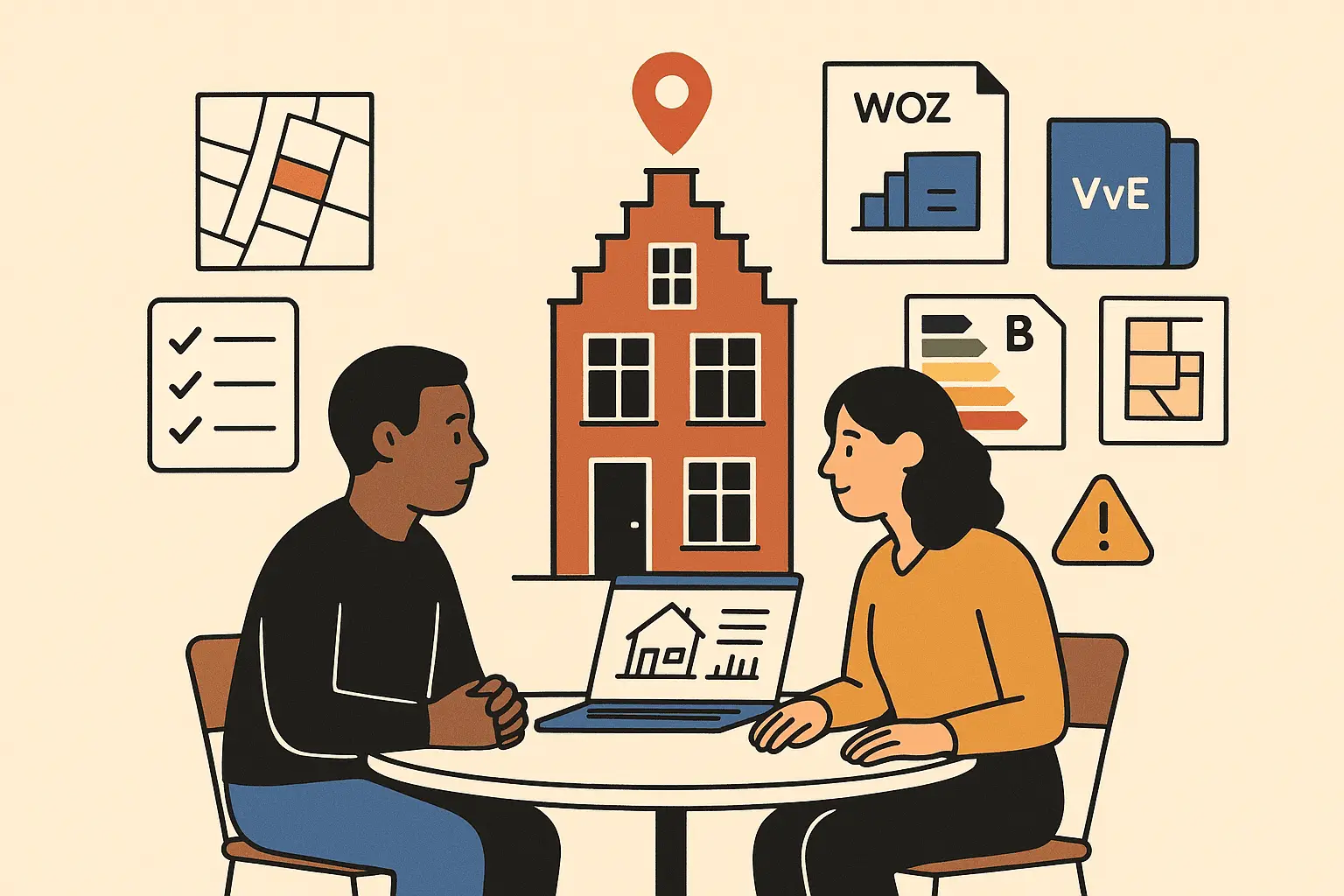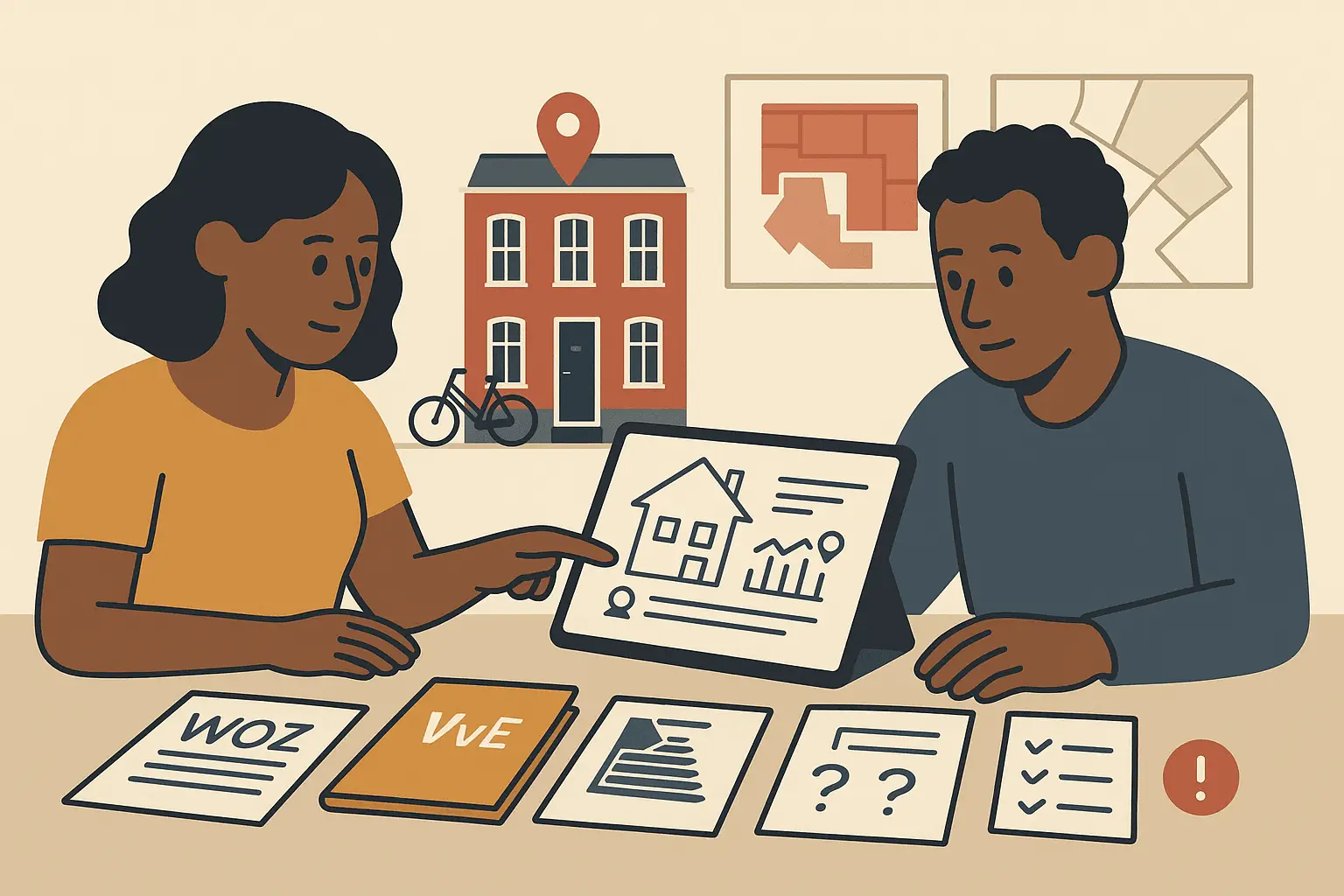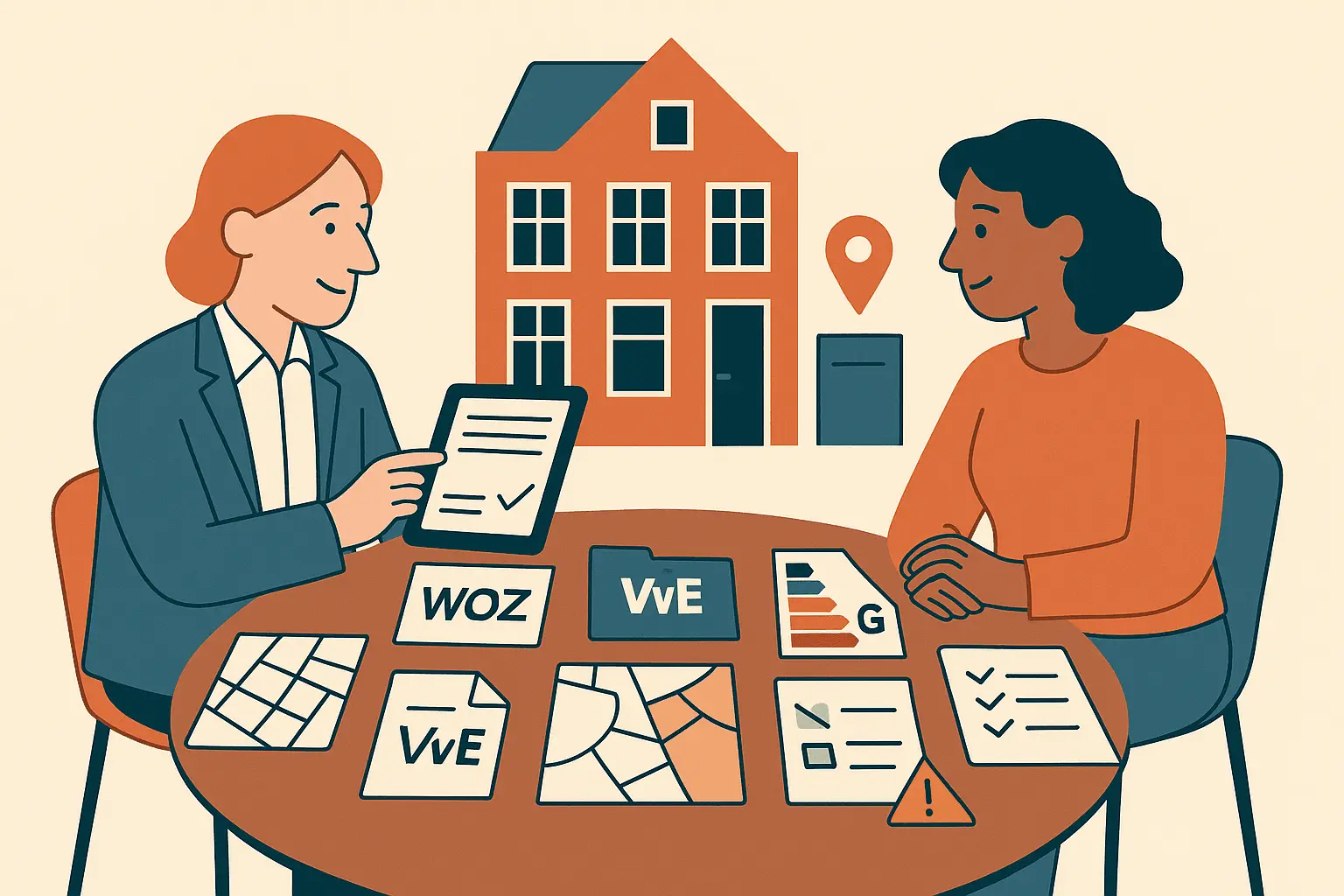
Buying with a buyer agent: what to prepare

A good buyer agent can help you understand the market, plan a bidding strategy, and communicate with the seller’s agent. But they still need clear input from you, and they may not have time to investigate every risk in depth before a fast deadline.
If you are buying a house in the Netherlands, the best preparation is practical: know your budget, understand the Dutch documents, check the property data, and agree what would make you lower your bid, add conditions, or walk away.
Have a property in mind? Use Huisscan to check one Dutch address before you bid and create a clear pre-bid report you can share with your buyer agent.
Why prepare if you already have a buyer agent?
In the Netherlands, a buyer agent is usually called an aankoopmakelaar. They work for the buyer, unlike the verkoopmakelaar, who represents the seller.
A buyer agent can be very valuable, especially in competitive areas or if you are an expat. They may help with:
- assessing the asking price
- advising on a bidding range
- contacting the seller’s agent
- explaining the bidding process
- reviewing available sales documents
- suggesting offer conditions
But the final decision is still yours. Before you bid, you need to be comfortable with the property, the price, the risks, and the conditions in your offer.
Think of this as a practical buyer agent checklist Netherlands house buyers can use before a bid meeting: what information do you and your agent need to make a calm decision?
Agree your bidding brief before you view
Before your buyer agent advises on a bid, be clear about your own boundaries.
Prepare these points:
- Maximum monthly cost you are comfortable with, not just the maximum mortgage.
- Total cash available, including transfer costs, notary costs, adviser fees, moving costs, renovation budget, and a buffer.
- Must-haves and nice-to-haves, such as number of bedrooms, outdoor space, energy performance, commute, schools, or parking.
- Walk-away points, such as major structural uncertainty, unclear leasehold costs, weak VvE documents, or renovation costs you cannot absorb.
- Offer conditions you may need, such as financing, valuation, building inspection, or sale of your current home.
Your buyer agent can give better advice when they know your limits. For example, a home with an old roof may still be interesting, but only at a lower price or with a technical inspection condition. An apartment with unclear VvE finances may require more questions before bidding.
Documents and Dutch terms to collect
Ask the seller’s agent which documents are available and send them to your buyer agent as early as possible. For apartments, this is especially important because you are also buying into the homeowners’ association.
Common Dutch documents and terms include:
- Verkoopbrochure: the sales brochure. Useful, but it is marketing material, not full due diligence.
- Vragenlijst: the seller’s questionnaire about the property, defects, renovations, nuisance, permits, and other known issues.
- Lijst van zaken: the list of items included or excluded, such as curtains, appliances, flooring, or light fixtures.
- Energielabel: the energy label. This gives an indication of energy performance, but does not replace an insulation or installation check.
- Kadastrale gegevens: cadastral information, such as plot size, boundaries, and registered property details.
- Erfpacht: leasehold. You own the building or apartment right, but not always the land. Ask about the ground rent, conditions, and whether payments have been prepaid or bought off.
- VvE: Vereniging van Eigenaars, the homeowners’ association for an apartment building.
- MJOP: meerjarenonderhoudsplan, the long-term maintenance plan of the VvE.
- VvE minutes and financials: meeting minutes, service charges, reserve fund, insurance, and planned works.
- Bestemmingsplan / omgevingsplan: local planning rules. Relevant for extensions, use of the property, nearby developments, or business use.
- Bouwkundig rapport: building inspection report, if already available. If it was arranged by the seller, consider whether you need your own independent view.
If documents are missing, that does not always mean something is wrong. But it does mean your buyer agent should know which assumptions are being made before advising on price or conditions.
Property risks to discuss before making an offer
A pre-bid property check in the Netherlands is not about finding a perfect home. It is about knowing which risks may affect your offer.
Discuss these topics with your buyer agent:
Price and comparable sales
Ask how the suggested bid is supported. Is it based on similar sold properties, local demand, renovation level, energy performance, outside space, or scarcity?
A high bid may still be rational in some situations, but you should understand the evidence behind it.
Building condition
Older Dutch homes can have issues with roofs, damp, timber, foundations, asbestos-containing materials, outdated electrics, or poor insulation. Not every risk is visible during a viewing.
If there are signs of technical uncertainty, ask whether your bid should include a bouwkundige keuring condition or whether you need a specialist inspection before bidding.
Apartment and VvE risk
For apartments, the VvE can affect your future costs. Check whether there is a maintenance plan, whether reserves look sufficient for planned work, and whether minutes mention disputes, leakage, facade repairs, roof works, lift replacement, or sustainability upgrades.
A low monthly service charge can look attractive, but it may also mean future one-off contributions if maintenance has been postponed.
Leasehold and ownership restrictions
With erfpacht, the financial impact depends on the contract and future payment obligations. Ask your buyer agent, mortgage advisor, and notary what the leasehold terms mean for your budget and mortgage options.
Also check for rights of way, shared access, restrictions, or obligations that may appear in title information or seller documents.
Area and environmental signals
Dutch property data can reveal useful context: noise, flood sensitivity, soil information, nearby infrastructure, zoning, protected status, or local development plans. These signals do not always mean “do not buy,” but they may lead to better questions.
For example: “Is a new road planned nearby?” or “Are there restrictions because the building is protected?”
Renovation and sustainability
If the home needs upgrades, estimate the impact before bidding. Energy label, glazing, insulation, heating system, roof condition, and ventilation can all affect your future budget.
Do not rely only on the asking price. Ask: “What will this home cost me in the first three to five years?”
Buyer agent checklist for a Netherlands house
Use this checklist before your buyer agent prepares or submits a bid.
Your personal bid limits
- I know my maximum comfortable monthly cost.
- I have checked my mortgage position with a qualified mortgage advisor.
- I know my available cash for costs, moving, repairs, and buffer.
- I know my absolute maximum bid and my preferred bid.
- I know which risks would make me walk away.
Property documents
- I have the sales brochure.
- I have the seller’s questionnaire.
- I have the list of included and excluded items.
- I have the energy label.
- I have cadastral or ownership information where available.
- For an apartment, I have VvE documents, minutes, financials, and MJOP.
- For leasehold, I have the relevant erfpacht information.
Property risks
- I understand the main maintenance issues.
- I know whether a building inspection is advisable.
- I understand any VvE concerns.
- I understand any leasehold or ownership restrictions.
- I have checked zoning or planning signals that may affect use or future works.
- I have considered renovation and energy upgrade costs.
Offer strategy
- I understand why the buyer agent recommends a certain bid.
- I know which conditions to include or waive.
- I understand what happens if the valuation is lower than the offer.
- I know which questions still need an answer before signing.
- I have agreed who communicates with the seller’s agent and when.
What Huisscan can help you check
Huisscan is designed for one practical moment: check a Dutch property before you bid.
With one Dutch address, and with documents you upload, Huisscan can help turn scattered information into a clear Huisscan pre-bid report. You can share that report with your buyer agent, mortgage advisor, or other professionals.
Huisscan can help you review:
- available Dutch property data for the address
- ownership and location signals where available
- apartment and VvE-related documents you upload
- seller questionnaires and lists of included items
- possible risk signals that deserve follow-up
- unclear or missing information
- practical buyer questions to ask before bidding
For example, Huisscan may help you spot that an apartment’s VvE documents mention planned roof work, or that a seller questionnaire contains a note about past leakage. That does not automatically mean the property is a bad purchase. It does mean you and your buyer agent can discuss whether it affects the price, the offer conditions, or the need for further specialist advice.
Huisscan supports decision-making. It does not replace a notary, appraiser, building inspector, mortgage advisor, lawyer, or tax professional.
Questions to ask your buyer agent before the bid
Use your pre-bid report and documents to have a focused conversation.
Good questions include:
What evidence supports the bid range?
Ask for the reasoning behind the price, not just the final number.Which risks affect the bid most?
Separate small issues from material risks that could cost money or limit use.Which documents are missing or unclear?
Missing VvE documents, leasehold information, or technical details may change your risk level.Should we include conditions?
Discuss financing, valuation, inspection, or other relevant conditions with the right professionals.What should we ask the seller’s agent before bidding?
Keep questions specific: leakage history, roof age, VvE decisions, renovation permits, service charges, or included items.At what price should we stop?
A buyer agent can help with strategy, but your walk-away number should be clear before emotions take over.
FAQ
Do I need a buyer agent to buy a house in the Netherlands?
No, it is not always required. Many buyers choose one because the Dutch process, documents, bidding culture, and local pricing can be difficult to judge alone. If you use a buyer agent, preparation still matters because you remain responsible for the decision to bid.
What should I send to my buyer agent before making an offer?
Send the address, sales brochure, seller questionnaire, list of included items, energy label, VvE documents if relevant, leasehold information if relevant, and any questions from your own review. A Huisscan pre-bid report can help organise the key points.
Can a buyer agent check all legal and technical risks?
A buyer agent can often identify practical issues and advise on next steps, but they do not replace a notary, lawyer, appraiser, building inspector, or mortgage advisor. For legal, structural, financial, or tax questions, ask the appropriate qualified professional.
How can a pre-bid property check affect my offer?
It can help you decide whether to bid higher, bid lower, add conditions, ask more questions, request specialist advice, or walk away. The goal is not to remove every uncertainty, but to avoid bidding blindly.
Is Huisscan useful for expats buying a house in the Netherlands?
Yes, especially when Dutch property documents and terms are unfamiliar. Huisscan helps turn one address and uploaded documents into a clearer pre-bid overview with property data, risk signals, document analysis, and buyer questions to discuss with your advisers.
Check the address before you bid.