How to compare two properties before bidding

You have two homes on your shortlist. One feels better located. The other has more space. Both seem possible within budget. But before you bid, the real question is not “which one do I like more?” It is: which property do I understand well enough to make a sensible offer?
If you want to compare two properties before bidding in the Netherlands, do not compare only the asking price. Compare the property data, documents, monthly obligations, risks, and unanswered questions behind each address.
Comparing two addresses? Huisscan can help you check each Dutch property before you bid. Turn one address and uploaded documents into a clear pre-bid report with available property data, risk signals, document analysis, and buyer questions.
Why comparing two Dutch homes is not just about asking price
In the Dutch housing market, the vraagprijs — asking price — is only one part of the decision. Two homes with the same asking price can have very different costs, risks, and bidding strategies.
For example:
- One apartment may have a lower asking price but high VvE servicekosten — monthly homeowners’ association fees.
- One house may have more square metres but unclear foundation or moisture risks.
- One property may be on eigen grond — freehold land — while another has erfpacht — leasehold.
- One home may look renovated, but the documents may show upcoming roof, façade, or installation costs.
- One property may be easier to finance because the condition, valuation, and documentation are clearer.
A practical pre-bid property check in the Netherlands should help you answer:
- What do I know for sure?
- What is still unclear?
- What could affect my bid price, conditions, or willingness to proceed?
That is the fairest way to compare two properties before bidding.
Build a fair side-by-side comparison
Start by putting both properties in the same table. Use the same categories, the same assumptions, and the same level of caution.
| What to compare | Dutch term or document | Why it matters before bidding |
|---|---|---|
| Usable living area | Gebruiksoppervlakte wonen, often measured under NEN 2580 | Helps compare price per square metre. Do not confuse living area with total floor area or storage. |
| Plot and ownership | Perceel, Kadaster, eigendom, erfpacht | Freehold and leasehold can have different obligations and long-term costs. |
| Apartment obligations | VvE, servicekosten, MJOP, reservefonds, notulen | A weak or expensive VvE can affect monthly costs and future contributions. |
| Energy performance | Energielabel | Gives a first indication of comfort and possible sustainability work, but it is not a full technical inspection. |
| Seller disclosures | Vragenlijst, lijst van zaken | Shows what the seller says about defects, inclusions, and known issues. |
| Legal and use restrictions | Omgevingsplan / bestemmingsplan, permits, deed information | Can affect extensions, use, rental plans, or future surroundings. |
| Condition and maintenance | Building age, inspection report, visible defects | Helps estimate near-term work and decide whether to include an inspection condition. |
| Surroundings | Noise, water, soil, infrastructure, future plans | Location risks can affect comfort, resale, and your maximum bid. |
For expats buying a house in the Netherlands, these terms can feel technical. The key is simple: compare the same evidence for both properties before you decide which one deserves your stronger bid.
Compare the bid impact: price, monthly costs, and uncertainty
A better comparison is not “Property A costs €10,000 less.” A better comparison is:
Bid price + monthly obligations + expected work + unresolved uncertainty.
1. Compare price per usable square metre
Use gebruiksoppervlakte wonen — usable residential floor area — where available. If one listing includes storage, attic space, or a garden house in a way that makes the property feel larger, check whether that space is actually counted as living area.
Price per square metre is useful, but it is not enough. A smaller home with a better layout may be more usable than a larger home with awkward rooms.
2. Compare monthly obligations
Look beyond the mortgage payment. Depending on the property, compare:
- VvE service charges for apartments.
- Leasehold payments or conditions if there is erfpacht.
- Energy costs, based on label and building type.
- Expected maintenance or planned contributions.
- Insurance or other owner obligations where relevant.
If one apartment has much higher service charges, it may still be worth it if the VvE is well funded and maintenance is planned. But you should know that before bidding.
3. Compare near-term costs
Ask: what would I likely need to spend in the first few years?
Possible examples:
- Kitchen, bathroom, flooring, or painting.
- Roof, façade, balcony, or window maintenance.
- Heating, insulation, ventilation, or electrical work.
- VvE contributions for planned maintenance.
- Garden, drainage, or moisture improvements.
You do not need a perfect estimate before bidding, but you do need enough clarity to avoid comparing an optimistic version of one property with a realistic version of the other.
4. Compare uncertainty
Uncertainty has value. If Property A has complete documents, clear ownership, and no major open questions, while Property B is missing VvE documents or has unclear leasehold conditions, that should affect your bid strategy.
Uncertainty can lead to:
- A lower maximum bid.
- A request for more documents before bidding.
- A condition in the offer, where appropriate.
- A decision to arrange a specialist inspection.
- A decision to walk away.
Discuss offer conditions with your buyer agent, mortgage advisor, legal advisor, or notary where relevant.
Compare documents and obligations before you bid
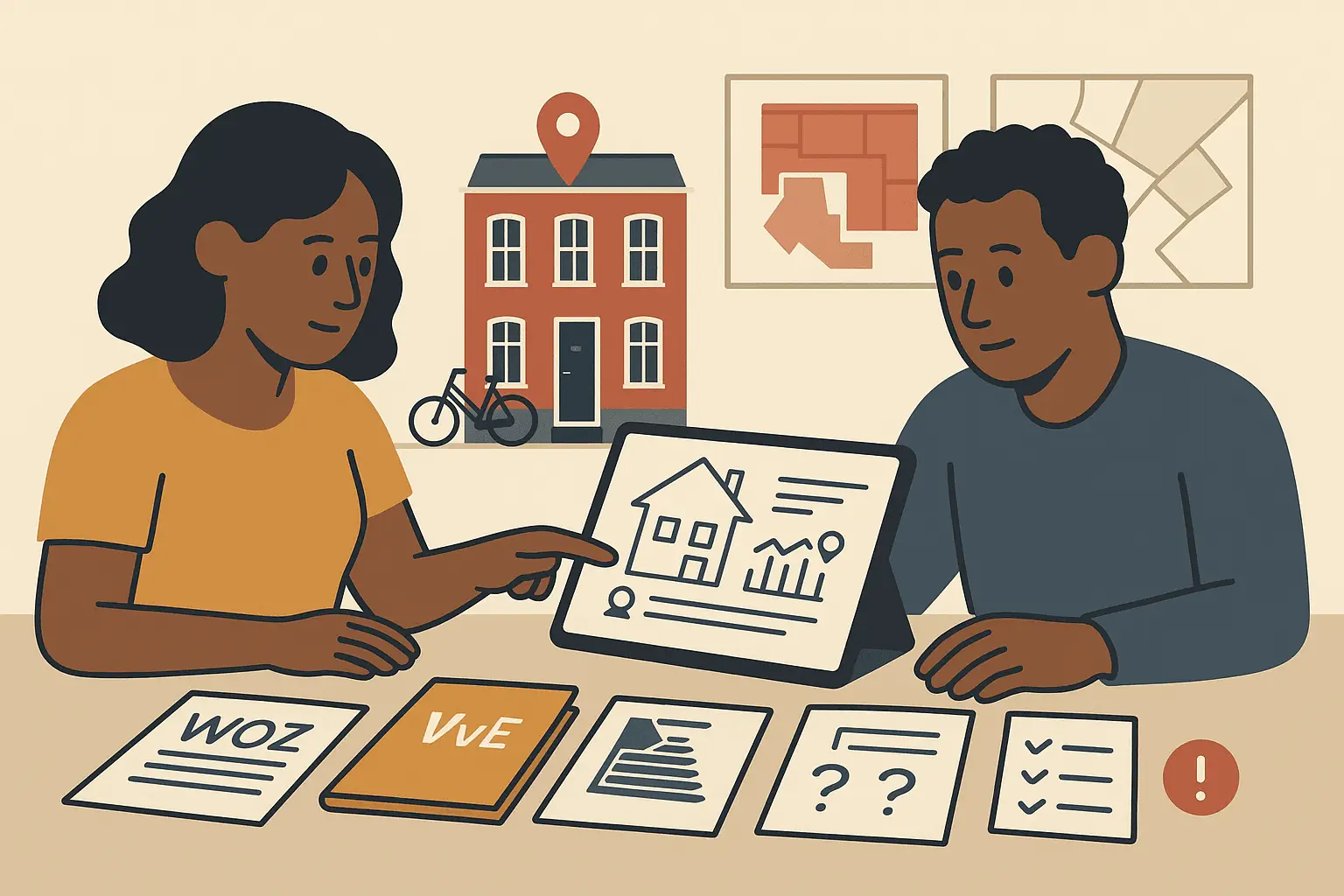
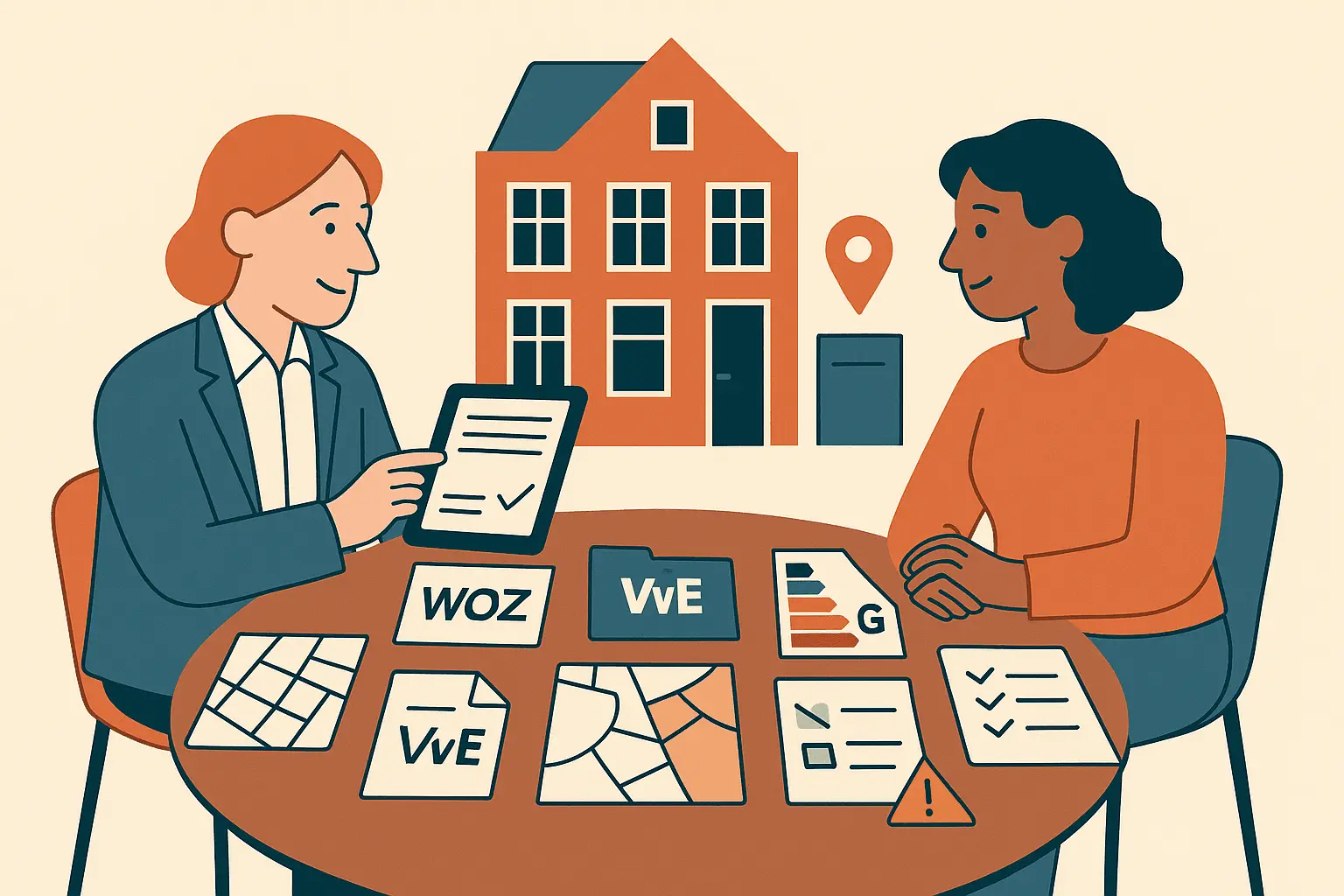
Documents often reveal the difference between two homes that look similar online. Ask for the relevant documents early, not after you have already emotionally chosen one property.
Common documents to compare include:
- Verkoopbrochure: the sales brochure.
- Vragenlijst: the seller’s questionnaire about the property.
- Lijst van zaken: what stays in the home and what the seller takes.
- Energielabel: the official energy label.
- Meetrapport: measurement report, if available.
- Kadasterinformatie: land registry information, ownership, parcel, and rights.
- Erfpachtvoorwaarden: leasehold terms, if applicable.
- Splitsingsakte and splitsingsreglement: apartment division deed and rules.
- VvE documents: annual accounts, budget, reserve fund, meeting minutes, house rules, insurance, and MJOP — long-term maintenance plan.
- Any available bouwkundig rapport: building inspection report.
For an apartment, the VvE documents are especially important. A nice apartment in a poorly organised VvE may be less attractive than a slightly more expensive apartment with clearer maintenance planning.
For a house, pay close attention to ownership, extensions, renovations, visible defects, and any statements about foundation, moisture, asbestos, or soil.
If documents are missing, do not panic. But do treat the gap as a pre-bid question:
- Can the selling agent provide the missing documents?
- Is the issue important enough to change the bid?
- Should you include a condition?
- Should a specialist review it?
- Is the uncertainty too large for your budget or risk tolerance?
Compare Dutch property risks that can change the decision
Property risks in the Netherlands are often local. A risk signal is not automatically a reason to walk away, but it is a reason to ask better questions before bidding.
Common property risks Netherlands buyers should compare include:
Foundation and subsidence
In some areas, older homes may have foundation or subsidence concerns. This is especially relevant in parts of the Netherlands with soft soil, historic buildings, or water-related ground conditions.
Pre-bid question:
Has any foundation assessment been done, and are there signs of cracks, sloping floors, or settlement?
Water, moisture, and drainage
The Netherlands is water-managed, but individual homes can still have moisture, basement, crawl space, or drainage issues.
Pre-bid question:
Are there known moisture problems, previous leaks, or drainage repairs?
Soil and contamination
Former industrial use, old fuel tanks, or local soil history can matter.
Pre-bid question:
Is there any known soil contamination or environmental information for the plot?
Leasehold
Erfpacht means you own the home but not always the land in the same way as freehold ownership. Conditions, payments, and future changes can be important.
Pre-bid question:
What are the current leasehold conditions, payments, review moments, and options?
Ask a notary or qualified legal professional to review leasehold details if they affect your decision.
VvE health
For apartments, the VvE can be a major difference between two properties.
Pre-bid question:
Does the VvE have a clear maintenance plan, sufficient reserves, recent meeting minutes, and any planned major works or contribution increases?
Permits and use
Extensions, roof terraces, converted spaces, or outbuildings may need permits or may be affected by municipal rules.
Pre-bid question:
Is the current use and layout permitted, and are there restrictions on future changes?
Monument or protected status
A rijksmonument, gemeentelijk monument, or protected cityscape can make a property special, but it may also affect renovation options.
Pre-bid question:
Are there heritage restrictions that could affect maintenance, renovation, or sustainability upgrades?
Practical checklist: compare two properties before bidding
Use this checklist for both addresses. Mark each item as green — clear, yellow — needs clarification, or red — material concern.
Basic data
- Address and property type checked.
- Usable living area compared.
- Plot size or apartment share understood.
- Building year and major renovation history reviewed.
- Energy label checked.
- WOZ value reviewed as context, not as a market valuation.
Ownership and obligations
- Freehold or leasehold checked.
- Leasehold terms reviewed if applicable.
- VvE documents reviewed if applicable.
- Service charges and planned contributions compared.
- Known rights, restrictions, or easements checked where available.
Documents
- Sales brochure reviewed.
- Seller questionnaire reviewed.
- List of movable items reviewed.
- Measurement information checked.
- Available inspection or maintenance reports reviewed.
- Missing documents listed as buyer questions.
Condition and future costs
- Visible maintenance issues noted after viewing.
- Roof, façade, windows, installations, and moisture signs considered.
- Renovation wishes separated from necessary repairs.
- Estimated near-term costs compared for both homes.
- Building inspection considered if condition is uncertain.
Location and surroundings
- Noise, traffic, rail, airport, or busy roads considered.
- Water, soil, and local environmental signals checked.
- Municipal planning or nearby developments reviewed.
- Parking, public transport, schools, shops, and commute compared realistically.
Bid strategy
- Maximum bid set separately for each property.
- Financing assumptions checked with a mortgage advisor.
- Possible appraisal gap considered.
- Offer conditions considered, such as financing or building inspection.
- Unanswered questions translated into bid price, conditions, or a decision not to bid.
The most useful comparison is not the longest one. It is the one that makes your next action clear.
What Huisscan can help you check
Huisscan is designed around one practical promise: Check a Dutch property before you bid.
If you are comparing two homes, you can create a Huisscan pre-bid report for each address and compare the reports side by side.
Huisscan can help you turn one Dutch address and uploaded documents into a clearer pre-bid view, including:
- Available Dutch property data for the address.
- Risk signals that may deserve attention before bidding.
- Analysis of uploaded sales documents, such as brochures, questionnaires, VvE documents, leasehold information, or other property files.
- Possible inconsistencies or missing points to clarify.
- Buyer questions you can ask the selling agent, your buyer agent, mortgage advisor, inspector, notary, or another qualified professional.
Huisscan does not replace a building inspection, valuation, mortgage calculation, legal review, or notarial advice. It helps you organise the available information so you can make a calmer, better-prepared pre-bid decision.
When comparing two reports, look for:
- Which property has fewer unresolved questions?
- Which risks are manageable with price or conditions?
- Which issues need specialist advice before you bid?
- Which property still fits your budget after realistic costs?
- Which address would you still want if you could not resolve every uncertainty?
That comparison is often more useful than simply asking which home is cheaper.
FAQ
How do I compare two properties before bidding in the Netherlands?
Use the same checklist for both homes. Compare usable living area, ownership, VvE or leasehold obligations, energy label, documents, condition, location risks, expected costs, and unanswered questions. Then decide how each point affects your bid price, conditions, or decision to walk away.
Is the property with the lower asking price usually the better option?
Not necessarily. A lower asking price can be offset by higher monthly costs, renovation needs, weak documentation, leasehold obligations, or VvE issues. Compare the full pre-bid picture, not only the price.
What should I check when comparing two apartments?
For apartments, check the VvE carefully. Compare service charges, reserve fund, annual accounts, budget, meeting minutes, house rules, insurance, and the MJOP — the long-term maintenance plan. Also check the apartment division deed and any restrictions that affect use or renovation.
What if one property has missing documents?
Missing documents do not automatically mean you should stop, but they should affect your decision process. Ask for the documents, list the unanswered questions, and decide whether the uncertainty changes your bid, requires a condition, or needs professional review.
Can Huisscan tell me which property to buy?
Huisscan supports your decision by organising available property data, risk signals, document analysis, and buyer questions into a clear pre-bid report. The final decision remains yours, supported where needed by your buyer agent, mortgage advisor, inspector, notary, or legal professional.
When should I walk away before bidding?
Consider walking away if a material issue remains unclear, the documents do not support the price, the risk does not fit your budget, or you cannot get comfortable even with conditions or professional advice. Sometimes the best pre-bid decision is not to bid.
Check the address before you bid.