
MJOP explained for apartment buyers
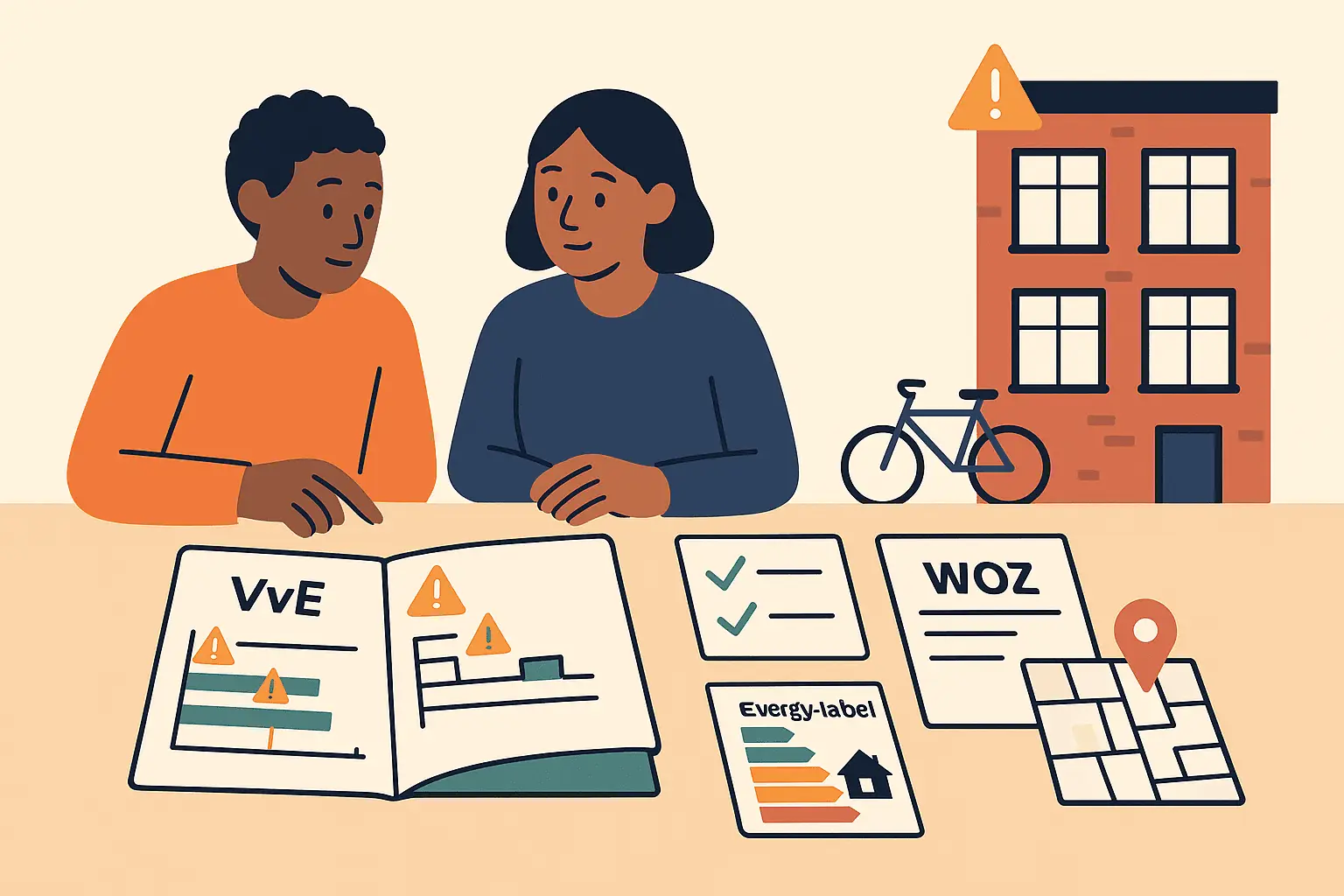
When you buy an apartment in the Netherlands, you do not only buy the space behind your own front door. You also become part of the VvE: the owners’ association responsible for the shared building.
That means the roof, façade, stairwell, lift, balconies, shared installations, and other common parts can affect your future costs. The MJOP is the document that helps you see what maintenance is expected, when it may happen, and how the VvE plans to pay for it.
For apartment buyers and expats, the MJOP can turn a vague concern into a clearer pre-bid question: is this building financially and technically prepared for the maintenance ahead?
Before you bid: check the address and upload the VvE documents you received. Huisscan can turn one Dutch address into a clear pre-bid report with available Dutch property data, risk signals, document analysis, and practical buyer questions. It helps you check a Dutch property before you bid, without replacing your buyer agent, building inspector, mortgage advisor, notary, or legal advisor.
What is an MJOP in the Netherlands?
MJOP stands for Meerjarenonderhoudsplan. In English: a multi-year maintenance plan.
For an apartment building, the MJOP usually describes:
- which shared building parts need maintenance;
- when that maintenance is expected;
- estimated costs per year;
- how the maintenance reserve may develop;
- whether the current VvE contribution is likely to be enough.
It is normally prepared for the VvE: the Vereniging van Eigenaars, or owners’ association. Every apartment owner is automatically part of the VvE.
Common Dutch terms you may see:
| Dutch term | Plain English | Why it matters before bidding |
|---|---|---|
| MJOP | Multi-year maintenance plan | Shows expected shared maintenance and costs |
| VvE | Owners’ association | Makes decisions and collects contributions |
| VvE-bijdrage / servicekosten | Monthly owner contribution | Affects your monthly budget |
| Reservefonds | Maintenance reserve fund | Should help pay for planned maintenance |
| Jaarrekening | Annual accounts | Shows actual finances and reserve position |
| Begroting | Budget | Shows planned income and expenses |
| Notulen ALV | Minutes of owners’ meeting | Reveals decisions, disputes, and postponed work |
| Extra bijdrage | Extra contribution or special levy | A possible one-off cost for owners |
| Achterstallig onderhoud | Deferred maintenance | Work that may have been delayed |
| Splitsingsakte | Deed of division | Defines private and shared responsibilities |
An MJOP is a planning document. It is not a guarantee that costs will be exact, and it is not the same as a full building inspection. But it is one of the most useful documents for MJOP Netherlands apartment buyers to review before making an offer.
Why the MJOP matters before you bid on an apartment
The asking price is only part of the decision. With an apartment, you also need to understand the building’s shared financial commitments.
A good MJOP helps answer three practical questions:
- What maintenance is coming?
- Has the VvE planned for it?
- Could it affect your offer, conditions, or decision to walk away?
For example:
- If the roof or façade needs major work soon and the reserve fund is low, the VvE may need to increase monthly contributions or ask owners for an extra contribution.
- If the MJOP is recent, detailed, and aligned with the VvE accounts, that can give more confidence that the building is actively managed.
- If there is no MJOP, no clear reserve, and unclear meeting minutes, you may be bidding with more uncertainty than the asking price suggests.
The MJOP can affect:
- your bid price;
- your monthly affordability;
- your renovation budget;
- your mortgage conversation;
- your inspection strategy;
- the conditions you include in your offer;
- whether the apartment still fits your risk tolerance.
An MJOP review is a sensible part of a pre-bid property check in the Netherlands, especially when buying a house in the Netherlands as an expat and dealing with unfamiliar Dutch VvE documents.
Documents to read together with the MJOP
Do not read the MJOP on its own. It should match the wider VvE picture.
Ask the selling agent, seller, or VvE manager for the available VvE document package. This often includes:
- MJOP: the maintenance planning itself.
- Jaarrekening: annual accounts showing the reserve fund, income, expenses, possible debts, and financial position.
- Begroting: the current or upcoming budget, including the VvE contribution.
- Notulen van de ALV: meeting minutes from the owners’ meetings.
- Splitsingsakte and splitsingstekening: deed and drawings that explain what is private and what is shared.
- Modelreglement and huishoudelijk reglement: regulations and house rules.
- Insurance information: usually the building insurance, called opstalverzekering.
- Technical reports or quotes: for roof, façade, lift, balconies, foundation, asbestos, sustainability works, or other projects.
- Seller questionnaire: sometimes called the vragenlijst, which may mention known issues.
Public Dutch property data can also help create context. For example, data from sources such as BAG, Kadaster, municipal information, or energy-label databases may help confirm building age, property type, registration details, or other address-level signals where available.
But for VvE maintenance risk, the core evidence is usually in the MJOP, annual accounts, budget, and meeting minutes.
How to read an MJOP in 20 minutes
You do not need to be a building expert to get useful pre-bid signals from an MJOP. Start with a calm, structured read.
1. Check the date and scope
Look for:
- the date of the MJOP;
- who prepared it;
- whether it was based on a physical inspection;
- which building parts are included;
- whether the plan has been updated after major works.
An older MJOP may still be useful, but it may not reflect current condition, labour costs, material prices, or recently approved projects.
2. Find the big-ticket items
Scan for expensive shared components, such as:
- roof replacement or roof covering;
- façade repairs;
- exterior painting;
- window frames and glazing;
- balconies and galleries;
- lift maintenance or replacement;
- shared heating systems;
- sewerage and drainage;
- electrical installations;
- fire safety measures;
- entrance, stairwell, and common areas.
Then check whether these costs fall soon after your possible purchase.
3. Compare planned costs with the reserve fund
The reserve fund is important, but the amount alone is not enough. Compare it with the maintenance planning.
Ask:
- Is there enough reserve for major works in the coming years?
- Does the MJOP expect the reserve to fall sharply?
- Does the VvE contribution appear realistic?
- Is there mention of a future increase in contributions?
- Are special contributions or VvE loans being discussed?
A low monthly VvE contribution is not automatically good. It can be attractive in the short term, but if the building is under-saving, costs may appear later.
4. Cross-check the meeting minutes
The notulen can reveal what the MJOP does not clearly show.
Look for signs that owners have discussed:
- postponed maintenance;
- disagreement about costs;
- approved major projects;
- contractor quotes;
- leaks or recurring defects;
- lift problems;
- façade or balcony concerns;
- sustainability plans;
- increases in VvE contributions.
If the MJOP says a project is planned, but the minutes show repeated delays, ask why.
5. Check what the MJOP does not cover
An MJOP usually focuses on common building parts. It may not cover:
- your private kitchen, bathroom, floors, or appliances;
- internal renovation needs;
- hidden defects;
- detailed structural investigations;
- foundation risk unless specifically assessed;
- asbestos unless included in a separate report;
- future legal or regulatory changes;
- all sustainability upgrades.
For technical condition, consider a qualified building inspector. For legal interpretation of the deed or VvE obligations, ask a notary or legal advisor.
Practical MJOP checklist before bidding
Use this checklist before making an offer on a Dutch apartment:
- I have received the MJOP, annual accounts, budget, and recent VvE meeting minutes.
- The MJOP is recent enough to reflect the current building condition and cost level.
- The MJOP clearly lists major shared building parts, such as roof, façade, balconies, lift, and installations.
- I know which major maintenance items are planned in the next few years.
- I have compared planned maintenance costs with the VvE reserve fund.
- I understand the monthly VvE-bijdrage and whether increases are expected.
- I checked whether an extra bijdrage or VvE loan has been discussed.
- I compared the MJOP with the annual accounts and budget.
- I read the VvE minutes for disputes, delays, urgent repairs, or recurring defects.
- I checked the splitsingsakte for private versus shared responsibilities.
- I know whether windows, balconies, roof terraces, or external doors are private or shared.
- I have listed questions for the selling agent, VvE manager, buyer agent, mortgage advisor, inspector, or notary.
- My offer price, conditions, and walk-away point reflect the maintenance information.
Red flags and buyer questions
Not every concern is a reason to stop. But some signals should make you slow down and ask better questions.
Watch for:
- no MJOP available;
- a very old MJOP with no clear update;
- a low reserve fund compared with planned maintenance;
- major works planned soon without a clear funding plan;
- repeated postponement of necessary maintenance;
- unclear responsibility for expensive parts such as windows, balconies, or roof terraces;
- VvE contributions that seem too low for the building size and condition;
- discussion of special contributions without clear amounts;
- owner arrears, disputes, or legal conflicts mentioned in minutes;
- sustainability ambitions without budget or decision-making;
- missing or inconsistent VvE documents.
Useful questions to ask before bidding:
- When was the MJOP last updated, and was it based on a physical inspection?
- Which major works are expected in the next few years?
- Is the current reserve fund enough for the planned works?
- Are VvE contributions expected to increase?
- Has an extra contribution been approved or discussed?
- Are there VvE loans or other shared financial obligations?
- Have any major works been postponed?
- Are there known issues with roof, façade, balconies, lift, leakage, or foundation?
- Which parts are private and which are shared under the deed of division?
- Are there recent quotes or technical reports for large projects?
If the answers remain unclear, you can reflect that uncertainty in your offer, add appropriate conditions, ask for more time, or decide not to bid. Discuss offer wording and legal consequences with a qualified professional.
What Huisscan can help you check
Huisscan is built around one practical promise: Check a Dutch property before you bid.
For apartment buyers, Huisscan can help turn an address and uploaded VvE documents into a clear pre-bid report. Depending on the available information, a Huisscan pre-bid report can help you:
- structure available Dutch property data for the address;
- identify property risks in the Netherlands that may be relevant to the building or location;
- analyse uploaded documents such as the MJOP, annual accounts, budget, and VvE minutes;
- highlight upcoming maintenance items and possible funding questions;
- spot inconsistencies between the MJOP and other VvE documents;
- explain Dutch terms in plain English for expats and international buyers;
- generate practical questions for the selling agent, VvE manager, buyer agent, mortgage advisor, inspector, or notary.
Huisscan does not replace professional legal, building, appraisal, mortgage, tax, or notarial advice. It helps you prepare better questions and make a clearer pre-bid decision.
FAQ
Is an MJOP mandatory for every Dutch apartment building?
Not always in the same way. Dutch VvEs are expected to reserve for maintenance, and many active VvEs use an MJOP to support that planning. If there is no MJOP, ask how the VvE calculates its maintenance reserve and whether a current plan or inspection is available.
For the legal position of a specific VvE, ask a notary or legal advisor.
Does the MJOP cover my own apartment?
Usually not. The MJOP mainly covers shared building parts managed by the VvE. Your private bathroom, kitchen, flooring, internal finishes, and appliances are normally your own responsibility.
Some items, such as window frames, balconies, or roof terraces, depend on the splitsingsakte and VvE rules. Always check the deed of division.
Is a low VvE contribution a good sign?
Not automatically. A low monthly contribution can be fine if the building is small, simple, and well-funded. But it can also mean the VvE is not saving enough for future maintenance.
Always compare the contribution with the MJOP, reserve fund, budget, and meeting minutes.
What if the MJOP is missing before I bid?
Ask for it first. If there is no MJOP, ask for the annual accounts, budget, recent minutes, reserve position, and any technical reports.
A missing MJOP does not always mean you must walk away, but it increases uncertainty. You may decide to bid lower, include conditions, request more documents, or pause until the maintenance position is clearer.
Can I rely on the MJOP instead of a building inspection?
No. An MJOP is a maintenance planning and budgeting document. A building inspection looks at technical condition. They answer different questions.
For older buildings, visible defects, foundation concerns, leakage, or major renovations, a qualified building inspector can provide a different type of assessment.
How can the MJOP affect my offer?
The MJOP can help you decide whether the asking price still makes sense after future shared maintenance costs are considered. It may lead you to:
- adjust your bid;
- budget for higher VvE contributions;
- ask for more documents;
- add a condition;
- consult your mortgage advisor;
- request a technical inspection;
- walk away if the uncertainty is too high.
Check the address before you bid.