How to spot missing property documents
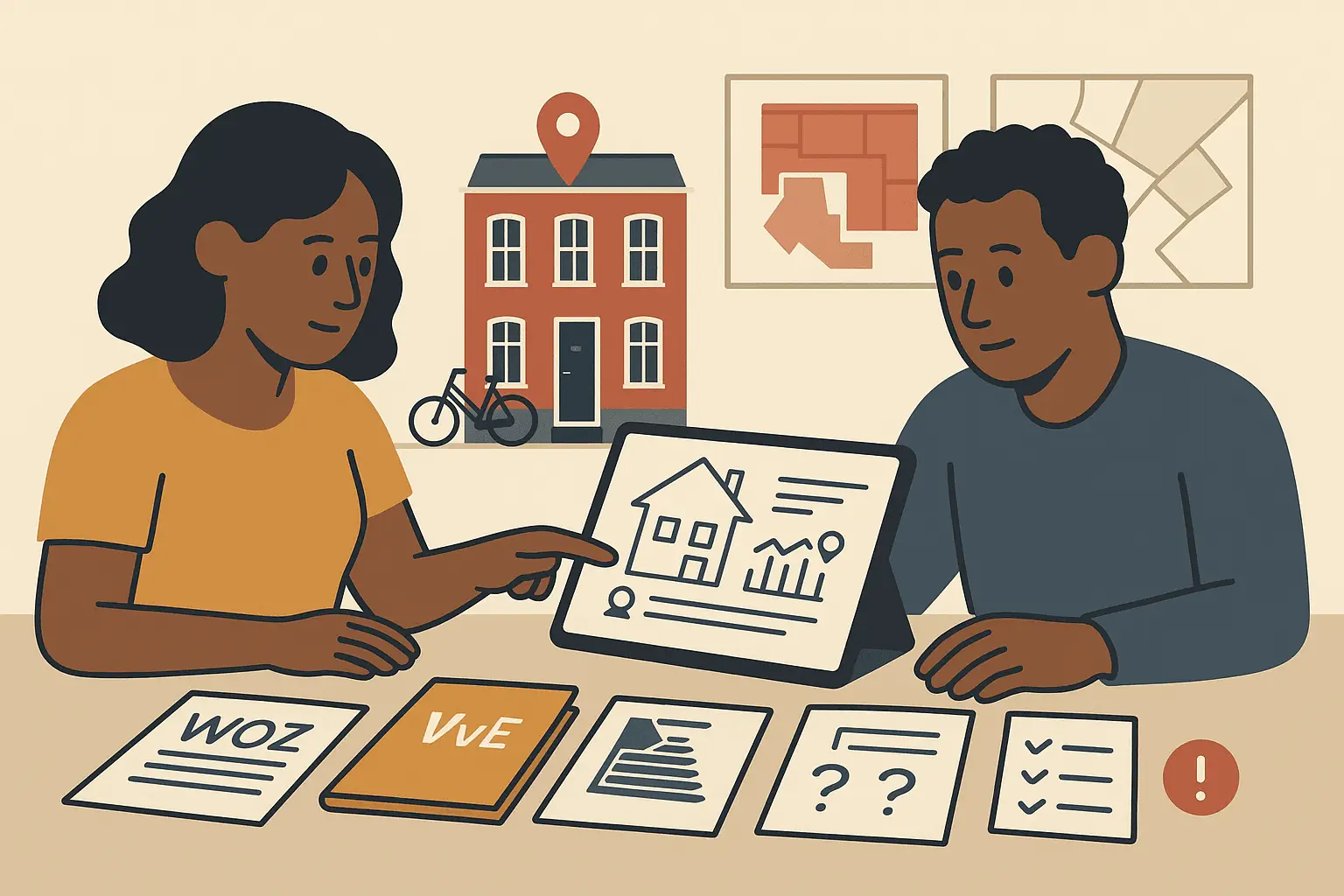
You have viewed a home, the bid deadline is close, and the selling agent has sent a brochure plus a few PDFs. But is that enough to make an offer?
In the Netherlands, important property information is often spread across the sales brochure, seller questionnaires, Kadaster data, VvE documents, permits, energy information, and municipal sources. Missing documents do not always mean something is wrong. But they do create uncertainty — and uncertainty can affect your bid, your conditions, or your decision to walk away.
If you are searching for missing property documents house buying Netherlands, the key question is simple: what should you reasonably check before you bid?
Preparing an offer? Use Huisscan to check a Dutch property before you bid. Enter one address, upload the documents you received, and get a clearer pre-bid view of available property data, missing items, risk signals, and buyer questions.
Why missing documents matter before a bid
A Dutch purchase agreement is usually signed after your offer is accepted. By then, you may already feel committed. That is why the pre-bid phase matters.
Missing property documents can hide or delay answers to questions such as:
- Is the home on private land or leasehold land?
- Are there apartment owners’ association risks?
- Are renovations supported by permits or invoices?
- Are there easements, obligations, or restrictions in the deed?
- Is the advertised living area consistent with available data?
- Are there known issues with foundation, moisture, asbestos, soil, or maintenance?
- Are the monthly costs and future maintenance obligations clear?
You do not need every possible document for every property. A 1930s apartment, a new-build home, a house on leasehold land, and a rural property all have different document risks. The practical goal is to spot what is missing for this specific address before you set your price and conditions.
The core sales file: what should normally be available
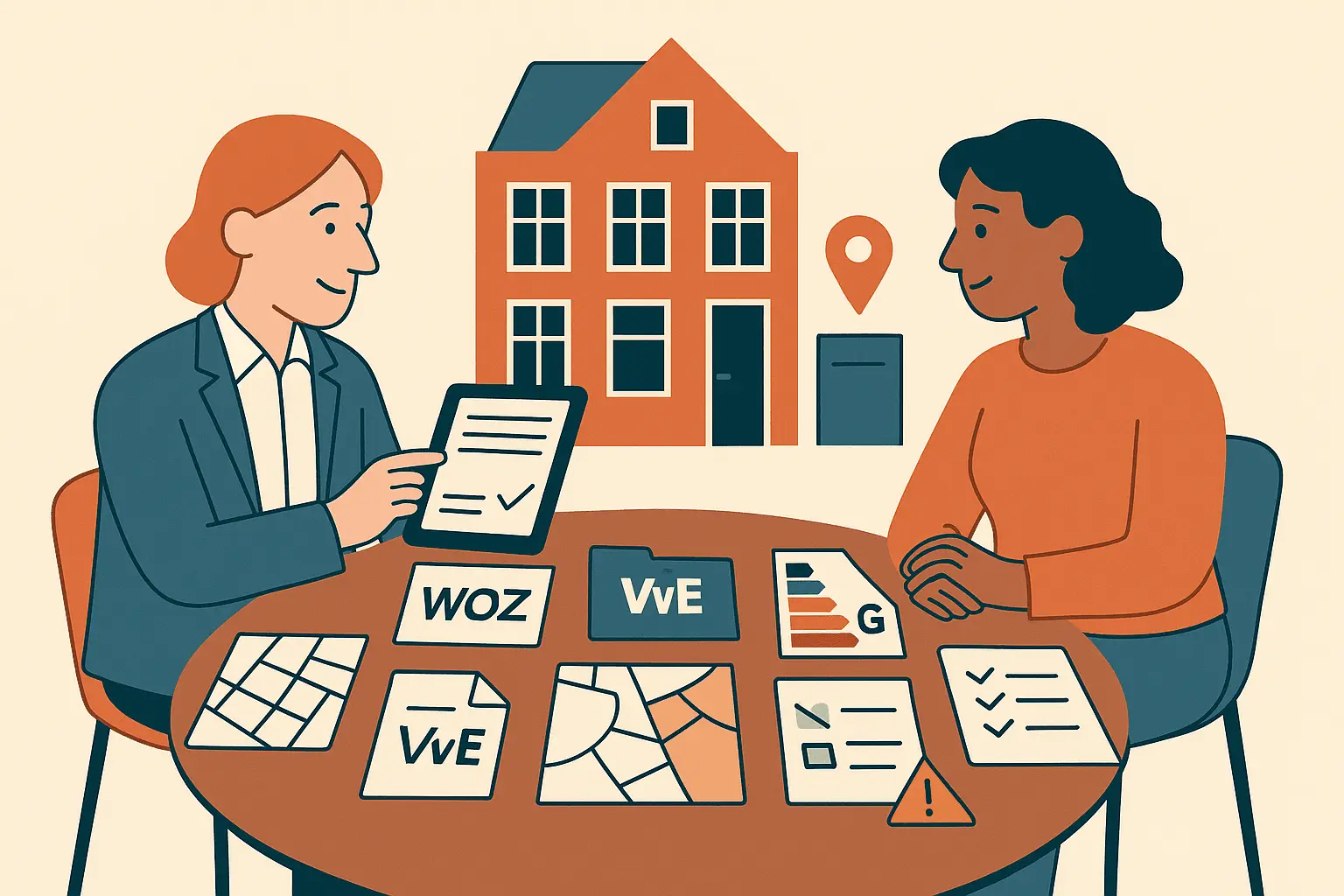
For many Dutch homes, buyers should expect at least part of the following document set before bidding. Names vary by agent and region, but these are the common terms.
General property documents
- Verkoopbrochure — sales brochure with asking price, photos, features, and basic information.
- Vragenlijst van de verkoper — seller questionnaire, often NVM or similar, with known defects, renovations, disputes, and usage information.
- Lijst van zaken — list of items included or excluded, such as curtains, appliances, flooring, garden items, or solar panels.
- Energielabel — energy label showing the home’s energy performance category.
- Meetrapport / NEN 2580 — measurement report supporting the listed living area, if available.
- Kadastrale informatie — Kadaster ownership and parcel information, including cadastral boundaries.
- Akte van levering / eigendomsbewijs — title deed or transfer deed, useful for restrictions, easements, leasehold, and special clauses.
Apartment documents
For an apartment, the VvE is often just as important as the apartment itself. VvE means Vereniging van Eigenaars, the owners’ association.
Ask for:
- Splitsingsakte — deed of division explaining the legal split of the building.
- Splitsingsreglement — rules for apartment owners.
- VvE notulen — minutes from recent VvE meetings.
- Jaarrekening — annual accounts.
- Begroting — current budget.
- MJOP — multi-year maintenance plan, if available.
- Servicekosten — monthly service charges.
- Reservefonds — maintenance reserve information.
- Huishoudelijk reglement — house rules, if applicable.
Leasehold documents
If the home is on erfpacht land, you need leasehold information before bidding.
Ask for:
- Current leasehold conditions.
- Annual canon or confirmation that canon has been prepaid or bought out.
- Applicable general provisions.
- End date or review moments, where relevant.
- Any correspondence about changes to the leasehold arrangement.
Leasehold can affect affordability, valuation, mortgage assessment, and resale. Ask a mortgage advisor, notary, or qualified professional if you are unsure.
Practical checklist: documents to request before bidding
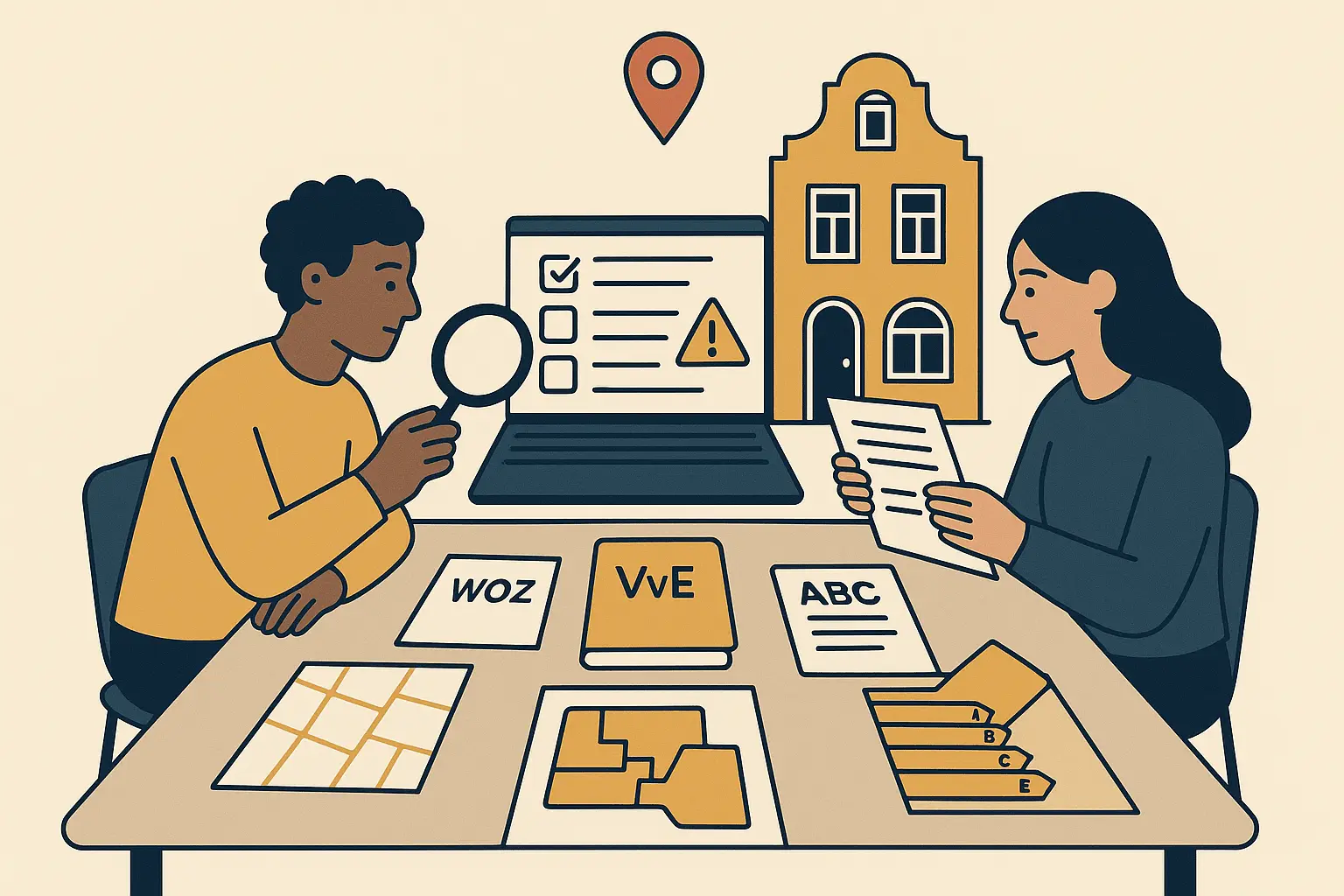
Use this checklist as a pre-bid document scan. You may not need every item, but each missing item should have an explanation.
For every property
- Sales brochure
- Seller questionnaire
- List of items included and excluded
- Energy label
- Kadaster ownership or parcel information
- Title deed or relevant deed clauses
- Measurement report or floor area explanation
- Information about known defects
- Information about renovations and maintenance
- Permits or approval for major works, if relevant
- Any building inspection report already available
- Any special clauses expected in the purchase contract
For apartments
- Splitsingsakte
- Splitsingsreglement
- Recent VvE meeting minutes
- VvE annual accounts
- VvE budget
- Service charge overview
- Maintenance reserve information
- MJOP or maintenance planning
- House rules
- Information about planned major works or disputes
For leasehold properties
- Erfpacht contract or conditions
- Canon amount or buyout/prepayment confirmation
- General provisions
- Review dates or end dates
- Any recent leasehold correspondence
For older or higher-risk properties
- Foundation information, if relevant for the area
- Asbestos information, especially for older homes
- Moisture, roof, or structural maintenance information
- Soil or contamination information, where relevant
- Monument or protected status information
- Renovation invoices, warranties, or technical reports
How to spot gaps and warning signs
Missing documents are not automatically a red flag. But patterns matter. Here are practical signs to watch for.
1. The brochure makes claims that documents do not support
Example: the brochure says “recently renovated,” but there are no invoices, permits, warranties, or explanation of what was done.
Ask:
- What exactly was renovated?
- Who carried out the work?
- Were permits needed?
- Are invoices or warranties available?
- Was the work done by the seller or a previous owner?
2. Apartment documents are incomplete or outdated
For apartments, weak VvE information can create real uncertainty. If you only receive the brochure and service charge amount, you do not yet know whether the building has enough reserves, planned maintenance, disputes, or upcoming cost increases.
Ask:
- When was the last VvE meeting?
- Are major works planned?
- Is there an MJOP?
- Are there known arrears or disputes?
- Are service charges expected to change?
3. Leasehold is mentioned but not explained
If the listing says erfpacht, do not bid as if it is the same as full ownership.
Ask:
- What is the current canon?
- Has the canon been prepaid or bought out?
- Until when?
- Which conditions apply?
- Could the canon change in the future?
4. The seller questionnaire has “unknown” too often
A seller may genuinely not know everything, especially with inherited property or a rented-out home. But repeated “unknown” answers increase uncertainty.
This is especially relevant when combined with a niet-zelfbewoningsclausule — a non-occupancy clause. This means the seller has not lived in the property and may not know the home as well as an owner-occupier.
5. Important pages or attachments are missing
Watch for PDFs with missing appendices, unsigned pages, old versions, or references to attachments that were not included.
Ask the agent for the complete file and name the missing attachment clearly.
6. Public data and sales documents do not match
If the brochure, Kadaster, BAG, energy label, or floor area information appears inconsistent, do not ignore it. Some differences have innocent explanations, but they should be checked before bidding.
Examples:
- Living area differs from public records.
- The parcel size does not match the garden impression.
- The energy label seems inconsistent with insulation claims.
- The property type or construction year differs between sources.
Dutch terms and data sources to know
When buying a house in the Netherlands, you will see Dutch terms that are not always translated. These are the main ones to understand.
Kadaster
The Dutch land registry. It contains ownership, parcel, and cadastral information. It may also point to deeds with easements or obligations.
BAG
The official register for addresses and buildings. It can include information such as building year, use function, and surface data.
Energielabel
The official energy label. Useful for comparing energy performance, but it does not replace a technical inspection.
Omgevingsplan / bestemmingsplan
Municipal planning rules. These may affect extensions, use, nearby development, or restrictions.
Erfpacht
Leasehold. You own the building or apartment right, but not necessarily the land. Conditions and payments can matter a lot.
Erfdienstbaarheid
Easement, such as a right of way for a neighbour or utility access.
VvE
Owners’ association for apartment buildings. The VvE manages shared parts such as the roof, façade, foundation, stairwell, and insurance.
MJOP
Multi-year maintenance plan. It helps show expected future maintenance and whether the VvE is planning for it.
WOZ-waarde
Municipal property value used for local taxes. It can be useful context, but it is not the same as market value or a valuation report.
How missing documents can affect your bid
A missing document does not always mean you should stop. It may mean you need to adjust your approach.
You might decide to:
- Ask for the missing documents before submitting a bid.
- Bid lower because of unresolved uncertainty.
- Include conditions, such as a building inspection or financing condition.
- Ask your buyer agent, mortgage advisor, notary, or legal professional to review specific risks.
- Delay your bid if the missing information is essential.
- Walk away if key risks cannot be clarified.
For example, missing VvE financial documents may affect how comfortable you are with an apartment bid. Missing leasehold information may affect affordability or mortgage assessment. Missing renovation permits may affect your view of quality, legality, and future resale.
The point is not to become negative about every missing PDF. The point is to avoid bidding as if uncertain information is already solved.
What Huisscan can help you check
Huisscan is built around one practical promise: Check a Dutch property before you bid.
With one Dutch address and the documents you have received, Huisscan can help turn scattered information into a clearer pre-bid report. Depending on what is available for the address and what you upload, Huisscan can help you:
- Review available Dutch property data.
- Compare listing information with public property signals.
- Identify document gaps for the property type.
- Analyse uploaded documents for relevant terms and risk signals.
- Highlight issues such as leasehold, VvE gaps, special clauses, area inconsistencies, or missing attachments.
- Generate buyer questions to send to the selling agent, your buyer agent, mortgage advisor, or notary.
- Organise the information into a practical Huisscan pre-bid report.
Huisscan does not replace a building inspector, appraiser, mortgage advisor, lawyer, or notary. It helps you prepare better questions and make a clearer pre-bid decision.
FAQ
Is it normal for documents to be missing before bidding?
Yes, sometimes. The file may still be in preparation, or certain documents may not exist for an older property. But if important documents are missing, ask why. The answer can affect your bid or conditions.
Which missing documents matter most for an apartment?
VvE documents are usually the most important: meeting minutes, annual accounts, budget, service charges, maintenance planning, and the splitsingsakte. Without them, it is harder to assess shared maintenance and financial obligations.
What if the agent says documents will come after my offer?
You can ask to receive them before bidding, bid with suitable conditions, or decide not to bid yet. If the missing information is important to your risk assessment, do not treat it as a minor detail.
Can missing documents affect my mortgage?
They can. Lenders and appraisers may need clarity on leasehold, VvE finances, property condition, valuation, or legal structure. Ask your mortgage advisor how missing information could affect your situation.
Should expat buyers rely on translated summaries?
Translated summaries are helpful, but the official documents are usually in Dutch. For important legal, financial, or technical points, ask a qualified professional to review the original wording.
Can Huisscan tell me whether to buy the property?
No. Huisscan helps you check the address, organise documents, flag missing items, and prepare better questions. The final decision is yours, ideally with support from the right professionals where needed.
Check the address before you bid.