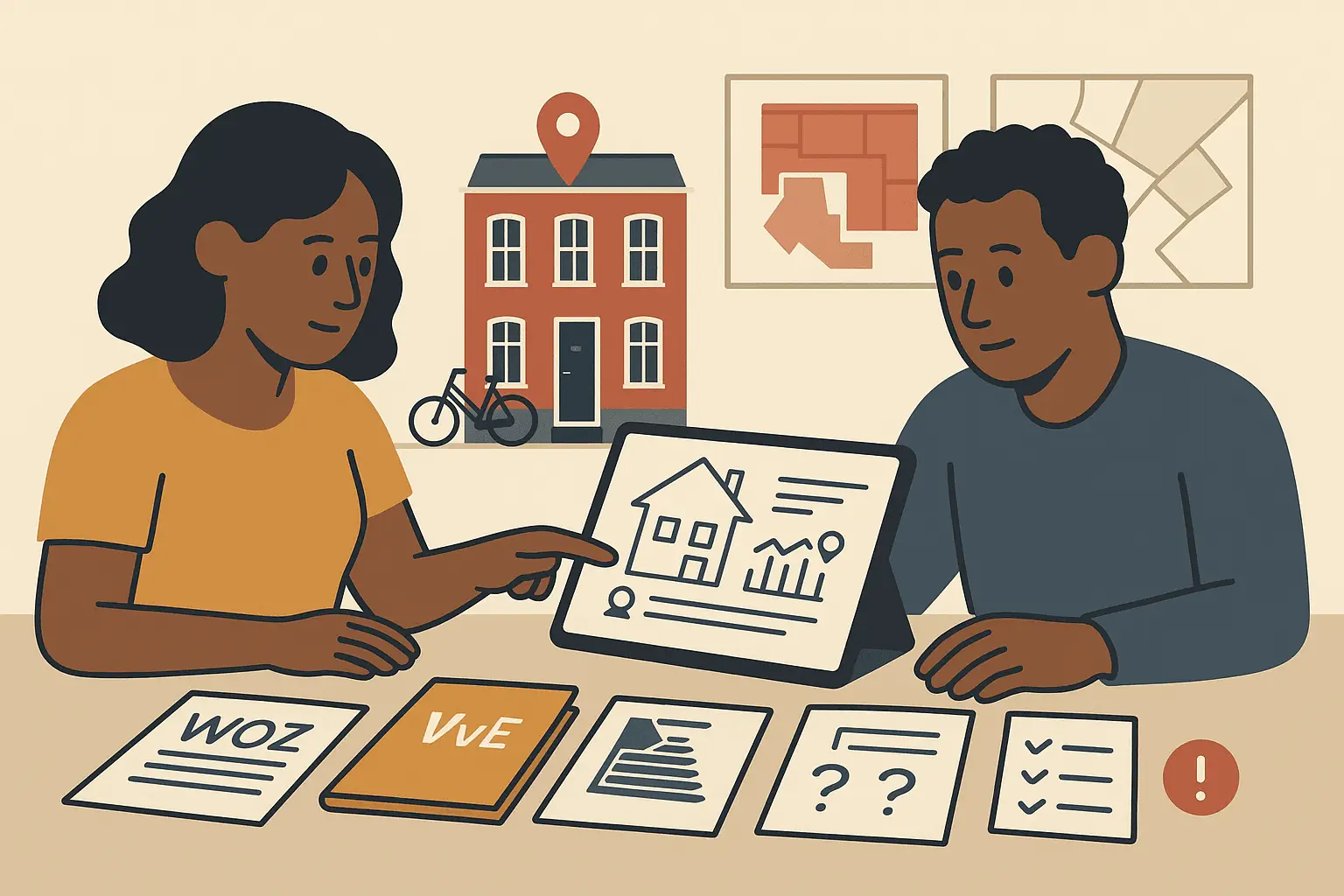
How expats can read Dutch sales documents

Buying a house in the Netherlands often means making a fast decision from documents that arrive in Dutch, under bidding pressure. For expats, a verkoopbrochure, vragenlijst, lijst van zaken or draft koopovereenkomst can feel like paperwork for later. It is not.
These Dutch sales documents can affect your offer price, your conditions, your renovation budget, your mortgage planning, and sometimes your decision to walk away. The goal is not to translate every word perfectly. The goal is to understand what matters before you bid.
Before you bid: check the address in Huisscan and upload the sales documents you received. Huisscan can turn one Dutch address into a clear pre-bid report with available property data, risk signals, document analysis, and buyer questions, so you can check a Dutch property before bidding.
Start with the decision, not the translation
When reading Dutch sales documents as an expat, use a decision lens:
- Does this property still fit my budget after likely costs?
- Are there risks I should price into my offer?
- Do I need a financing, building inspection, or document-related condition?
- Is something unclear enough that I should ask before bidding?
- Is there a reason to pause or walk away?
Separate the documents into four buckets:
Facts to verify
Address, size, plot, energy label, ownership, leasehold, VvE details.Seller statements
Answers about defects, renovations, nuisance, permits, leaks, disputes, or known issues.Contract terms and clauses
Conditions, transfer date, deposit, age clause, asbestos clause, non-occupancy clause.Missing or unclear information
Anything you need to ask the selling agent, your buyer agent, mortgage advisor, inspector, notary, or another qualified professional.
A machine translation can help with language, but it may miss the practical meaning of Dutch property terms. Your pre-bid question is always: what could this mean for price, conditions, or risk?
The Dutch sales documents you may receive
The document pack differs by property, seller, and selling agent. For apartments, there should usually be more VvE documents. For older houses, technical and environmental information may matter more.
| Dutch document or source | Plain English meaning | What to check before bidding |
|---|---|---|
| Verkoopbrochure / Funda listing | Sales brochure or listing | Marketing claims, asking price, stated living area, plot size, rooms, renovation claims, disclaimers. |
| Vragenlijst voor de verkoop | Seller questionnaire | Known defects, leaks, nuisance, renovations, asbestos, foundation, disputes, permits, soil, neighbours, VvE issues. |
| Lijst van zaken | List of items included/excluded | Curtains, appliances, flooring, lamps, garden items, solar panels, fitted furniture, items for takeover. |
| Energielabel | Registered energy label | Energy performance, insulation clues, possible improvement costs. |
| Meetrapport / NEN 2580 | Measurement report | Whether the stated living area is measured consistently; check storage, balconies, attic, basement, and external space separately. |
| Kadastrale gegevens | Land Registry information | Parcel, apartment right, boundaries, ownership structure, possible rights such as easements. |
| Draft koopovereenkomst | Draft purchase agreement | Conditions, clauses, deposit or bank guarantee, transfer date, responsibilities, included documents. |
| VvE documents | Homeowners’ association documents for apartments | Monthly service charges, reserves, maintenance plan, minutes, insurance, rules, planned works, disputes. |
| Technical or municipal documents | Building, soil, permit, zoning or environmental information | Renovation history, permit questions, soil signals, foundation concerns, protected status, future use restrictions. |
Useful Dutch property data sources can include the Kadaster for land and ownership data, BAG for address and building registration, the WOZ-waardeloket for municipal assessed value, the energielabelregister, and the Omgevingsloket or municipality for planning and permit context. These sources do not replace professional checks, but they help you ask better pre-bid questions.
Dutch terms and clauses expats should recognise
Some Dutch words appear often in sales documents. They are not all red flags, but they can change how you bid.
| Dutch term | Plain English meaning | Why it matters |
|---|---|---|
| Vraagprijs | Asking price | Not a valuation. Compare with data, condition, location, and risks. |
| Kosten koper / k.k. | Buyer pays certain transaction costs | Budget for buyer-side costs and check current rules with a qualified advisor. |
| Woonoppervlakte / gebruiksoppervlakte wonen | Living area | Important for price per square metre and comparison with other homes. |
| Ontbindende voorwaarden | Conditions that can allow cancellation | Financing or building inspection conditions are not automatic; they must be agreed. |
| Voorbehoud financiering | Financing condition | Relevant if your mortgage approval is not fully certain before bidding. |
| Voorbehoud bouwkundige keuring | Building inspection condition | Can help if technical risks are unclear before signing. |
| Waarborgsom / bankgarantie | Deposit or bank guarantee | Usually required after signing; check timing and amount with your advisor. |
| Leveringsdatum | Transfer date | Affects mortgage planning, rent overlap, renovation timing, and moving logistics. |
| Oplevering | Delivery condition | Check whether the home is delivered empty, furnished, cleaned, or with certain items. |
| Erfpacht / canon | Leasehold and ground rent | Common in some cities. Check the conditions, payment, revision moments, and buy-out status. |
| Appartementsrecht | Apartment right | You own a share in the building plus exclusive use of your apartment, under VvE rules. |
| VvE | Homeowners’ association | Important for maintenance, monthly costs, rules, reserves, and future contributions. |
| MJOP | Multi-year maintenance plan | Shows expected building works and estimated costs for an apartment building. |
| Reservefonds | Reserve fund | Indicates whether the VvE has money set aside for maintenance. |
| Ouderdomsclausule | Age clause | The seller points out that older homes have age-related risks. |
| Asbestclausule | Asbestos clause | Signals possible asbestos risk, especially in older properties. Ask what is known. |
| Niet-zelfbewoningsclausule | Non-occupancy clause | The seller has not lived there and may know less about defects. |
| Erfdienstbaarheid | Easement | Someone may have a right affecting use, access, pipes, paths, or land. |
| Kettingbeding | Chain clause | An obligation that passes to future owners. Ask what it requires. |
| Bestemmingsplan / omgevingsplan | Zoning or environmental plan | Affects allowed use, extensions, business use, or future development context. |
| Gebreken | Defects | Look for leaks, damp, cracks, foundation issues, pests, installations, and disputes. |
A clause does not automatically mean “do not buy”. It means: understand the risk, ask questions, and decide whether it affects your offer or conditions.
A practical way to read the documents before bidding
Use this method before you submit an offer.
1. Confirm the exact property
Check that the address, house number addition, apartment index, storage unit, parking space, garden, and plot match across the brochure, Kadaster information, floor plan, and draft contract.
For apartments, confirm whether storage and parking are separate apartment rights, exclusive use rights, rented spaces, or informal arrangements.
2. Compare the size and layout
Look at the meetrapport if available. Separate:
- living area;
- other indoor space;
- external storage;
- balcony or terrace;
- garden or plot size.
A small difference in square metres can affect price comparison. A larger difference should lead to questions before bidding.
3. Read the seller questionnaire carefully
Search for words such as:
- lekkage — leakage;
- vocht — damp or moisture;
- scheuren — cracks;
- fundering — foundation;
- asbest — asbestos;
- bodemverontreiniging — soil contamination;
- overlast — nuisance;
- buren — neighbours;
- verbouwing — renovation;
- vergunning — permit;
- gebreken — defects.
If the seller writes “unknown” many times, that is not always suspicious, but it does reduce certainty. A non-occupancy clause makes this especially relevant.
4. Follow the money
Ask which documents point to future costs:
- roof, façade, windows, foundation, damp, or installation work;
- low energy performance and insulation needs;
- VvE service charges and planned maintenance;
- leasehold payments;
- required repairs after inspection;
- renovation plans that need permits.
This helps you decide whether to lower your offer, add a condition, ask for documents, or stop.
5. Check use restrictions
Dutch property documents can contain rules that affect how you may use the home. Examples:
- VvE rules on flooring, pets, short-stay rental, balconies, or alterations;
- municipal rules on extensions, roof terraces, or business use;
- monument or protected area restrictions;
- leasehold conditions;
- easements or chain clauses.
If your plan depends on renovation, renting out, working from home, or changing the layout, check this before bidding.
6. Identify missing documents
Missing documents are common, especially when bidding deadlines are tight. Do not assume missing means fine.
For example, if you are buying an apartment and receive no recent VvE minutes, no annual accounts, and no maintenance plan, ask for them before bidding or discuss how to reflect that uncertainty in your offer.
7. Convert findings into bid decisions
For each issue, choose one response:
- Ask a question before bidding.
- Adjust the offer price.
- Add or strengthen a condition.
- Plan a professional inspection or review.
- Walk away if the uncertainty is too large.
This is the core of a pre-bid property check in the Netherlands: not collecting documents for the sake of it, but turning them into a clearer decision.
Red flags that can change your bid
A red flag does not always mean the property is bad. It means you should not ignore the issue before bidding.
| Signal | Why it matters | Possible pre-bid response |
|---|---|---|
| No complete VvE package for an apartment | You cannot judge maintenance, reserves, rules, or upcoming costs. | Ask for minutes, accounts, budget, MJOP, rules, and service charge details. |
| Many “unknown” answers in the seller questionnaire | The seller may not know the property well. | Ask follow-up questions and consider inspection or contract conditions. |
| Non-occupancy clause | The seller did not live in the home and may not confirm defects. | Treat seller statements with caution and gather independent information. |
| Leasehold unclear | Future ground rent or conditions can affect affordability and resale. | Ask for the leasehold deed, current payment, revision details, and buy-out status. |
| Living area differs between documents | Price comparison and expectations may be wrong. | Ask for the measurement report and clarify what is included. |
| Major VvE maintenance with limited reserves | Future contributions may rise. | Ask whether extra payments are expected and factor this into your bid. |
| Past leakage, damp, or cracks | Repairs may not be complete or structural causes may remain. | Ask for repair details, invoices, warranties, and inspection options. |
| Extension, dormer, roof terrace, or layout change without permit clarity | Legal or resale questions may arise. | Ask what permits exist and check with the municipality where needed. |
| Asbestos, foundation, or soil signals | Can affect renovation, safety, financing, or future costs. | Seek specialist advice before relying on assumptions. |
| Pressure to bid before key answers arrive | You may be taking avoidable risk. | Decide whether to bid lower, add conditions, or step back. |
Practical checklist: questions to ask before you bid
Use this checklist when reviewing Dutch sales documents as an expat.
Documents and data
- Do I have the brochure, seller questionnaire, list of items, energy label, measurement report, and draft purchase agreement?
- For an apartment, do I have the VvE minutes, annual accounts, budget, MJOP, rules, insurance information, and service charge details?
- Do the address, apartment right, storage, parking, garden, and plot match across the documents?
- Are any documents missing, old, unsigned, or unclear?
Price and size
- Is the living area supported by a measurement report?
- Are storage, balcony, basement, attic, and garden counted correctly?
- Does the condition of the home support the asking price?
- Are future maintenance or energy improvement costs likely?
Technical condition
- Are there mentions of leakage, damp, cracks, foundation issues, pests, roof problems, or outdated installations?
- Have renovations been done with clear invoices, warranties, or permits?
- Is a building inspection sensible before signing or as a condition?
Legal and use questions
- Is there leasehold, and do I understand the payment and conditions?
- Are there easements, chain clauses, or restrictions on use?
- Are extensions, dormers, roof terraces, or structural changes permitted?
- Is the home a monument or in a protected area?
- Do VvE rules affect my plans for flooring, pets, rental, renovation, or outdoor space?
Offer conditions
- Do I need a financing condition?
- Do I need a building inspection condition?
- Do I need more time or extra documents before making a strong offer?
- Which questions should be answered in writing before I bid?
- Which risks should affect my price, and which are too uncertain?
What Huisscan can help you check
Huisscan is designed around one practical promise: Check a Dutch property before you bid.
With one Dutch address, Huisscan can create a Huisscan pre-bid report using available Dutch property data, risk signals, and your uploaded sales documents. If you upload the brochure, seller questionnaire, VvE documents, draft contract, or other files, Huisscan can help turn them into a clearer pre-bid overview.
Huisscan can help you:
- understand Dutch property terms in plain English;
- organise uploaded documents by topic;
- compare document statements with available property data where possible;
- flag risk signals such as VvE issues, leasehold, measurement questions, energy performance, permit uncertainty, or technical clues;
- identify missing documents;
- generate practical buyer questions for the selling agent, buyer agent, mortgage advisor, inspector, notary, or other professional.
For example, if the seller questionnaire mentions old leakage and the VvE minutes mention roof maintenance, Huisscan can help you connect those points and ask better questions: when did the leakage occur, what caused it, was it repaired, who paid, and is more roof work expected?
Huisscan does not replace a notary, lawyer, appraiser, building inspector, mortgage advisor, or buyer agent. It helps you prepare before you bid, so your next conversation is more focused.
FAQ about Dutch sales documents for expats
Can I rely on an English translation of Dutch sales documents?
A translation is useful, but it is not enough on its own. Some Dutch property terms have practical or legal meaning that a direct translation may not explain. Use translation to understand the text, then check what each point means for price, risk, conditions, and follow-up questions.
Are Dutch sales documents binding before I bid?
The brochure and document pack help inform your bid, but the purchase agreement is where many terms are formally recorded. Be careful with the word voorlopige koopovereenkomst — “provisional” does not mean casual. Once signed, it can have legal consequences, subject to agreed conditions and applicable protections. Ask a qualified professional if you are unsure before signing.
Which documents matter most for an apartment?
For an apartment, the VvE documents are essential. Review the splitsingsakte, VvE rules, minutes, annual accounts, budget, service charges, reserve fund, insurance, and MJOP. These documents can reveal upcoming maintenance, restrictions, disputes, and future costs.
What should I do if documents are missing before the bidding deadline?
Ask for the missing documents in writing. If they are not available in time, decide whether to bid lower, include a relevant condition, seek professional advice, or walk away. Missing information increases uncertainty, especially for apartments, leasehold properties, older homes, or renovated homes.
Can Huisscan replace a buyer agent, inspector, mortgage advisor, or notary?
No. Huisscan supports pre-bid decision-making by turning an address and uploaded documents into a clearer report with available data, risk signals, document analysis, and buyer questions. It does not replace professional legal, building, valuation, mortgage, tax, or notarial advice.
Check the address before you bid.