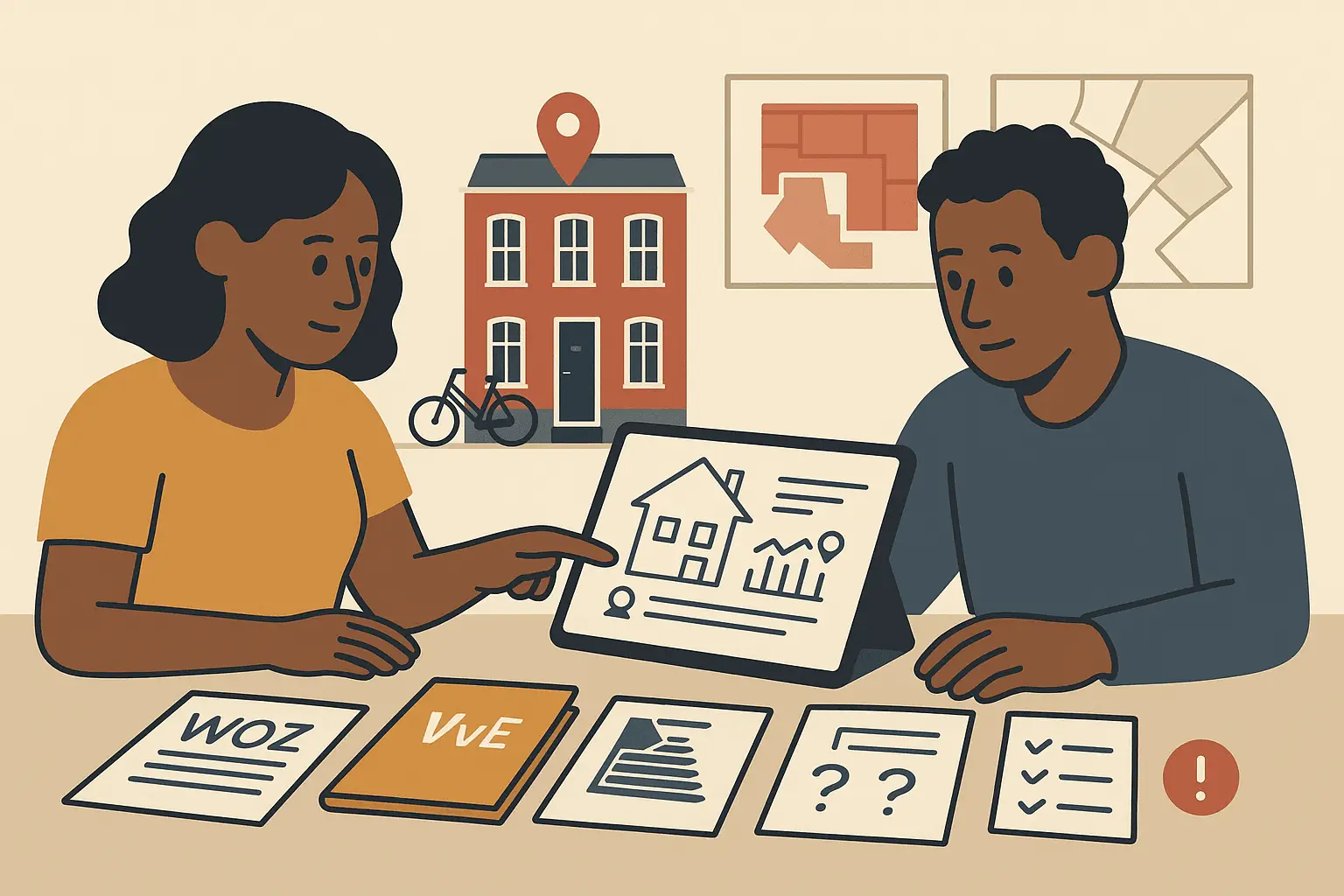
How to read a Dutch energy label before buying
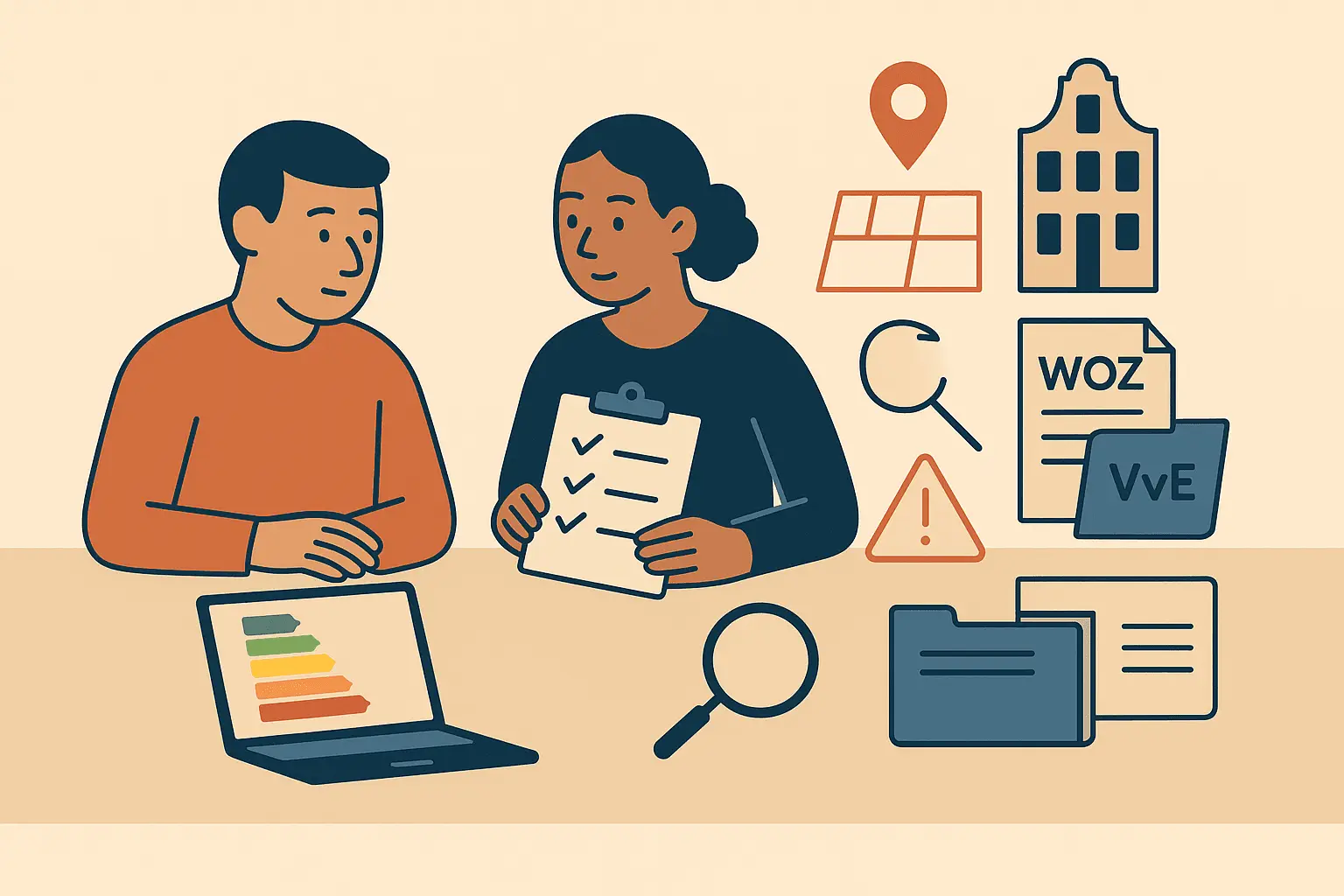
You find a Dutch home you like. The listing says energy label B, D, or maybe G. What does that mean for your bid?
Many buyers search for “energy label Netherlands house buying” because the label feels important, but it is easy to overread. A Dutch energy label is useful, but it is not a building inspection, renovation quote, mortgage assessment, or energy bill.
This guide explains how to use the label as a pre-bid signal: what to verify, what to ask, and when energy upgrades could affect your offer.
Before you decide what to bid, you can check the address with Huisscan. One Dutch address can become a clear pre-bid report with available property data, risk signals, document analysis, and better buyer questions. Check a Dutch property before you bid.
What a Dutch energy label tells you
A Dutch energy label, or energielabel, gives a standardised indication of a home’s energy performance. The scale generally runs from G at the least efficient end through A and A-labels with plus signs at the efficient end.
The label is mainly about the building and its installations, such as:
- roof, wall, floor, and window insulation;
- heating and hot water systems;
- ventilation;
- solar panels or other renewable systems;
- calculated energy performance per square metre.
For buyers, the label helps answer a practical question:
If I buy this property as it is, what level of energy performance and upgrade risk am I accepting?
A better label can suggest lower energy demand and better comfort, but it is not a guarantee. A lower label does not automatically mean “do not buy”. It means you should understand the likely upgrade path before you bid.
Where to find the EP-Online energy label
Do not rely only on the label shown in a property listing. Before bidding, try to verify the EP-Online energy label or ask the selling agent for the official energy label certificate.
Check:
- the exact address, postcode, and house number addition;
- whether the label belongs to the specific apartment or home you are buying;
- the registration date and validity information;
- whether the brochure, Funda listing, and official source show the same label;
- whether the seller can share the full certificate, not just the letter.
This matters especially for apartments. One building can contain homes with different positions, windows, floors, and heating setups. A label for a similar unit or the overall building is not always enough for your decision.
If the listing says label A but the official source or certificate shows something else, pause and ask for clarification before you bid.
How to read the label without overreading it
A Dutch energy label is a calculated performance indicator. It is not the same as the previous owner’s energy bill.
Actual energy use depends on things the label cannot fully capture, including household size, heating behaviour, working from home, comfort preferences, weather, and energy contracts.
Useful Dutch terms you may see:
| Dutch term | Plain English meaning | Why it matters before bidding |
|---|---|---|
| Energielabel | Energy label | The headline letter, such as A, C, or F |
| Registratiedatum | Registration date | Shows when the label was registered |
| Geldig tot | Valid until | Helps you check whether the label is still current |
| Gebruiksoppervlakte | Usable floor area | Affects the energy performance calculation |
| Isolatie | Insulation | Important for comfort and upgrade planning |
| Beglazing | Glazing / windows | Single, double, HR, or triple glazing can change upgrade needs |
| Installaties | Technical systems | Heating, hot water, ventilation, solar panels |
| Verbeteradvies | Improvement advice | Suggested measures, not a fixed renovation plan |
| VvE | Owners’ association | Important for apartment upgrades and shared decisions |
Read the label in this order:
- Confirm the address. Make sure it is the right property.
- Look at the label class. Use it as a first signal, not a final verdict.
- Check the date. Older labels may not reflect recent upgrades, or recent changes may not yet be registered.
- Review the systems. Heating, ventilation, hot water, and solar panels can affect comfort and maintenance.
- Compare with the seller documents. The label should make sense next to the brochure, questionnaire, inspection report, and VvE documents.
- Turn gaps into questions. A missing or unclear detail is a reason to ask, not to guess.
Example: a label E home may have recently received roof insulation, but if the label was not updated, the official score may not show it. Ask for invoices, photos, guarantees, or an updated assessment.
Another example: a label A home with solar panels may still require contract checks if the panels are leased or linked to a separate agreement.
Pre-bid energy signals that can affect your offer
The label becomes most useful when you connect it to upgrade risk. This is where a sustainability property check can help you prepare better questions.
| Pre-bid energy signal | Why it matters | Ask before you bid |
|---|---|---|
| Low label with little renovation evidence | Insulation, glazing, or heating upgrades may be needed | Which measures have already been done, and is there proof? |
| Older home with single glazing or limited insulation | Comfort and energy demand may be weaker than expected | What parts are insulated: roof, walls, floor, windows? |
| Gas boiler near the end of its service life | Replacement planning may affect your budget | How old is the system, and are maintenance records available? |
| Apartment with a VvE | Roof, façade, windows, and shared systems may require collective decisions | What does the MJOP say, and are energy works planned? |
| Monument or protected streetscape | Upgrades can be more restricted or require permits | Are there heritage or municipal limitations? |
| Solar panels, heat pump, or district heating | Ownership, maintenance, and contracts matter | Are systems owned, leased, shared, or tied to service agreements? |
| Listing and official label do not match | Your assumptions may be wrong | Can the agent provide the official certificate and explanation? |
| Good label but poor documentation | The label alone may hide practical questions | Which documents support the claimed performance? |
For a calm pre-bid decision, do not ask “Is this label good or bad?” Ask:
Does this home’s energy profile fit my bid, renovation budget, financing plan, and comfort expectations?
For mortgage or renovation financing questions, speak with a qualified mortgage advisor. Rules and lender policies can change.
Practical checklist before you bid
Use this checklist when buying a house and reviewing the energy label in the Netherlands:
- Verify the official energy label or ask for the full certificate.
- Match the label to the exact address and apartment number.
- Compare the label with the listing, brochure, and seller questionnaire.
- Check the registration date and validity information.
- Look for insulation details: roof, walls, floor, and glazing.
- Check heating, hot water, ventilation, and cooling systems.
- Ask whether solar panels are owned, leased, or shared.
- For apartments, review VvE minutes, the MJOP, reserves, and planned works.
- Check whether monument status or local rules could limit upgrades.
- Ask for recent energy usage only as context, not as a guarantee.
- If upgrades seem likely, get professional input or indicative quotes before relying on assumptions.
- Decide how the energy signals affect your maximum bid, conditions, and follow-up questions.
What Huisscan can help you check
Huisscan helps buyers turn one Dutch address into a clearer pre-bid picture. It can support your energy label review by combining available property data, risk signals, document analysis, and buyer questions in one report.
For energy-related decisions, Huisscan can help you look at:
- available energy label information and possible mismatches with listing claims;
- building age, property type, and other context that may affect upgrade risk;
- seller documents, brochures, questionnaires, inspection files, and VvE documents;
- signals around insulation, heating systems, solar panels, and shared building responsibilities;
- practical questions to ask the selling agent, inspector, mortgage advisor, or VvE.
Huisscan is decision support. It does not replace a certified energy adviser, building inspector, appraiser, mortgage advisor, lawyer, notary, or other qualified professional.
Official sources and documents to verify
Useful sources and documents include:
- EP-Online for registered energy performance data.
- Energielabel.nl for general Dutch energy label information.
- RVO information on energy labels for homes for official government guidance.
- Milieu Centraal for practical information about insulation and energy-saving measures.
- BAG Viewer for basic address and building data.
- Omgevingsloket rules on the map or the municipality for local restrictions, permits, and protected status.
- The seller’s documents, including the questionnaire, technical reports, invoices, guarantees, and VvE documents where relevant.
Use these sources to verify your assumptions before making an offer.
FAQ
Is an energy label mandatory when buying a house in the Netherlands?
In most residential sales, the seller is expected to provide a valid energy label. Some exceptions can apply, so check the current rules or ask a qualified professional if the property has no label.
For your bid, the key point is simple: if the label is missing, unclear, or inconsistent, ask why before you make assumptions.
Is a Dutch energy label the same as an energy bill?
No. The label is based on a standardised calculation of the property’s energy performance. An energy bill reflects how previous occupants used the home, their energy contract, household size, and behaviour.
Both can be useful, but neither is a complete prediction of your future costs.
What is a good energy label when buying a Dutch home?
There is no single “safe” label for every buyer. A high label can be attractive, but you still need to check systems, documents, and ownership of installations. A lower label may be acceptable if the price, renovation plan, and financing fit your situation.
The better question is whether the label matches your budget, comfort expectations, and upgrade appetite.
Can I use the label to estimate renovation costs?
Only as a first signal. The label may suggest possible improvements, but it does not give a full renovation scope, technical diagnosis, or fixed budget.
For major upgrades, speak with a building inspector, contractor, energy adviser, or other qualified professional before relying on cost assumptions.
What should I check for an apartment with a VvE?
Check whether energy upgrades depend on the owners’ association. Roof insulation, façade work, window replacement, shared heating, and ventilation can require VvE decisions.
Review the MJOP, meeting minutes, reserve position, planned works, and any special contributions or loans. If the apartment has a good label, still check whether shared systems have upcoming maintenance.
Can the energy label affect my mortgage?
Energy performance and sustainability upgrades can be relevant to mortgage discussions, but lender rules and government policy can change. Ask a qualified mortgage advisor how the property’s label, planned upgrades, and your personal situation may affect financing options.
Check the address before you bid.