
Buying in Utrecht: pre-bid checklist
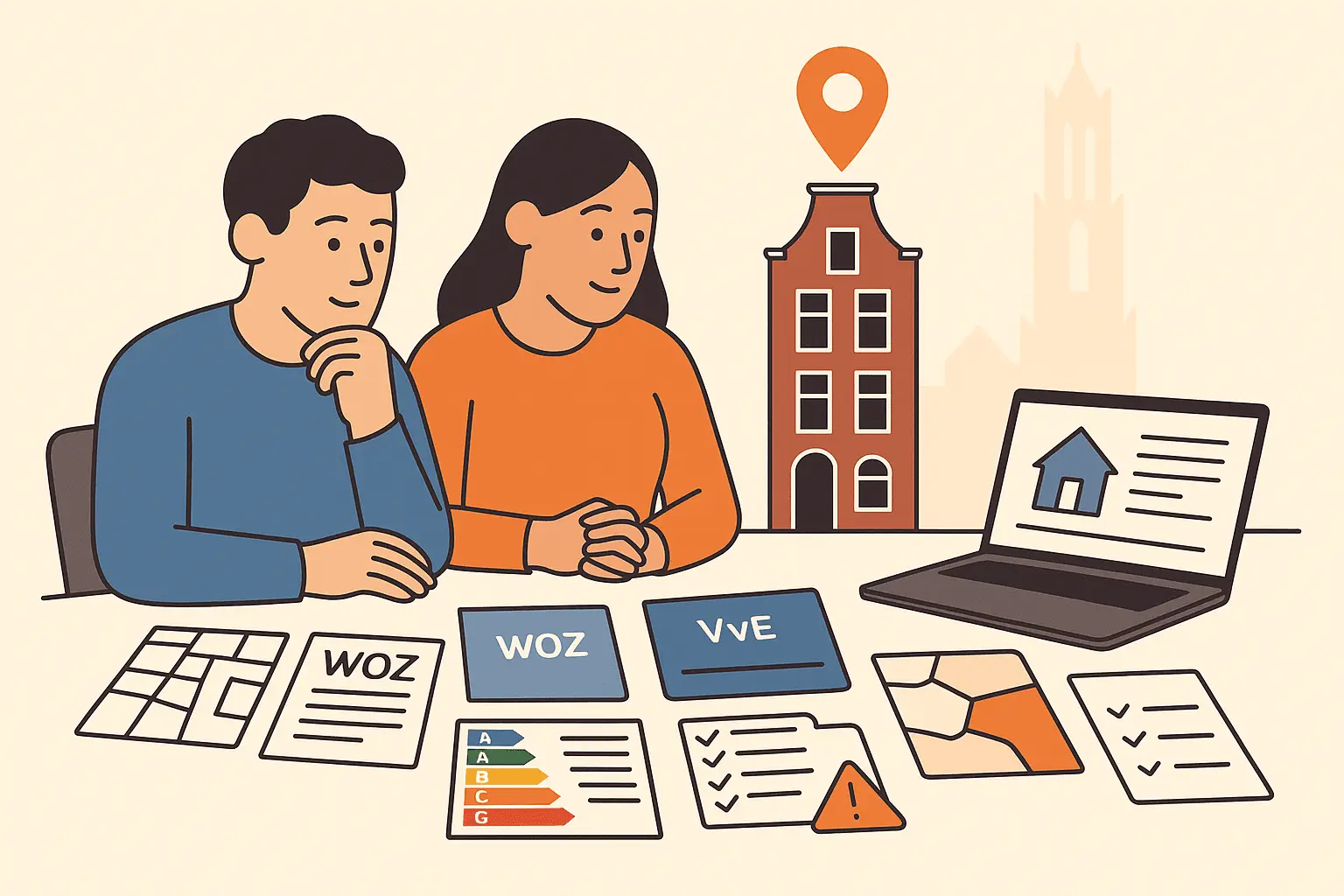
Buying in Utrecht can move quickly. After a viewing, you may need to decide whether the asking price makes sense, which conditions to include, and what questions are still unanswered.
The risk is that two Utrecht homes with similar photos can have very different realities: an older canal-area apartment, a 1930s family house, a post-war flat, and a newer Leidsche Rijn home each need different checks.
This buying house Utrecht checklist helps you make one clearer decision before bidding: bid, adjust your price, add conditions, ask more questions, or walk away.
Already have a Utrecht address in mind? Huisscan can turn one Dutch address and uploaded documents into a clear pre-bid report with available property data, risk signals, document analysis, and better buyer questions. Check a Dutch property before you bid.
Why Utrecht needs an address-specific pre-bid check
When buying a house in the Netherlands, you are not just buying a neighbourhood. You are buying a specific property, ownership situation, maintenance history, energy profile, and set of obligations.
In Utrecht, those details can vary street by street. A home near the city centre may involve older construction, protected status, cellar moisture, or renovation restrictions. An apartment may depend heavily on the health of the VvE — the owners’ association. A newer home may still have important checks around heating systems, parking rights, shared areas, or energy performance.
A good pre-bid property check in the Netherlands should help answer:
- What am I actually buying?
- Which risks could affect my costs after transfer?
- Which documents are missing or unclear?
- Should I bid lower, add conditions, or pause?
- Which questions should I ask the selling agent before making an offer?
Buying house Utrecht checklist: what to check before you bid
Use this practical checklist before you submit an offer.
- Confirm the basic property facts
Check address, living area, plot or apartment right, construction year, energy label, and whether the listing matches official Dutch property data. - Understand the ownership situation
Is it full ownership, apartment right, leasehold (erfpacht), or subject to easements or restrictions? - Check the documents, not only the brochure
The sales brochure is useful, but the key details are often in the questionnaire, title deed, VvE documents, measurement report, and clauses. - Review the VvE if it is an apartment
Look at service costs, reserve fund, maintenance plan, meeting minutes, insurance, and planned repairs. - Look for maintenance and renovation risks
Roof, façade, windows, damp, cracks, old installations, insulation, asbestos risk, and possible lead pipes can all affect your bid. - Check location-specific issues
Noise, rail lines, busy roads, parking, future development, soil information, flood or water risk, and protected status can matter. - Estimate the total cost, not only the purchase price
Include buyer costs, mortgage-related costs, possible renovations, energy improvements, VvE contributions, and moving costs. Check current rules with a qualified adviser. - Decide your offer conditions
Consider whether you need a financing condition, appraisal-related caution, building inspection condition, or document review before going unconditional. - Write down your top buyer questions
If the answer could change your bid, ask before bidding. - Know your walk-away points
Examples: unclear ownership, missing VvE documents, major defects you cannot price, or a seller refusing reasonable checks.
Property data and public sources worth checking
Dutch property data is spread across several sources. None of them tells the full story alone, but together they help you ask better questions.
| Source | What it can show | Why it matters before bidding |
|---|---|---|
| BAG — Basisregistratie Adressen en Gebouwen | Official address, building year, use function, registered surface data | Helps check whether the listing basics make sense |
| Kadaster | Cadastral map, plot, apartment right, ownership registrations, title information | Helps clarify what is legally registered |
| Energy label register | Registered energy label | Gives a first view of energy performance, but not exact future costs |
| WOZ-waardeloket | Municipal tax valuation | Useful reference point, but not the same as market value |
| Omgevingsloket / omgevingsplan | Planning rules, land use, permits, restrictions | Important for extensions, use, redevelopment, or protected areas |
| Municipal and environmental sources | Soil information, monuments, local restrictions, public space plans | Can reveal issues not visible during a viewing |
| Seller documents | Known defects, movable items, VvE details, clauses | Often the most practical source for pre-bid questions |
If data sources conflict, do not assume the best version is correct. Treat the difference as a question for the selling agent, your buyer agent, or another qualified professional.
Documents and Dutch terms to understand before an offer
Ask for the relevant documents as early as possible. For a house, you usually want more than the brochure. For an apartment, VvE documents are essential.
Important documents can include:
- Sales brochure
- NEN 2580 meetrapport — measurement report for living area
- Vragenlijst — seller questionnaire about the property
- Lijst van zaken — list of items included or excluded
- Eigendomsbewijs / akte van levering — title deed or deed of transfer
- Cadastral information
- Energy label
- Building inspection report, if available
- Permit information for extensions, dormers, roof terraces, or major alterations
- VvE documents for apartments
- Leasehold documents if erfpacht applies
Useful Dutch terms in plain English:
| Dutch term | Plain English meaning | Pre-bid question |
|---|---|---|
| VvE | Owners’ association for an apartment building | Is the VvE financially healthy and actively maintained? |
| Splitsingsakte | Deed dividing the building into apartment rights | What exactly belongs to the apartment, and what is shared? |
| MJOP | Multi-year maintenance plan | Which major repairs are planned, and who pays? |
| Erfpacht | Leasehold: you own the building right but not always the land | What are the costs, terms, and future obligations? |
| Ouderdomsclausule | Old-age clause for older properties | Does the seller limit responsibility for age-related defects? |
| Asbestclausule | Clause about possible asbestos | Is inspection needed before you price renovations? |
| Niet-bewoningsclausule | Non-occupancy clause: seller has not lived there | What does the seller actually know about the property? |
| Financieringsvoorbehoud | Financing condition | What happens if your mortgage is not approved? |
| Bouwkundige keuring | Building inspection | Should your bid depend on an inspection outcome? |
| Onderzoeksplicht | Buyer’s duty to investigate | What should you check before relying on the seller’s information? |
These terms can affect risk and negotiation. They do not automatically mean you should not bid, but they may change your price, conditions, or follow-up questions.
Utrecht-specific risks that can change your offer
A risk signal is not automatically a reason to stop. It is a reason to understand, price, condition, or investigate.
Historic centre and older buildings
In and around the historic centre, check for older construction, damp, cellar issues, protected façades, monument status, and renovation restrictions. If there is a cellar or wharf-related structure, ask who owns and maintains it.
Foundation, settlement, and structural movement
Not every Utrecht home has foundation problems, but older homes can show cracks, sloping floors, or signs of movement. If you see structural clues, consider a building inspection before bidding or include a condition if possible.
Apartments and VvE obligations
For apartments, the building’s financial health matters as much as the apartment itself. A low reserve fund, missing maintenance plan, or upcoming roof/façade work can affect your future costs.
Energy performance and heating systems
An energy label gives a first indication, not a full cost forecast. Check insulation, glazing, ventilation, heating type, service contracts, and whether upgrades are realistic for the building.
Noise, rail, roads, and future development
Visit the area at different times if you can. Check rail lines, major roads, nightlife, schools, construction plans, and parking pressure. Future development can be positive or negative depending on your situation.
Soil, water, asbestos, and old materials
Older Dutch properties may involve asbestos risk, old pipes, damp, or soil questions. These are common property risks Netherlands buyers should check calmly and specifically, especially before renovating.
Permits and actual use
Extensions, dormers, roof terraces, converted spaces, or rental use should match the permitted situation. If a feature adds value to the asking price, verify that it is properly documented.
How to turn the check into a bid decision
The goal is not to collect endless information. The goal is to make a better pre-bid decision.
Use four simple categories:
| Finding | Possible impact on your bid |
|---|---|
| Facts match, documents complete, no major concerns | You may feel more comfortable bidding within your budget |
| Maintenance or energy upgrades are likely | Adjust your bid or reserve extra cash |
| VvE or ownership information is unclear | Ask questions before bidding or include conditions |
| Serious issues cannot be priced | Consider pausing or walking away |
| Financing or appraisal risk is high | Discuss your maximum bid with your mortgage adviser |
Example: if a Utrecht apartment has attractive photos but the VvE minutes mention upcoming façade repairs, that does not automatically make it a bad purchase. But you should understand the likely contribution, whether it is already funded, and whether your bid still makes sense.
Example: if an older house includes an ouderdomsclausule and visible damp, you may want a building inspection, a lower bid, or both.
What Huisscan can help you check
Huisscan is designed for buyers who want to check Dutch property before bidding, using one address and the documents they already have.
A Huisscan pre-bid report can help you:
- Structure available Dutch property data for the address
- Highlight risk signals relevant to Dutch homes and the Utrecht context
- Review uploaded documents such as the brochure, questionnaire, VvE files, title deed, or clauses
- Identify missing information or inconsistencies
- Explain Dutch property terms in clearer language
- Generate practical buyer questions for the selling agent, buyer agent, mortgage adviser, inspector, or notary
- Decide what needs professional follow-up before you bid
Huisscan supports decision-making. It does not replace a notary, lawyer, appraiser, building inspector, mortgage adviser, or buyer agent. It helps you arrive better prepared.
For buyers, expats, mortgage advisers, and buyer agents, it can be a practical pre-bid property check Netherlands workflow: one address, relevant documents, clearer risks, and better questions.
FAQ
What should I check first before bidding on a house in Utrecht?
Start with the basics: property facts, ownership situation, living area, energy label, documents, and visible maintenance risks. If it is an apartment, check the VvE early. If the property is older, check clauses, damp, structural signs, and renovation history.
Is buying in Utrecht different from buying elsewhere in the Netherlands?
The legal process is broadly Dutch, but Utrecht has local property patterns. You may encounter older city homes, apartments with active VvEs, protected buildings, parking pressure, rail or road noise, and fast-moving bidding situations. That makes an address-specific check important.
Which documents matter most for an apartment in Utrecht?
For an apartment, request the splitsingsakte, VvE regulations, recent meeting minutes, annual accounts, budget, reserve fund information, insurance, service costs, and the MJOP. These documents help you understand shared maintenance and future obligations.
Should I bid without a building inspection condition?
That depends on the property, competition, your risk tolerance, and professional advice. For older homes, visible defects, damp, cracks, or unclear renovation history, a building inspection can be important. If you choose not to include a condition, make sure you understand what risk you are accepting.
Can Huisscan tell me exactly what to bid?
No. Your bid depends on budget, financing, risk tolerance, competition, and advice from qualified professionals. Huisscan helps you understand the address, documents, risk signals, and buyer questions so your bid decision is better informed.
What should expats watch for when buying a house in the Netherlands?
Expats should pay extra attention to Dutch terms, offer conditions, VvE obligations, leasehold, clauses, financing assumptions, and documents that may not be translated. If a document affects your decision, ask for clarification before bidding.
Check the address before you bid.


