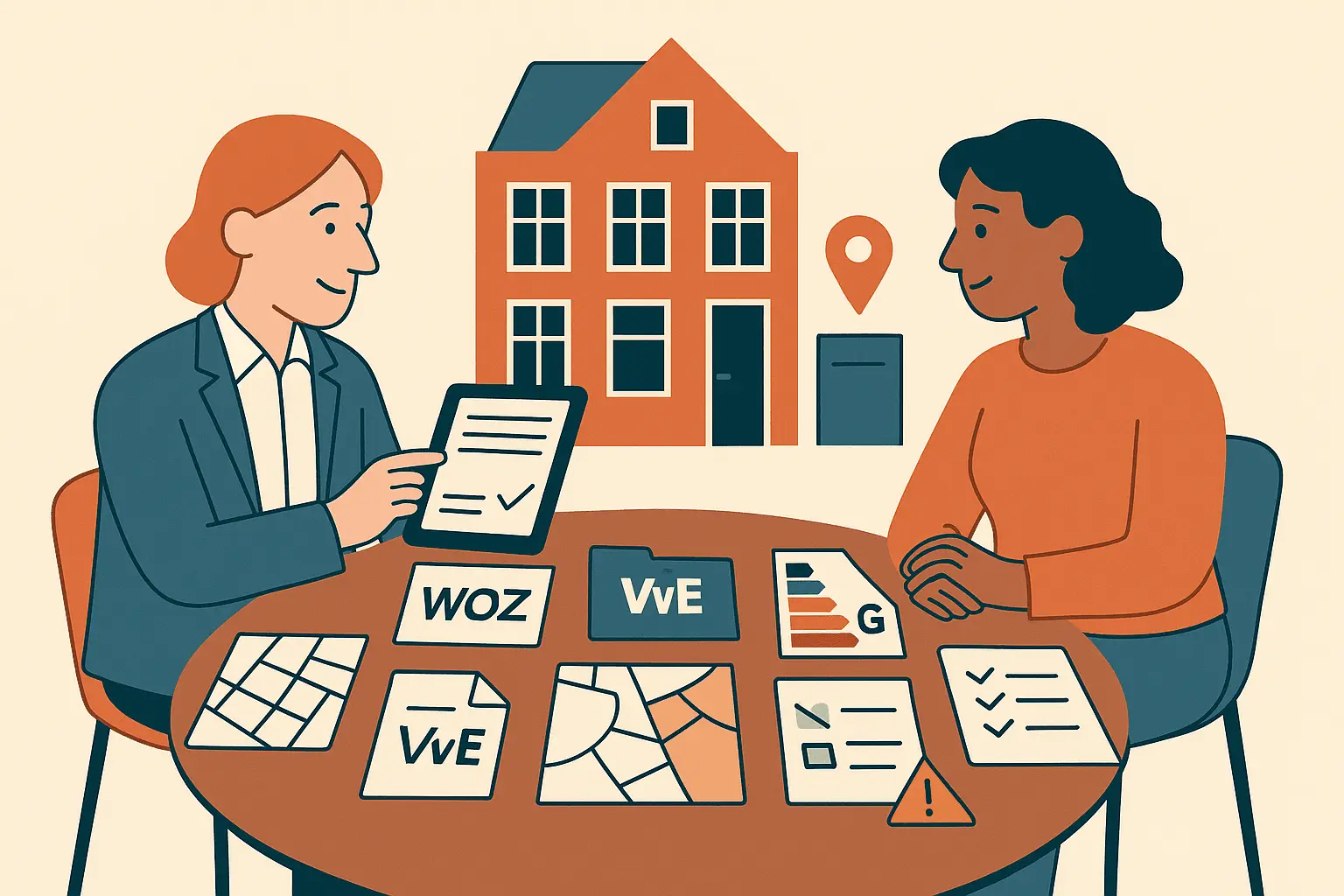
Buying in Delft: pre-bid checklist

Buying in Delft can move quickly, especially when a well-located apartment, canal house, or family home comes onto the market. The problem is not only “Can I afford it?” but also: “What do I know about this specific address before I bid?”
Use this buying house Delft checklist to check the property, the documents, the location risks, and the Dutch terms that can affect your offer. The goal is simple: Check a Dutch property before you bid — then decide whether to bid, adjust your price, add conditions, or walk away.
Looking at a specific Delft address? Huisscan can turn one Dutch address and uploaded documents into a clear pre-bid report with available property data, risk signals, document analysis, and practical buyer questions.
Why Delft needs a local pre-bid check
Delft is compact, but the property types vary a lot. A historic home near the canals has a different risk profile from a post-war apartment, a renovated student-area property, or a family house in Tanthof or Wippolder.
Before bidding, pay attention to:
- Older buildings and maintenance history in and around the historic centre.
- Apartments with a VvE — the homeowners’ association — where future maintenance costs can matter as much as the purchase price.
- Water, soil, and foundation signals, especially for older properties or homes near canals.
- Noise and access near rail, tram routes, busy roads, or the A13.
- Planning rules such as the omgevingsplan — zoning and permitted use.
- Monument or protected cityscape status, which can limit renovations.
In the Netherlands, buyers have an onderzoeksplicht — a duty to investigate. Sellers also have a mededelingsplicht — a duty to disclose known issues. Your job before bidding is to make the unknowns smaller.
Delft checks that can affect your bid
Some checks are not just “nice to know”. They can change your price, your conditions, or your decision to walk away.
| Check | Why it matters in Delft | Possible pre-bid decision |
|---|---|---|
| Older or historic property | May involve ageing roofs, damp, settlement cracks, outdated installations, or renovation limits | Ask for a building inspection, lower your bid, or add a condition |
| Canal-side or low-lying location | Water, moisture, and foundation questions can be more relevant | Ask about past issues and consider specialist advice |
| Monument or protected area | Renovations, windows, insulation, solar panels, or exterior changes may need permission | Check restrictions before assuming you can renovate |
| VvE apartment | A weak VvE, low reserves, or upcoming major works can create extra costs | Review VvE documents before bidding |
| Energy label and insulation | Older Delft homes may need investment to improve comfort and energy use | Include realistic renovation costs in your budget |
| Soil and environmental history | Former industrial, garage, or workshop use can be relevant in Dutch cities | Check public environmental information and ask questions |
| Noise, parking, and access | Station, tram, busy roads, and permit parking can affect daily life | Visit at different times and check municipal parking rules |
| Future development nearby | Construction or planning changes can affect view, light, noise, and value | Check the omgevingsplan and municipal project information |
Dutch documents and terms to understand before you offer
When buying a house in the Netherlands, the documents often tell you where the real questions are. For Delft buyers and expats, these are the key terms to know:
- Vragenlijst: the seller’s questionnaire. Look for leaks, defects, disputes, renovations, permits, and past damage.
- Lijst van zaken: list of items included or excluded, such as flooring, curtains, appliances, or garden items.
- Eigendomsinformatie / akte van levering: ownership information and previous transfer deed. Check clauses, rights of way, and special obligations.
- Kadastrale gegevens: Kadaster registration, parcel information, apartment rights, and boundaries.
- Splitsingsakte: deed of division for apartments. This explains which parts are private, shared, and how costs are divided.
- VvE stukken: VvE documents, including minutes, annual accounts, reserve fund, monthly contribution, and MJOP — long-term maintenance plan.
- Energielabel: energy label. Useful, but also ask what has actually been insulated or upgraded.
- Ouderdomsclausule: age clause, common for older homes. It can shift more risk to the buyer for age-related defects.
- Asbestclausule: asbestos clause, often relevant for older buildings.
- Niet-bewoningsclausule: non-occupancy clause. The seller may not have lived in the property and may know less about defects.
- Omgevingsplan: zoning and permitted-use rules. Check whether your intended use or renovation plans fit.
These documents do not replace professional advice, but they help you ask better questions before your offer becomes serious.
Practical buying house Delft checklist
Use this as a pre-bid property check Netherlands buyers can repeat for any address, with extra attention to Delft’s older housing stock, apartments, water context, and planning rules.
1. Confirm the property basics
- Check the address, floor area, plot or apartment right, and year of construction.
- Compare the brochure with public Dutch property data such as BAG, Kadaster, WOZ context, and energy label where available.
- Check whether the property is freehold, leasehold, or subject to special rights.
- For apartments, confirm exactly what is private and what belongs to the VvE.
2. Check building condition signals
- Look for cracks, damp, roof condition, window frames, ventilation, and old installations.
- Ask about foundation investigations, settlement, leaks, sewer issues, and structural repairs.
- Check whether renovations were done with permits and invoices.
- For older homes, ask whether asbestos may be present.
- Decide whether a bouwkundige keuring — building inspection — should be a condition in your offer.
3. Review the VvE if it is an apartment
- Read the MJOP and check planned maintenance.
- Review annual accounts, reserves, insurance, and meeting minutes.
- Ask whether major works are planned, such as roof, façade, lift, balconies, or sustainability upgrades.
- Check monthly service charges and whether increases are expected.
- Look for disputes, arrears, or delayed maintenance.
4. Check Delft location risks
- Visit the street during the day, evening, and commuting times.
- Check noise from rail, tram, traffic, nightlife, or student activity.
- Check parking rules and permit availability with the municipality.
- Review flood, heavy-rain, heat, and water information through Dutch public sources such as the water authority and climate maps.
- Check soil and environmental information where relevant.
- Review nearby development or zoning plans through the omgevingsplan.
5. Link risks to your offer strategy
- Decide your maximum price before the bidding deadline.
- Include renovation and maintenance costs, not only the purchase price.
- Discuss financing risk with your mortgage advisor, especially if bidding above comparable sales.
- Consider conditions such as financing, valuation, building inspection, or document review.
- Decide in advance what would make you walk away.
Questions to ask the selling agent before bidding
Ask specific questions. If an answer matters to your decision, ask for it in writing and discuss it with your advisor where needed.
Useful questions for Delft properties:
- Are there known issues with damp, leaks, cracks, foundations, roof, sewer, or façade?
- Have renovations been done? Were permits required and are invoices or guarantees available?
- Is the property a municipal monument, national monument, or in a protected cityscape?
- Which clauses will be included in the purchase agreement, such as age, asbestos, or non-occupancy clauses?
- Has the seller lived in the property? If not, what does the seller actually know about its condition?
- For apartments: are major VvE works planned and will monthly contributions increase?
- Are there disputes with neighbours, the VvE, the municipality, or contractors?
- Are there restrictions on renting, room rental, short stay, or home office use?
- Are there current or expected works nearby that could affect access, noise, or view?
- Which documents are missing, and why?
Good answers do not guarantee a problem-free purchase. But unclear, missing, or evasive answers can be a signal to slow down.
What Huisscan can help you check
Huisscan is designed for one practical moment: you have found a Dutch property and need a clearer view before bidding.
With one Delft address, and any documents you upload, a Huisscan pre-bid report can help you organise:
- Available Dutch property data: address facts, building context, public data points, and document-based information.
- Risk signals: items that may deserve extra attention, such as age, VvE, surroundings, legal clauses, or missing information.
- Document analysis: review of uploaded documents such as the brochure, vragenlijst, VvE documents, deed information, and clauses.
- Buyer questions: practical questions to ask the selling agent, VvE, mortgage advisor, buyer agent, inspector, or notary.
- Decision support: whether to request more documents, adjust your bid, add conditions, or pause.
Huisscan helps you check Dutch property before bidding, but it does not replace a building inspector, appraiser, mortgage advisor, lawyer, notary, tax advisor, or buyer agent. It gives you a clearer pre-bid starting point.
FAQ
Is Delft a risky place to buy a house?
Not automatically. Delft has attractive neighbourhoods and many solid homes. The risk depends on the exact address, building age, maintenance history, VvE situation, surroundings, and documents. Treat each property as its own case.
What should expats check before buying in Delft?
Expats should pay extra attention to Dutch terms, VvE documents, financing conditions, valuation risk, ownership structure, clauses in the purchase agreement, and local rules for renovation or use. If you are not fluent in Dutch, have key documents explained before you bid.
Should I always include a building inspection condition?
Not always, but it is often worth considering for older homes, visibly renovated properties, canal-side buildings, or houses with unclear maintenance history. Discuss the wording and consequences of any condition with a qualified professional.
How important is the VvE for a Delft apartment?
Very important. A low monthly contribution is not always positive if the VvE has weak reserves or postponed maintenance. Review the MJOP, meeting minutes, accounts, and upcoming decisions before deciding your bid.
Which public sources are useful for a Delft pre-bid check?
Useful sources can include Kadaster, BAG, WOZ information, the energy label register, Omgevingsloket, municipal information, Bodemloket, climate and water maps, and VvE documents. Huisscan helps bring available property data and document signals into one clearer report.
Can Huisscan tell me the right bid price?
Huisscan can help you understand property risks, missing information, and useful buyer questions. It is not a formal valuation. For price strategy, combine the report with advice from your buyer agent, appraiser, and mortgage advisor.
Check the address before you bid.