Buying a terraced house: pre-bid checklist
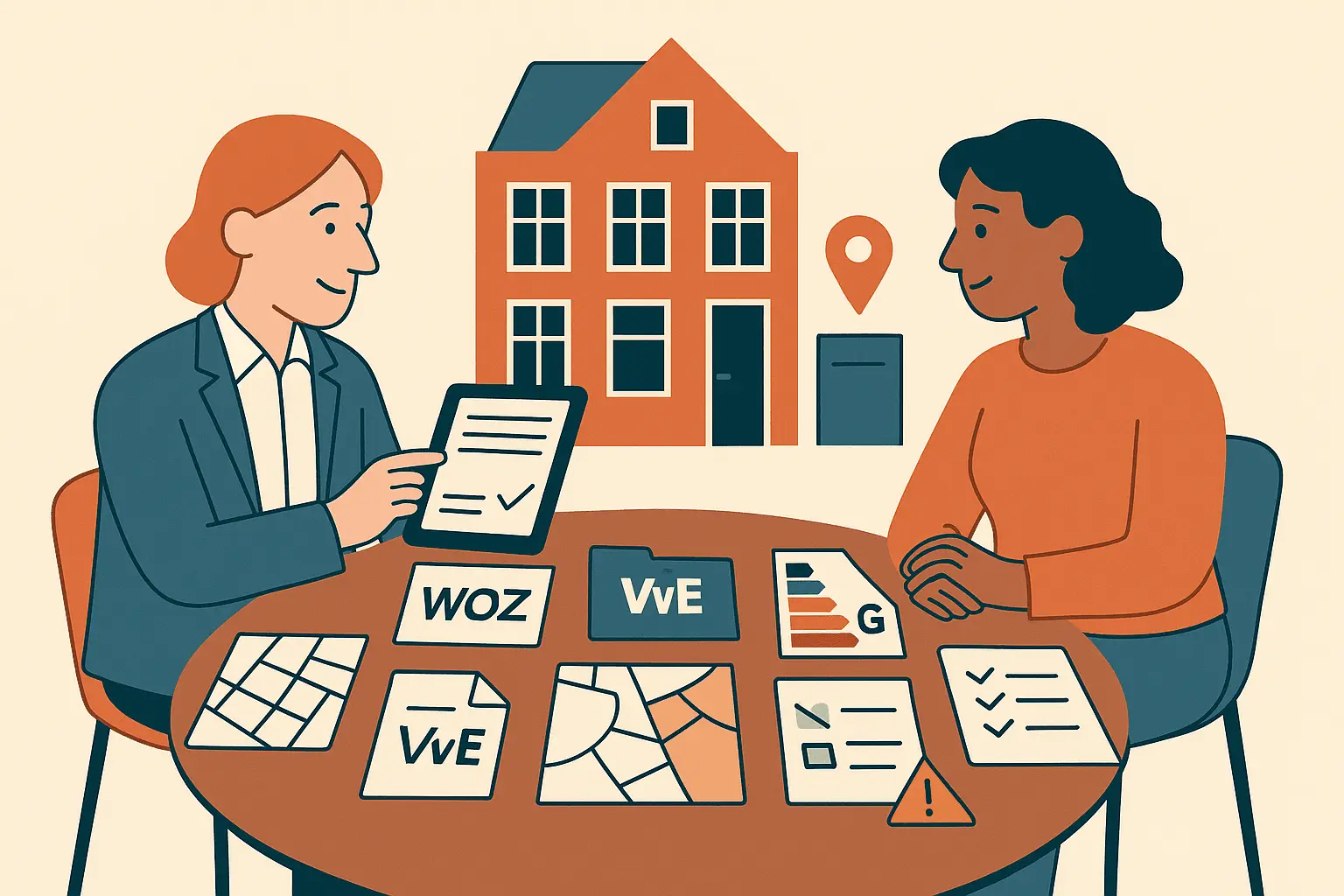
A Dutch terraced house can look straightforward: a front door, a back garden, neighbours on one or both sides, and often a practical layout. But before you bid, the important questions are often not in the living room. They are in the shared walls, the back alley, the roofline, the extension, the title deed, and the municipal records.
This terraced house Netherlands buying checklist helps you check the signals that can affect your offer, your conditions, or your decision to walk away.
Before you bid: use Huisscan to check one Dutch address. Huisscan can turn available Dutch property data and uploaded documents into a clear pre-bid report with risk signals, document findings, and buyer questions.
Check a Dutch property before you bid.
Why a terraced house needs a different pre-bid check
In the Netherlands, a terraced house is usually called a rijtjeshuis. A mid-terrace house is a tussenwoning. An end-of-row house is a hoekwoning.
Compared with a detached house, a terraced house has more shared-boundary questions:
- Are the side walls, roof parts, gutters, drains, or chimneys shared?
- Is there a back alley, and do you have a registered right to use it?
- Have neighbours built extensions, dormers, sheds, or fences close to the boundary?
- Are cracks, damp, noise, or drainage issues connected to the adjoining homes?
- Are there easements or shared maintenance obligations in the deed?
A good pre-bid property check in the Netherlands should not only ask “Do I like this house?” It should also ask:
- What exactly am I buying?
- What is shared with neighbours?
- What documents are missing?
- What should be priced into the offer?
- Which conditions should I include?
- Is there a reason not to bid?
Dutch terms, data sources, and documents to know
When buying a house in the Netherlands, you will see Dutch terms that may not be obvious if you are an expat buyer.
| Dutch term | Plain-English meaning | Why it matters before bidding |
|---|---|---|
| Rijtjeshuis | Terraced house | A row house with neighbouring properties attached. |
| Tussenwoning | Mid-terrace house | Usually has neighbours on both sides. Shared-wall checks are important. |
| Hoekwoning | End-of-row house | Usually has one attached neighbour and more exterior wall, garden, or side access to check. |
| Erfgrens / kadastrale grens | Property boundary / cadastral boundary | Helps you understand what land is included. Physical fences do not always match legal boundaries. |
| Kadaster | Dutch land registry | Shows ownership, parcel data, and registered rights or restrictions. |
| Erfdienstbaarheid | Easement | A registered right or burden, such as a right of way over land. |
| Recht van overpad | Right of way | Often relevant for a shared back alley or access path. |
| Achterom / brandgang | Rear access / back alley | Useful for bikes, bins, garden access, and renovations. Check whether use is legally arranged. |
| Mandeligheid | Shared ownership or shared maintenance responsibility | Can apply to walls, paths, fences, or other shared elements. |
| Omgevingsvergunning | Environmental/building permit | Relevant for extensions, dormers, structural changes, and some outbuildings. |
| Omgevingsplan | Municipal environment/zoning plan | Shows what is allowed in the area and nearby land uses. |
| Vragenlijst | Seller’s questionnaire | Contains seller-provided information about defects, renovations, disputes, and known issues. |
| Eigendomsakte / leveringsakte | Title deed / deed of transfer | Can contain rights, restrictions, old clauses, and obligations. |
| Energielabel | Energy label | Gives an indication of energy performance, but does not replace an inspection. |
| Bouwkundige keuring | Building inspection | Useful to understand technical condition and repair costs. |
| Erfpacht | Leasehold | You own the building but lease the land. Check terms, payments, and future changes with a qualified advisor. |
Useful Dutch property data sources may include the Kadaster, BAG building records, the WOZ value, the official energy label, municipal permit information, and public maps for environmental, flood, soil, noise, or foundation signals where available.
Documents to request or review before bidding include:
- Sales brochure and floor plans
- Seller’s questionnaire
- Title deed and Kadaster information
- Energy label
- Building inspection report, if available
- Permit documents for extensions, dormers, sheds, or structural changes
- List of items included in the sale, called lijst van zaken
- Leasehold documents, if applicable
- Any shared-maintenance or association documents, if the property is part of a shared courtyard, private road, parking area, or small owners’ arrangement
Shared-boundary signals to check before bidding
For a terraced house, shared-boundary signals can be more important than they first appear.
1. Party walls, noise, and structural clues
A tussenwoning has neighbours on both sides. Ask about:
- Noise transfer between homes
- Shared chimneys or old flues
- Cracks near party walls
- Damp patches on adjoining walls
- Recent renovations by neighbours
- Whether structural walls were removed or altered
Small cracks are not always serious, but visible movement, sloping floors, sticking doors, or repeated repairs deserve further inspection.
2. Roofline, gutters, and chimneys
Rows of houses often have connected rooflines. Check:
- Who maintains gutters and downpipes
- Whether there have been roof leaks
- Whether a dormer, solar panels, or roof extension was added
- Whether chimneys are shared, removed, capped, or leaking
- Whether repairs have been done only on one house while the wider roofline remains older
If the roof looks continuous across several homes, ask what is private and what is shared.
3. Back alley and right of way
A rear alley can be valuable in Dutch daily life. It affects bikes, bins, deliveries, garden work, and emergency access.
Check whether the achterom or brandgang is:
- On your parcel, a neighbour’s parcel, or shared land
- Covered by a recht van overpad
- Maintained by residents, the municipality, or another party
- Accessible by gate or key
- Mentioned in the deed
If back access is important to you, do not rely only on “everyone uses it”. Ask for the legal basis.
4. Extensions, dormers, sheds, and boundary overlap
Terraced houses are often extended over time. Look closely at:
- Uitbouw: rear extension
- Aanbouw: attached addition
- Dakkapel: dormer
- Garden office or shed
- Side extension on a corner house
- Balcony, canopy, or overhang near the boundary
Ask whether permits were required and obtained. Also check whether the extension affects drainage, daylight, foundations, or neighbouring walls.
5. Drainage, sewer, and damp
Rows of houses can share practical infrastructure, even when ownership is separate. Ask about:
- Shared sewer connections
- Rainwater downpipes
- Blocked drains
- Crawl-space damp
- Garden drainage
- Leaks from neighbouring roofs or gutters
Damp in a Dutch terraced house may come from the roof, ground level, ventilation, old masonry, or neighbouring drainage. A building inspector can help interpret the cause.
6. Boundaries, fences, and garden use
The garden fence may not exactly match the cadastral boundary. Before bidding, check:
- The Kadaster parcel shape
- Whether garden sheds or fences appear to cross a boundary
- Whether the neighbour has access rights
- Whether parking, side access, or storage is actually part of the property
If the exact boundary matters for your plans, ask for clarification before you bid.
The practical terraced house Netherlands buying checklist
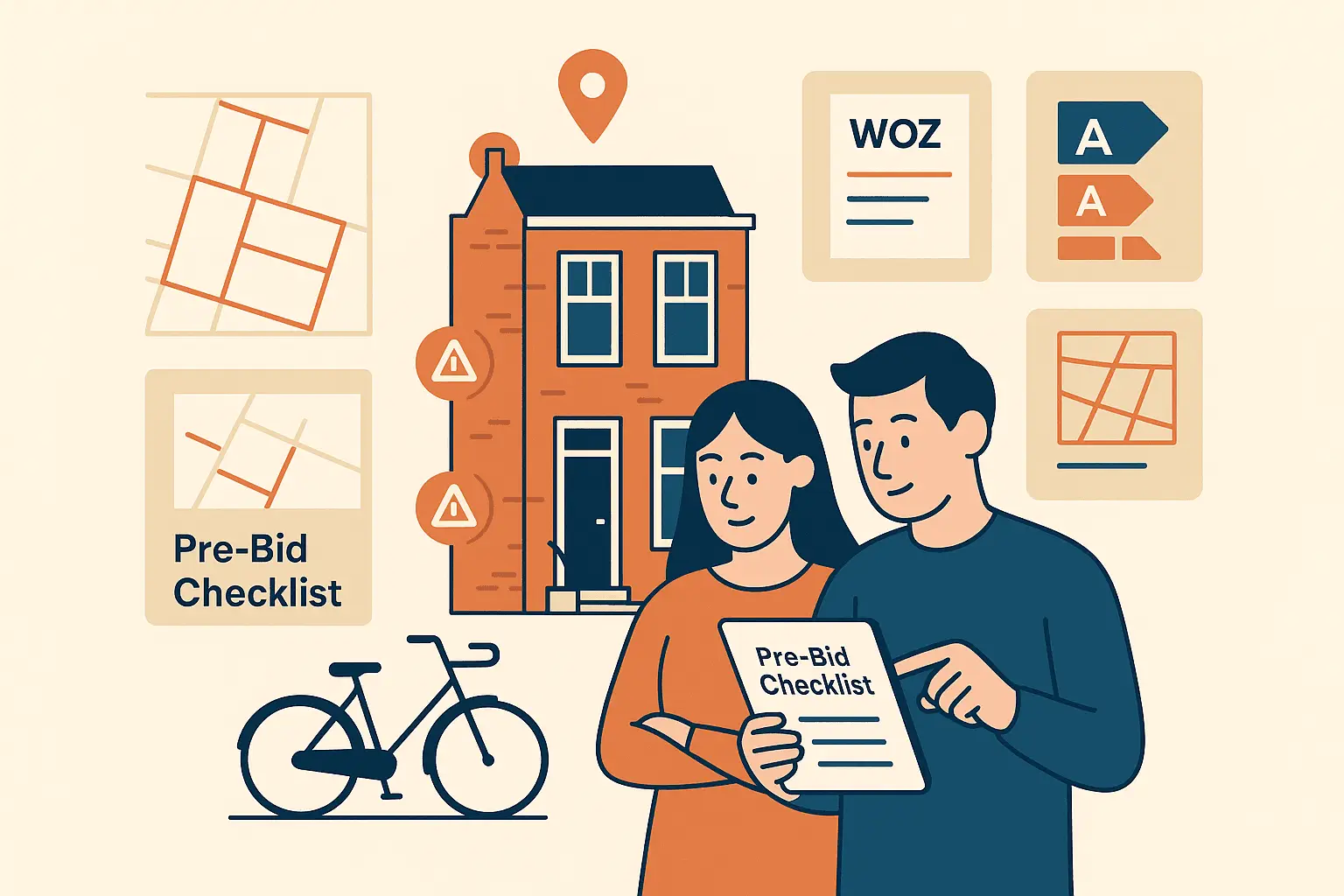
Use this checklist before making an offer.
Address and property data
- Compare the listing details with available Dutch property data.
- Check the house type: tussenwoning, hoekwoning, or another form.
- Review the registered build year and known renovations.
- Compare living area in the brochure with available records and floor plans.
- Check the energy label and note likely insulation or ventilation upgrades.
- Review WOZ value as context, not as a market valuation.
- Look for public signals on foundation, flood, soil, noise, or environmental risks where available.
Ownership and legal documents
- Check Kadaster information for parcel, ownership, and registered rights.
- Request the title deed.
- Look for erfdienstbaarheden, recht van overpad, mandeligheid, or other obligations.
- Check whether the property is freehold or erfpacht.
- Confirm what land, garden, parking, storage, or side access is included.
- Review the seller’s questionnaire carefully.
- Ask about any neighbour disputes, leaks, access issues, or known defects.
Building condition
- Look for cracks, sloping floors, sticking doors, or uneven window frames.
- Ask about foundation history, especially in areas known for settlement or older foundations.
- Check roof age, gutter condition, chimney condition, and previous leaks.
- Ask about damp, ventilation, crawl-space issues, and drainage.
- Check heating system, electrical installation, glazing, insulation, and ventilation.
- For older houses, ask whether asbestos-containing materials may be present.
- Consider a bouwkundige keuring or include a building inspection condition.
Shared-boundary checks
- Confirm whether side walls, gutters, roof parts, drains, or paths are shared.
- Ask who maintains the back alley.
- Check whether rear access is legally registered.
- Ask about noise transfer from neighbours.
- Check whether extensions or dormers have permits and drawings.
- Ask whether any part of the building crosses a boundary.
- Check whether neighbouring renovations could affect your wall, roof, drainage, or light.
Bid preparation
- Estimate repair, maintenance, and upgrade costs before setting your maximum bid.
- Decide which conditions you need, such as financing or building inspection conditions.
- Ask your mortgage advisor whether any issue may affect financing or valuation.
- Ask the selling agent for missing documents before the offer deadline.
- Decide in advance which unanswered questions are acceptable and which are deal-breakers.
How your findings can affect the bid
A pre-bid check is useful only if it changes your decision-making. For a terraced house, findings can affect the offer in several ways.
| Finding | Possible pre-bid response |
|---|---|
| Unclear right of way to the back alley | Ask for deed evidence. If rear access is essential, consider a condition or do not bid until clarified. |
| Missing permit information for an extension or dormer | Ask for municipal documents, drawings, or seller confirmation. Consider professional advice before pricing the risk. |
| Damp, cracks, or foundation signals | Request a building inspection or specialist review. Avoid treating it as a minor cosmetic issue without evidence. |
| Shared gutter, roof, or drain problems | Ask who is responsible and whether neighbours contribute to repair costs. Price future maintenance carefully. |
| Energy label is weak or upgrades are unclear | Budget for insulation, glazing, ventilation, or heating improvements before setting your maximum bid. |
| Title deed contains easements or obligations | Ask a notary or legal professional to explain the practical impact before bidding high. |
| Documents are missing or inconsistent | Ask follow-up questions. If answers are not available, decide whether to lower your bid, add conditions, or walk away. |
In a competitive market, buyers sometimes feel pressure to make a clean offer. A clean offer should not mean a blind offer. Even if you choose to bid with fewer conditions, you should still understand the main property risks Netherlands buyers commonly face before deciding your price.
Questions to ask before you make an offer
Use these questions with the selling agent, your buyer agent, inspector, mortgage advisor, or notary as relevant.
- Is this property a tussenwoning or hoekwoning, and what exactly is included in the parcel?
- Are there any registered easements, rights of way, or shared-maintenance obligations?
- Who owns and maintains the back alley, fences, gutters, drains, and any shared walls?
- Have there been leaks, damp issues, foundation concerns, or structural repairs?
- Have extensions, dormers, sheds, or structural changes been permitted and documented?
- Does the listed living area include an extension, attic conversion, garage, or storage space?
- Are there known disputes with neighbours about boundaries, noise, drainage, or access?
- Are there old-age, asbestos, non-occupancy, or other special clauses in the draft contract?
- Are there planned municipal or nearby developments that may affect light, noise, parking, or access?
- Which issues should be reflected in the offer price or conditions?
If a question matters to your bid, ask it before you bid.
What Huisscan can help you check
Huisscan is built for one practical purpose: check a Dutch property before you bid.
With one address, and with any documents you upload, a Huisscan pre-bid report can help you bring scattered information together. This may include:
- Available Dutch property data for the address
- Property risk signals from public or available sources
- Checks for inconsistencies between listing data, public records, and uploaded documents
- Document analysis of brochures, seller questionnaires, deeds, inspection reports, or energy information
- Shared-boundary signals to investigate, such as easements, alley access, extensions, or maintenance responsibilities
- Plain-English explanations of Dutch terms
- Buyer questions you can send to the selling agent, buyer agent, mortgage advisor, inspector, or notary
Huisscan does not replace professional legal, building, appraisal, mortgage, tax, or notarial advice. It helps you prepare better questions and make a clearer pre-bid decision.
FAQ
Is a terraced house in the Netherlands a good choice for expat buyers?
It can be, depending on your budget, location, maintenance appetite, and long-term plans. Terraced houses are common in the Netherlands, but expat buyers should pay close attention to Dutch documents, shared boundaries, rights of way, and building condition before bidding.
What is the biggest risk when buying a Dutch terraced house?
There is no single biggest risk for every property. Common pre-bid concerns include unclear back-alley rights, undocumented extensions, damp, roof or gutter issues, foundation signals, neighbour-related restrictions, and deed obligations. The key is to identify which risks apply to the specific address.
Do I need a building inspection before bidding?
For older, renovated, or visibly imperfect houses, a building inspection can be useful. Some buyers include a bouwkundig voorbehoud, which is a building inspection condition, in the offer. Ask your buyer agent or advisor what is realistic for the market situation and the property.
How can I check whether an extension or dormer has a permit?
Ask the selling agent for permit documents and drawings. You can also check with the municipality or relevant online permit information where available. If documents are missing, ask whether the change was permit-free, permitted, or never formally checked.
What if the back alley is used by everyone but not clearly documented?
Do not assume informal use equals a secure right. Ask whether a recht van overpad or other arrangement is registered in the deed or Kadaster records. If rear access matters to you, clarify this before bidding or ask a qualified professional to review it.
Can Huisscan tell me whether to buy the house?
Huisscan helps you understand available data, risk signals, document findings, and buyer questions before you bid. The final decision, offer amount, and conditions remain yours, ideally with support from the right professionals.
Check the address before you bid.