
Buying a home in Rotterdam: pre-bid checklist
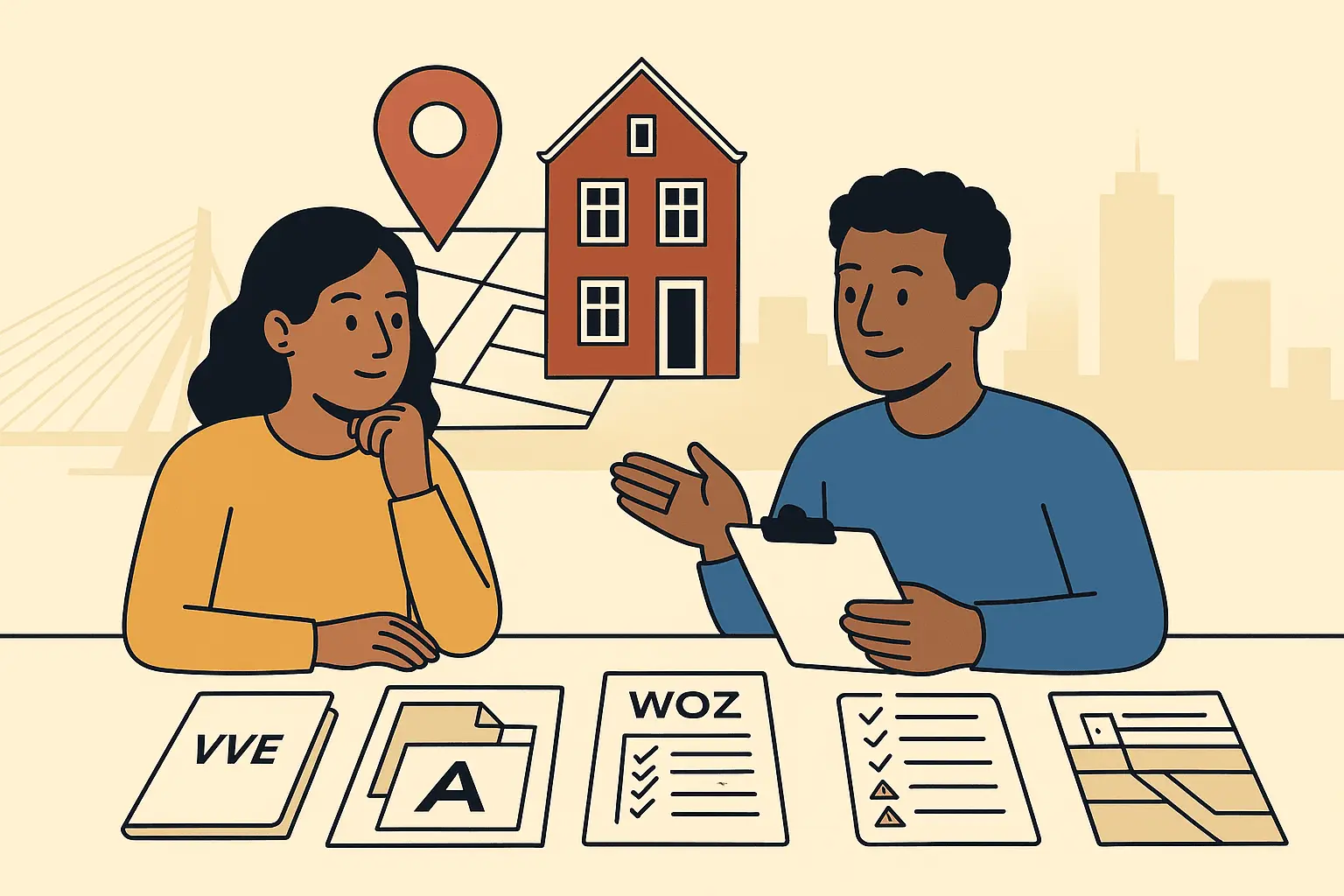
Buying in Rotterdam can feel direct and fast: you view a property, receive the documents, and may need to decide whether to bid within days. The risk is not only overpaying. It is bidding before you understand the address, the building, the VvE, the land situation, or the questions you should have asked.
This buying house Rotterdam checklist helps you make one clearer pre-bid decision: bid, bid with conditions, lower your price, ask more questions, or walk away.
Considering a property in Rotterdam? Huisscan can help you check a Dutch property before you bid by turning one address and uploaded documents into a clear pre-bid report with available property data, risk signals, document analysis, and buyer questions.
Why Rotterdam needs a local pre-bid check
Rotterdam is not one single housing market. A 1930s apartment in Blijdorp, a post-war flat in Zuid, a family house in Hillegersberg, and a newer apartment on Kop van Zuid can have very different risks.
Before bidding, look beyond the asking price and floor area. Rotterdam-specific checks often include:
- VvE health for apartments, especially in older or larger buildings.
- Foundation and soil questions in older neighbourhoods or areas with soft ground.
- Erfpacht: leasehold land instead of full land ownership.
- Noise and environmental context near busy roads, rail, port activity, nightlife, or industrial zones.
- Future development under the local planning rules, called the omgevingsplan.
- Parking and permits, which can affect daily life and resale value.
- Flooding and water management context, especially in low-lying or riverside areas.
None of these automatically means “do not buy”. They mean: understand the property before you decide what to offer.
First checks on the address, ownership, and value context
Start with the basics. Many pre-bid mistakes happen because buyers focus on the viewing and miss the underlying property data.
Useful Dutch terms and sources:
| What to check | Dutch term | Why it matters before bidding |
|---|---|---|
| Official address and building data | BAG | Confirms registered use, construction year, and property details where available. |
| Ownership and parcel | Kadaster | Shows registered ownership, parcel boundaries, and sometimes relevant rights. |
| Land ownership | Eigen grond or erfpacht | Leasehold can affect costs, financing, resale, and notarial review. |
| Municipal valuation | WOZ-waarde | Not a market value, but useful context next to asking price and comparable sales. |
| Energy label | Energielabel | Helps estimate comfort, improvement needs, and future renovation questions. |
| Floor area | NEN 2580 meetrapport | Helps verify whether the advertised living area is measured consistently. |
| Planning rules | Omgevingsplan | Shows permitted use and may reveal nearby development or restrictions. |
For expats buying a house in the Netherlands, these terms can be confusing because some information is public, some is in the sales file, and some must be requested. A good pre-bid property check in the Netherlands combines address data with the documents from the selling agent.
Rotterdam risks to review before you bid
1. VvE quality for apartments
Most Rotterdam apartments are part of a VvE: a homeowners’ association responsible for shared parts of the building, such as the roof, façade, staircase, foundations, balconies, lift, and insurance.
Before bidding, ask:
- Is the VvE active?
- Are annual meetings held?
- Is there a recent MJOP: a multi-year maintenance plan?
- Are there enough reserves for planned maintenance?
- Are there discussions about roof, façade, balcony, lift, sewer, or foundation work?
- Are service charges likely to rise?
A low monthly service charge can look attractive, but it may also mean maintenance has been postponed. A higher service charge is not automatically bad if it is well explained and backed by a serious maintenance plan.
2. Foundation and structural questions
Some older Rotterdam properties may need extra attention for foundations, settlement, moisture, cracks, or previous repairs. This is especially relevant for older houses and apartment buildings, but the exact risk depends on the address, construction, soil, maintenance history, and available inspections.
Look for:
- Cracks in walls or stairwells.
- Sloping floors.
- Doors or windows that do not close properly.
- Mentions of foundation research in VvE minutes.
- Older seller questionnaires mentioning settlement or structural repairs.
- Past or planned foundation work.
If there are signals, consider a bouwkundige keuring: a building inspection. For serious foundation questions, ask a specialist. Huisscan can help you identify signals and questions, but it does not replace a structural engineer or building inspector.
3. Erfpacht: leasehold instead of full land ownership
Some Rotterdam homes are on erfpacht. This means you own the home, but the land is leased under specific conditions.
Check:
- Is the property on eigen grond or erfpacht?
- If erfpacht, is the ground rent, called canon, still payable?
- Has the canon been bought off for a period?
- When do the leasehold conditions change or expire?
- Are there restrictions or obligations in the erfpacht deed?
- Will your mortgage lender accept the conditions?
Erfpacht does not automatically make a property unsuitable. But it should be understood before you bid, because it can affect affordability, financing, and future resale.
4. Noise, environment, and location context
Rotterdam has busy roads, rail lines, metro routes, nightlife areas, commercial zones, and port-related activity. Two properties in the same neighbourhood can feel very different depending on the exact street and orientation.
Before bidding, check:
- Road, tram, metro, rail, or aircraft noise.
- Nearby hospitality venues or late-night activity.
- Industrial or commercial surroundings.
- Soil information where available.
- Planned construction nearby.
- Sunlight, wind, and street-level noise at different times of day.
Visit more than once if you can: during the day, evening, and commute hours. A quiet viewing slot does not always show the normal living situation.
5. Renovations, permits, and legal use
Rotterdam has many homes with extensions, roof terraces, split levels, converted storage rooms, or altered layouts. Do not assume every improvement was permitted or professionally documented.
Ask for:
- Building permits, called omgevingsvergunningen.
- Drawings for extensions, dormers, roof terraces, or internal structural changes.
- Confirmation that living area is legally usable as living space.
- VvE permission for changes to shared parts.
- Documentation for insulation, roof work, windows, electrical upgrades, or heating systems.
If a property includes a roof terrace, basement, garden room, or converted attic, check carefully whether it is included in the legal situation and whether it is properly described in the sales documents.
Documents to request before making an offer
A serious pre-bid review depends on documents. For a Rotterdam apartment or house, ask the selling agent for the relevant sales file before you bid.
Common documents include:
- Vragenlijst: seller’s questionnaire about known issues.
- Lijst van zaken: list of items included or excluded from the sale.
- Energielabel.
- NEN 2580 measurement report or floor-area explanation.
- Kadaster information and cadastral map.
- Deed of ownership and any erfpacht documents.
- Draft purchase agreement if available.
- Building inspection report, if already done.
- Permits and renovation documentation for major works.
- VvE documents for apartments:
- Splitsingsakte: deed dividing the building into apartment rights.
- Splitsingsreglement and house rules.
- Recent meeting minutes.
- Annual accounts.
- Budget.
- Reserve position.
- MJOP.
- Insurance details.
- Information about arrears, disputes, or planned major works.
Read the documents for what they say, but also for what they do not say. Missing documents are not always a deal-breaker, but they should influence your questions, bid level, and conditions.
Practical buying house Rotterdam checklist before you bid
Use this checklist before you send an offer.
Address and market context
- Is the official address correct in Dutch property data sources?
- Does the listed living area match a measurement report or reliable source?
- Is the asking price reasonable compared with similar recent sales?
- Is the WOZ value much lower or higher than expected, and can you explain why?
- Are you comparing the property to similar homes: same type, condition, location, land situation, and VvE quality?
Land, ownership, and legal context
- Is the home on eigen grond or erfpacht?
- If erfpacht applies, are the canon, duration, and conditions clear?
- Are there easements, restrictions, or shared access rights?
- Does the advertised use match the registered and permitted use?
- Are extensions, roof terraces, or conversions supported by permits or documentation?
Building and maintenance
- Are there signs of moisture, cracks, settlement, or poor maintenance?
- Is a building inspection advisable before bidding or as a condition?
- Are roof, façade, window frames, sewer, heating, and electrical systems documented?
- Are energy improvements needed soon?
- Could maintenance costs affect your maximum bid?
VvE for apartments
- Is the VvE active and financially organised?
- Is there a recent MJOP?
- Are reserves appropriate for planned maintenance?
- Do meeting minutes mention disputes, leaks, foundation issues, roof work, façade work, or rising service charges?
- Are monthly service charges included in your affordability calculation?
Location and future plans
- Have you checked noise at different times of day?
- Are there nearby roads, rail, hospitality, or industrial activities?
- Are future developments planned nearby?
- Is parking realistic for your situation?
- Do flood, water, soil, or environmental signals require further questions?
Offer strategy
- What is your maximum bid based on the property, not emotion?
- Which conditions do you need, such as financing or building inspection?
- Which issues should reduce your bid?
- Which unanswered questions must be resolved before signing?
- What would make you walk away?
What Huisscan can help you check
Huisscan is designed for one practical moment: you have an address, you may have documents, and you need to decide whether and how to bid.
With one Dutch address, Huisscan can help create a clear Huisscan pre-bid report using available property data, risk signals, document analysis, and buyer questions. You can also upload sales documents so the report can highlight relevant points in the file.
Huisscan can help you review:
- Address and property data where available.
- Building characteristics and data mismatches.
- Ownership, land, and erfpacht signals.
- VvE documents and possible maintenance or financial concerns.
- Energy label and renovation questions.
- Seller questionnaire signals.
- Clauses that need attention, such as age, asbestos, non-occupancy, or foundation-related wording.
- Questions to ask the selling agent, VvE, buyer agent, mortgage advisor, notary, or building inspector.
Huisscan supports decision-making. It is not a replacement for a notary, appraiser, mortgage advisor, building inspector, tax specialist, or lawyer. It helps you organise the information before you bid, so your next question is clearer.
Questions to ask the selling agent, VvE, or your advisor
Use these questions when the documents are incomplete or unclear.
About the building
- Are there known issues with foundations, settlement, moisture, roof, façade, or sewer?
- Has a building inspection been done recently?
- Have major renovations been permitted and documented?
- Are there upcoming works that the buyer should expect?
About the VvE
- Is there a recent MJOP?
- What maintenance is planned in the next few years?
- Are there enough reserves?
- Have there been special contributions or discussions about increasing service charges?
- Are there disputes, arrears, or insurance issues?
About land and legal rights
- Is the property on eigen grond or erfpacht?
- If erfpacht applies, what are the current and future financial obligations?
- Are there easements or restrictions?
- Are all advertised spaces legally part of the apartment or property?
About your bid
- Which conditions can be included in the offer?
- What information is still missing?
- Which risks justify a lower bid?
- Which findings should be checked by a specialist before signing?
FAQ
Is Rotterdam different from other Dutch cities when buying a home?
Yes, in practical terms. Rotterdam has a mix of older neighbourhoods, post-war apartment blocks, high-rise apartments, waterfront developments, and homes near busy infrastructure or commercial areas. This makes the exact address important. A general view of the neighbourhood is not enough.
What is the most important check for a Rotterdam apartment?
The VvE is often one of the most important checks. Review the splitsingsakte, meeting minutes, financial statements, reserves, service charges, and MJOP. A good apartment can become expensive if the VvE has delayed maintenance or large works coming up.
Should I worry about foundation problems in Rotterdam?
Not automatically. But foundation and settlement questions are worth checking, especially for older buildings or when documents mention cracks, subsidence, moisture, or previous research. If there are signals, ask for specialist input before relying on assumptions.
What does erfpacht mean when buying in Rotterdam?
Erfpacht means leasehold. You own the home, but the land is leased under conditions. The canon, duration, buy-off status, and future changes can affect costs and financing. Ask your notary or mortgage advisor to review the exact erfpacht terms.
Can I bid before receiving all documents?
You can sometimes make an offer with conditions, but missing documents increase uncertainty. At minimum, know which documents are missing, why they matter, and whether your bid should be lower or conditional. Do not treat unknowns as harmless.
Can Huisscan tell me what to bid?
Huisscan can help you understand property data, document signals, and buyer questions before bidding. It does not replace an appraisal or personal financial advice. Use the report to support your bid strategy together with your buyer agent, mortgage advisor, or other qualified professional.
Check the address before you bid.