Buying a canal house: what to check
A canal house can be a beautiful place to live, but the pre-bid question is practical: are the foundation, heritage rules, maintenance costs, and legal documents clear enough to support your offer?
Many canal houses in the Netherlands are old, altered over time, and sometimes protected as heritage. That does not make them a bad purchase. It does mean you should check the right information before you bid.
Looking at a specific canal house? Huisscan can help you check a Dutch property before you bid. Enter one address and upload the sales documents to get a clear pre-bid report with available Dutch property data, risk signals, document analysis, and buyer questions.
Why canal houses need a different pre-bid check
A canal house is not just a normal Dutch row house with a nice view. In cities such as Amsterdam, Utrecht, Leiden, Haarlem, Delft, and Dordrecht, canal houses can involve:
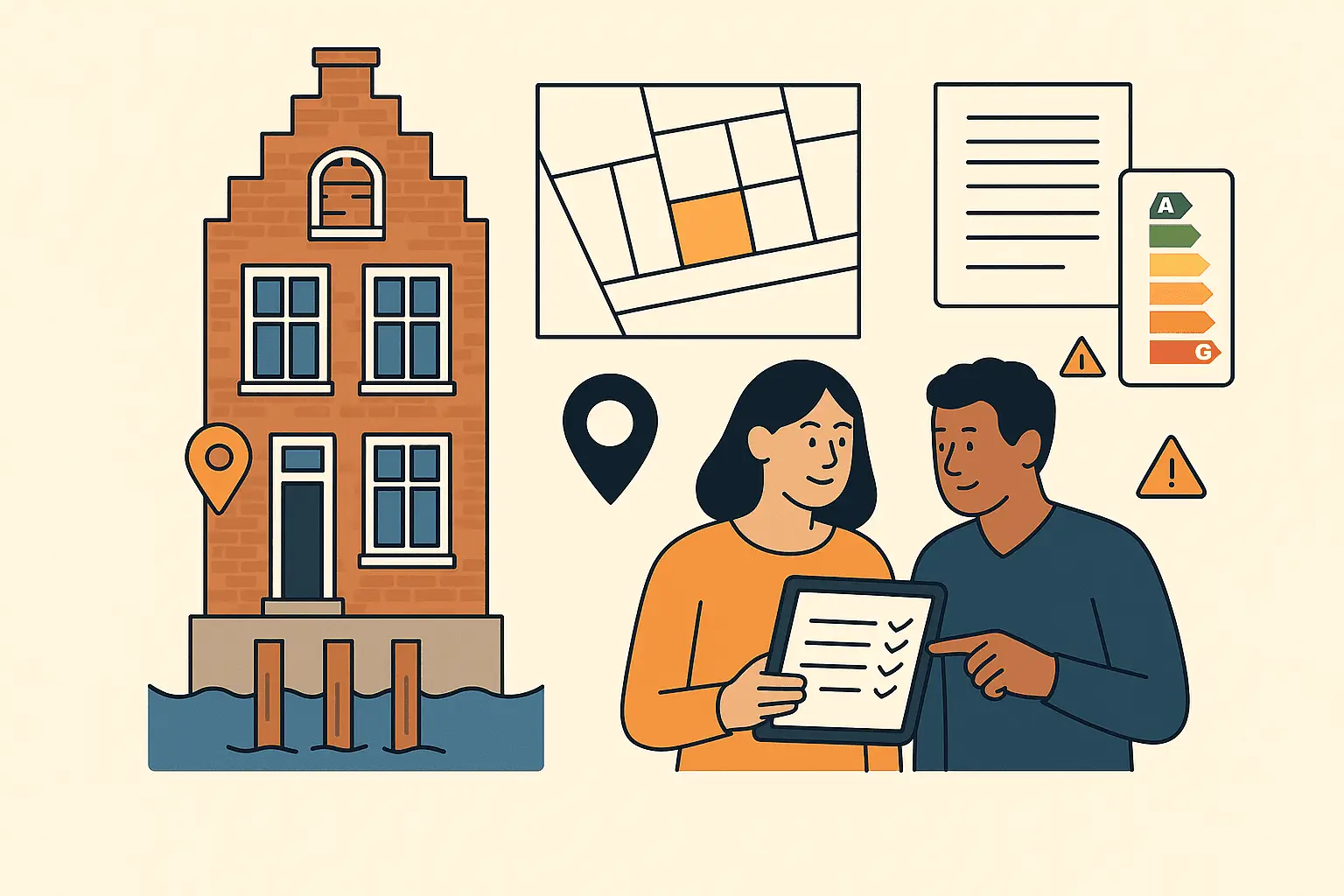
- Older foundations, sometimes on wooden piles
- Settlement, sloping floors, or façade movement
- Heritage protection or protected cityscape rules
- Narrow, deep layouts with shared walls
- Cellars or souterrains with damp risks
- Split ownership, where the property is part of a VvE
- Renovations carried out over many decades
- Higher maintenance sensitivity for roofs, gutters, façades, and windows
Your goal is not to find a “perfect” old building. Your goal is to understand what you are buying, what is already priced in, and what could change your bid, conditions, or decision to walk away.
Foundation, settlement and water: check this early
For many buyers, the foundation is the most important canal house risk to understand before bidding.
Dutch term to know: fundering means foundation. In older Dutch cities, buildings may have been built on houten palen: wooden piles driven into soft ground. Wooden piles can function well for a long time if conditions are stable, but problems can arise from settlement, changing groundwater levels, decay, or earlier structural alterations.
Useful Dutch terms:
- Paalrot: pile rot, often discussed when wooden piles are affected by oxygen exposure.
- Zakking: settlement or sinking.
- Scheefstand: leaning or tilting.
- Funderingsonderzoek: foundation investigation.
- Funderingsherstel: foundation repair.
Before you bid, ask:
- Is the foundation type known?
- Is there a recent foundation report?
- Have neighbouring properties had foundation repairs?
- Are there visible signs of settlement, such as cracks, sloping floors, sticking doors, or a leaning façade?
- Has the municipality published any foundation information for the area?
- If foundation repair was done, what exactly was repaired and when?
- If no foundation information is available, are you comfortable bidding without it?
A normal viewing is not enough to confirm foundation quality. If the risk matters for your budget, speak with a building inspector or foundation specialist before relying on assumptions.
Heritage status and permits: know what you can change
Many canal houses are protected in some way. This can affect maintenance, renovation options, timing, and cost.
Important Dutch terms:
- Rijksmonument: a national monument.
- Gemeentelijk monument: a municipal monument.
- Beschermd stadsgezicht: a protected cityscape.
- Beeldbepalend pand: a building considered visually important by the municipality.
- Omgevingsvergunning: environmental/building permit.
Heritage protection does not mean you cannot renovate. It does mean you may need permission for work that would be simple in another house. Examples include replacing windows, insulating the façade, changing the roof, adding solar panels, altering the front or rear façade, creating a roof terrace, or modifying structural parts.
Before bidding, check:
- Is the building listed as a national or municipal monument?
- Is it in a protected cityscape?
- Are previous renovations permitted and documented?
- Are you planning changes that may require permission?
- If the house is an apartment, does the VvE also need to approve changes?
- Are there maintenance obligations or material requirements?
If your bid depends on a renovation plan, do not assume it is possible because a neighbour did something similar. Check the specific address, building status, and local rules.
Dutch documents and terms to read before you bid
A canal house Netherlands buying checklist should always include the documents, not just the viewing.
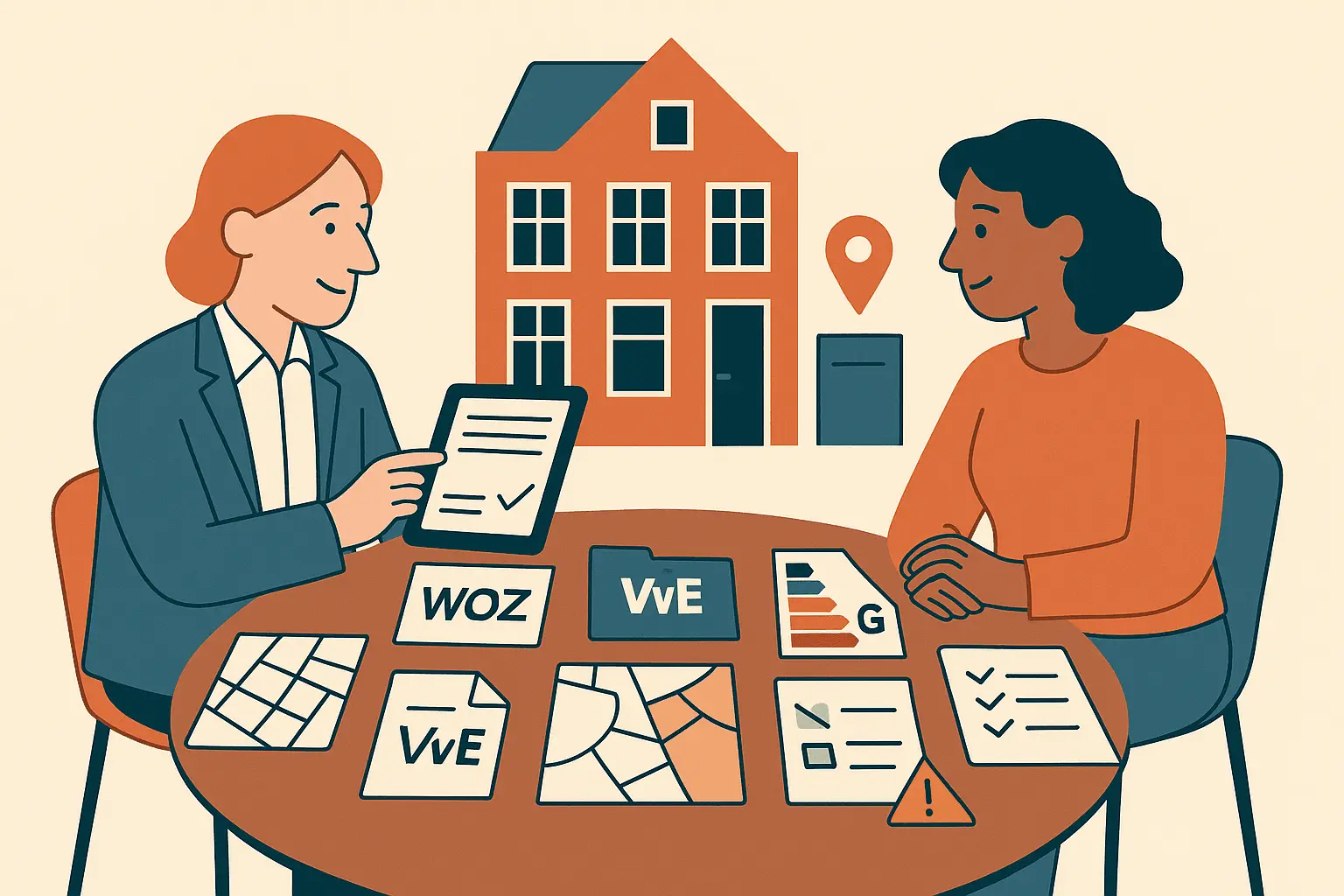
Ask the selling agent for the available sales pack and read it carefully. Key documents and terms include:
| Dutch term | Plain-English meaning | Why it matters |
|---|---|---|
| Vragenlijst voor de verkoop | Seller questionnaire | May mention defects, renovations, leaks, disputes, permits, foundation issues, or asbestos. |
| Lijst van zaken | List of items included/excluded | Clarifies what stays with the property. |
| Eigendomsakte / akte van levering | Deed of transfer | Can mention rights, obligations, easements, or restrictions. |
| Kadastrale gegevens | Land registry information | Helps identify the parcel, apartment right, or ownership structure. |
| Erfpacht | Leasehold land | Common in some cities. Check the conditions, payments, and future changes with a professional. |
| Splitsingsakte | Deed of division for apartments | Explains what is private, what is shared, and how costs are divided. |
| VvE-stukken | Owners’ association documents | Important for apartments in canal buildings. Check reserves, minutes, maintenance plans, and service charges. |
| MJOP | Long-term maintenance plan | Shows expected shared maintenance, often relevant for roof, façade, foundation, and common areas. |
| Bouwkundig rapport | Building inspection report | Can identify maintenance issues, but check scope and limitations. |
| Energielabel | Energy label | Useful, but older or heritage buildings may have practical limits on insulation. |
| Ouderdomsclausule | Age clause | Often used for older homes and may shift some risk to the buyer. |
| Asbestclausule | Asbestos clause | Relevant in older buildings or older renovations. |
| Niet-zelfbewoningsclausule | Non-owner-occupancy clause | Means the seller may not know the property as a resident would. |
Also check public data where available, such as BAG building records, Kadaster information, monument registers, municipal permit information, the omgevingsplan, energy label data, and local environmental or soil information.
Practical canal house Netherlands buying checklist
Use this checklist before making an offer.
Address and ownership
- Confirm whether you are buying a whole house or an apartment right.
- Check Kadaster information for parcel or apartment ownership.
- Check whether the property is on freehold land or erfpacht.
- Compare the listed living area with official records where available.
- Check whether the house is a monument or in a protected area.
Foundation and structure
- Ask for any funderingsonderzoek or foundation repair documents.
- Ask whether neighbouring buildings have foundation issues or repairs.
- Look for cracks, sloping floors, moisture, and façade movement.
- Check whether structural walls, beams, floors, or cellars were altered.
- Consider a building inspection or specialist review if the risk is material.
Heritage and permits
- Check national and municipal monument status.
- Ask for permits for extensions, basement work, roof terraces, façade changes, or major renovations.
- Check whether planned renovations are realistic under local rules.
- If the building is split into apartments, check whether the VvE approved past or planned works.
Maintenance and energy
- Review roof, gutters, windows, masonry, and damp issues.
- Check the energy label and heating system.
- Ask what insulation has been installed and whether it was permitted.
- Consider future maintenance costs, not only the purchase price.
If it is an apartment
- Read the splitsingsakte and VvE regulations.
- Check VvE reserves, service charges, minutes, and MJOP.
- Look for discussion of foundation, roof, façade, leaks, disputes, or arrears.
- Understand which costs are shared and which are yours alone.
Bid decision
- List the unknowns that could change your offer.
- Decide which questions must be answered before bidding.
- Decide whether you need a condition, such as financing or building inspection.
- Ask a qualified professional where legal, mortgage, building, or notarial judgement is needed.
How the findings can affect your bid
The point of a pre-bid property check Netherlands is not to collect information for its own sake. It should help you make a clearer decision.
A finding can affect your bid in several ways:
- Price: you may adjust your offer if there are expected maintenance costs, foundation uncertainty, heritage limitations, or VvE obligations.
- Conditions: you may decide to include a building inspection condition, financing condition, or request for specific documents. Discuss the wording and consequences with a qualified professional.
- Questions: you may ask the seller’s agent for missing permits, foundation documents, VvE minutes, or clarification on clauses.
- Timing: you may need more time before bidding if the property depends on specialist checks.
- Walk-away decision: you may decide not to bid if the uncertainty is too large for your budget or plans.
Examples of walk-away signals can include serious visible settlement without documentation, unclear ownership or leasehold information, unpermitted living space included in the price, a weak VvE for a split canal house, or heritage restrictions that block your intended renovation.
None of these automatically means “do not buy.” They mean: do not bid as if the risk does not exist.
What Huisscan can help you check
Huisscan helps buyers, expats, buyer agents, and mortgage professionals check Dutch property before bidding.
With one Dutch address and uploaded documents, Huisscan can turn scattered information into a clear Huisscan pre-bid report. Depending on availability, this can include:
- Available Dutch property data for the address
- Building age, use, and registered property indicators
- Heritage, permit, leasehold, VvE, and planning signals
- Foundation and settlement risk prompts where relevant information is available
- Review of uploaded documents such as the brochure, seller questionnaire, draft purchase contract, VvE documents, inspection report, or foundation report
- Plain-English explanations of Dutch terms
- Missing-document warnings
- Practical buyer questions to ask before bidding
Huisscan does not replace a notary, appraiser, mortgage advisor, building inspector, lawyer, or foundation specialist. It helps you organise the pre-bid picture so you know what to ask, what to verify, and what may affect your offer.
FAQ: buying a canal house in the Netherlands
Is buying a canal house in the Netherlands risky?
Not automatically. Many canal houses are good homes, but older buildings near water can have specific risks around foundations, damp, maintenance, heritage rules, and permits. The key is to check the address and documents before bidding.
How do I check the foundation of a canal house before bidding?
Ask for a foundation report, repair documents, seller disclosures, and any available municipal information. Look for signs such as cracks, sloping floors, or façade movement, but do not rely only on what you can see. If the risk is important, involve a building inspector or foundation specialist.
Can I renovate a Dutch canal house?
Often yes, but it depends on the property. Monument status, protected cityscape rules, VvE approval, structural constraints, and permit requirements can all affect what is possible. Check this before you bid if renovation is part of your plan.
What if the canal house is split into apartments?
Then the VvE is central. Check the deed of division, VvE reserves, service charges, minutes, and long-term maintenance plan. Foundation, roof, façade, and common areas may be shared responsibilities.
Should I bid if documents are missing?
It depends on what is missing and how material it is. Missing foundation information for an old canal house is different from a missing appliance list. Use missing documents to decide whether to ask more questions, add a condition, adjust your bid, or pause.
Can Huisscan tell me whether to buy the property?
Huisscan helps you understand available data, risk signals, documents, and buyer questions before bidding. The final decision, and any legal, financial, building, mortgage, or notarial advice, should come from the right qualified professionals.
Check the address before you bid.