Apartment rights explained for buyers
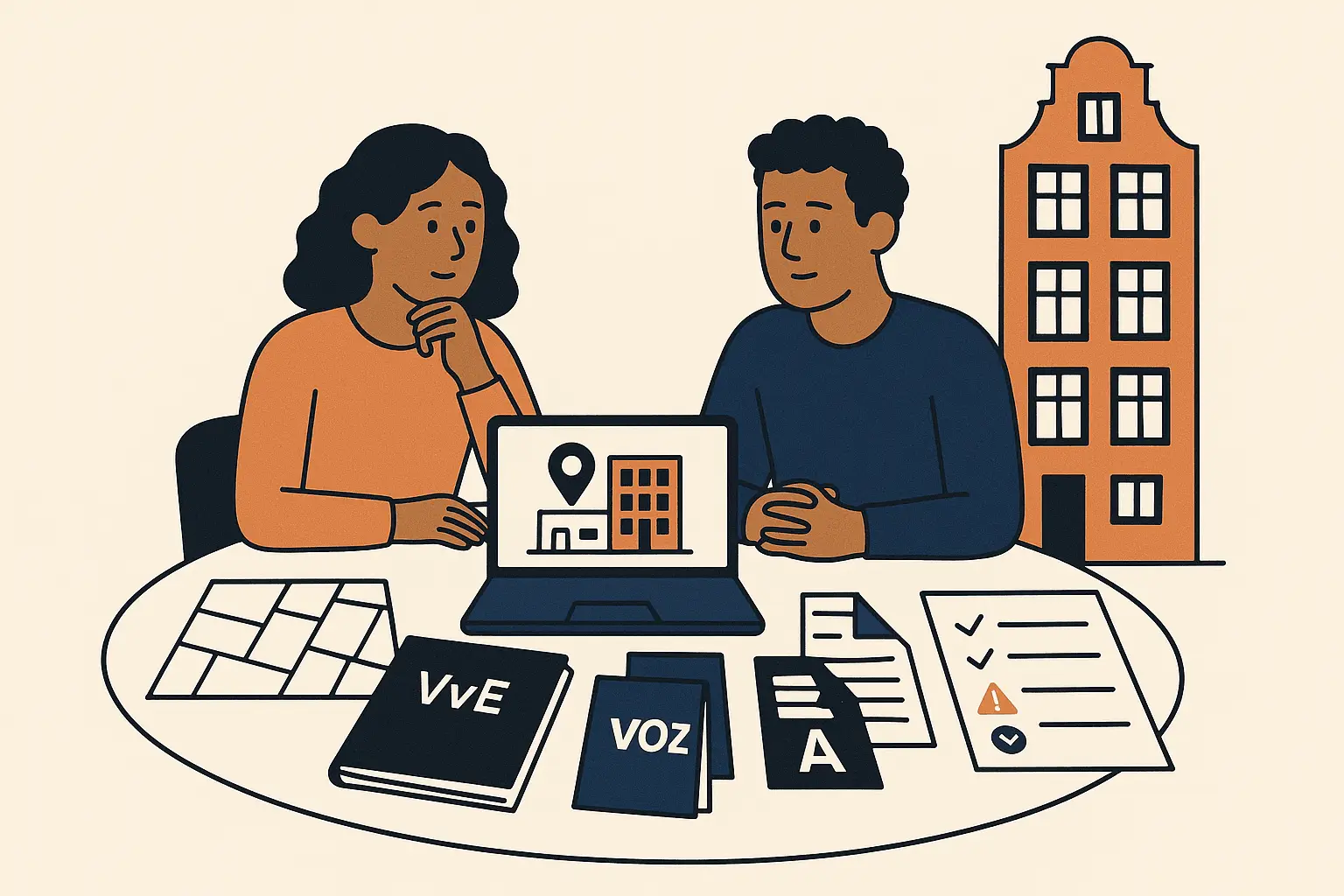
Buying a Dutch apartment is not just about the flat you can see during the viewing. Legally, you usually buy an apartment right: a private right to use your own unit, plus a share in the building, land, and shared responsibilities through the VvE.
That ownership structure can affect your monthly costs, renovation plans, mortgage discussion, resale value, and even whether you should bid at all. Before you make an offer, you want to know what exactly is included, which rules apply, and whether the VvE looks healthy enough.
Planning to bid on an apartment? Use Huisscan to check a Dutch property before bidding. One address, plus any uploaded VvE or sales documents, can become a clear pre-bid report with available property data, risk signals, document analysis, and better buyer questions.
Apartment right Netherlands buying: what are you actually buying?
In Dutch, an apartment right is called an appartementsrecht.
It normally gives you:
- the exclusive right to use a private part of the building, such as your apartment;
- a share in the ownership of the whole building and land;
- shared responsibility for common parts, such as the roof, foundations, stairwell, façade, lift, pipes, or entrance;
- automatic involvement in the VvE: the owners’ association.
So you are not simply buying “unit 3B”. You are buying a registered legal right that is defined in documents such as the splitsingsakte and splitsingstekening.
Example: a listing may mention an apartment, storage room, balcony, and parking space. Before bidding, check whether all of those are legally included in the apartment right, whether some are separate apartment rights, or whether they are only shared or informal use.
Dutch terms and documents to understand before bidding
These are the key terms buyers and expats should know when buying a house in the Netherlands that is legally an apartment right.
| Dutch term | Plain English meaning | Why it matters before bidding |
|---|---|---|
| Appartementsrecht | Apartment right | Defines what you are actually buying. |
| Splitsingsakte | Deed of division | Sets out the legal structure, rights, obligations, voting shares, and cost shares. |
| Splitsingstekening | Division drawing | Shows which parts are private and which are common. |
| Appartementsindex | Apartment index number | Identifies the exact registered apartment right in the Kadaster. |
| Privégedeelte | Private part | The area you may use exclusively. |
| Gemeenschappelijke gedeelten | Common parts | Parts managed and paid for collectively through the VvE. |
| VvE | Owners’ association | Manages common maintenance, insurance, rules, budgets, and decisions. |
| VvE-bijdrage / servicekosten | Monthly owners’ contribution | Affects affordability and future costs. |
| Breukdeel | Ownership or cost share | Often affects voting rights and how costs are divided. |
| MJOP | Multi-year maintenance plan | Shows expected maintenance and planned spending. |
| Jaarrekening / begroting | Annual accounts / budget | Shows the VvE’s financial position and expected costs. |
| Notulen | Meeting minutes | Often reveal disputes, repairs, planned works, or one-off contributions. |
| Huishoudelijk reglement | House rules | May include rules on pets, noise, use of common areas, or short-stay letting. |
| Erfpacht | Ground lease | Can affect costs, mortgage assessment, and long-term value. |
Useful data and document sources include the seller’s documents, VvE documents, the purchase file, Kadaster information, municipal information, BAG data, the energy label, and any documents your buyer agent, notary, or mortgage advisor requests.
Why apartment rights can change your pre-bid decision
Apartment rights matter because they connect your private home to a shared building and shared financial obligations.
Before bidding, check whether the ownership structure supports the price you are considering. A cheaper apartment with weak VvE reserves and major roof works coming up may not be cheaper in practice. A more expensive apartment with a clear VvE file, recent maintenance, and transparent rules may give more certainty.
Apartment rights can affect:
- Your bid price: future maintenance, low reserves, or missing documents may justify a lower bid.
- Your conditions: you may want conditions around financing, inspection, document review, or VvE information.
- Your renovation plans: structural changes, floors, balconies, roof terraces, or façade changes may need VvE approval.
- Your monthly affordability: VvE contributions and ground lease can matter for your mortgage discussion.
- Your decision to pause or walk away: unclear rights, an inactive VvE, or serious unresolved issues may be too much uncertainty.
The goal is not to become a legal expert. The goal is to understand enough before bidding to ask better questions and avoid bidding blind.
Common apartment-right risks to check
For apartment rights, many property risks Netherlands buyers face are not visible during a viewing. They are hidden in documents, meeting minutes, cost shares, or missing information.
Check especially for:
Storage, parking, garden, or roof terrace not clearly included
These may be separate apartment rights, common areas with exclusive use, or not legally secured at all.Inactive or weak VvE
A “slapende VvE” may have poor administration, little planning, or unclear maintenance responsibility.Low reserves or no clear maintenance plan
This does not automatically mean you should walk away, but it raises questions about future contributions.Planned major works
Roof, façade, lift, foundation, balcony, sustainability, or pipe works can lead to higher monthly payments or one-off contributions.Unclear or unauthorised renovations
Removed walls, added roof terraces, changed windows, or split rooms may need approvals or permits.Restrictions on use
Check rules for renting out, short stay, Airbnb-style use, home business, pets, floor types, or noise.Ground lease or special municipal conditions
Erfpacht can affect long-term costs and should be checked with a qualified advisor.Disputes inside the VvE
Meeting minutes may show conflicts, arrears, legal discussions, or repeated unresolved issues.One owner controlling many votes
In mixed buildings, a large landlord, housing corporation, or commercial owner may influence VvE decisions.Insurance or damage history
Ask about building insurance, water damage, leaks, and recurring defects in common areas.
Practical checklist before you bid
Use this checklist before making an offer on an apartment right in the Netherlands.
- Confirm the property is legally an appartementsrecht.
- Match the listing to the correct Kadaster registration and apartment index.
- Check whether storage, parking, balcony, garden, or roof terrace are legally included.
- Read or review the splitsingsakte and splitsingstekening.
- Check the latest VvE contribution and what it covers.
- Review VvE annual accounts, budget, reserve fund, and MJOP if available.
- Read recent VvE meeting minutes for planned works, disputes, or extra payments.
- Ask whether there are VvE loans, arrears, or upcoming one-off contributions.
- Check rules on renovation, floor types, renting out, pets, and short stay.
- Check whether erfpacht applies.
- Share relevant costs and documents with your mortgage advisor.
- Decide whether to bid as planned, lower the bid, add conditions, ask more questions, or walk away.
Questions to ask before making an offer
Ask the selling agent, seller, buyer agent, VvE manager, notary, or mortgage advisor the right questions early.
Good pre-bid questions include:
- Which exact apartment index or indices are included in the sale?
- Is the storage room, parking space, balcony, garden, or roof terrace legally part of the apartment right?
- Are there separate apartment rights that must be included in the purchase agreement?
- Can I receive the latest VvE documents before bidding?
- What is the current monthly VvE contribution, and is it expected to change?
- Are major works planned or discussed?
- Has the VvE approved any renovations made by the current owner?
- Are there disputes, arrears, insurance claims, leaks, or legal issues?
- Are there restrictions on renting out, short stay, pets, or working from home?
- Does ground lease apply, and what should my advisor check?
- If documents are missing, can my offer include a condition for document review?
If an important answer is unclear, treat that as a decision point. You may still bid, but you may want to adjust the price, add conditions, or wait for documents.
What Huisscan can help you check
Huisscan is built around one practical promise: Check a Dutch property before you bid.
For apartment rights, a Huisscan pre-bid report can help you organise what is known, what is unclear, and what needs asking before an offer. You enter one Dutch address and upload documents such as the sales brochure, VvE documents, draft purchase information, or seller questionnaires.
Huisscan can help with:
- available Dutch property data linked to the address;
- ownership-structure signals, including whether the property appears to be an apartment right;
- risk signals from available data and uploaded documents;
- document analysis of VvE information, rules, costs, and maintenance signals;
- missing-document checks;
- buyer questions tailored to the property;
- a clearer overview to share with your buyer agent, mortgage advisor, or other professional.
Huisscan supports decision-making. It does not replace a notary, appraiser, building inspector, lawyer, mortgage advisor, or tax professional. But it can help you see the right issues earlier, before your bid becomes a commitment.
FAQ
Is an apartment right the same as owning an apartment?
Not exactly. In the Netherlands, you usually own an apartment right: exclusive use of your private unit plus a share in the building and common parts. The exact rights and obligations are defined in the deed of division and related documents.
Do I automatically become part of the VvE?
If you buy a Dutch apartment right, you generally become part of the VvE. You cannot treat the apartment as fully separate from the building. The VvE manages shared maintenance, insurance, finances, and rules.
Which VvE documents should I request before bidding?
Ask for the deed of division, division drawing, house rules, annual accounts, budget, recent meeting minutes, MJOP, current VvE contribution, insurance information, and any documents about planned works or special contributions.
Can the VvE limit renovations or renting out?
Yes, the deed of division, regulations, house rules, mortgage conditions, municipal rules, or permits may limit what you can do. Always check before bidding if your plan depends on renovation, letting, short stay, or a home business.
Is a low VvE reserve always a reason to walk away?
Not always. It depends on the building, maintenance condition, plans, monthly contributions, and upcoming decisions. But low reserves should lead to more questions, especially for older buildings or buildings with major works expected.
Can Huisscan tell me whether an apartment right is safe to buy?
Huisscan can help you check available property data, uploaded documents, ownership-structure signals, and buyer questions. It helps you make a clearer pre-bid decision, but final legal, financial, technical, or mortgage conclusions should be checked with qualified professionals.
Check the address before you bid.