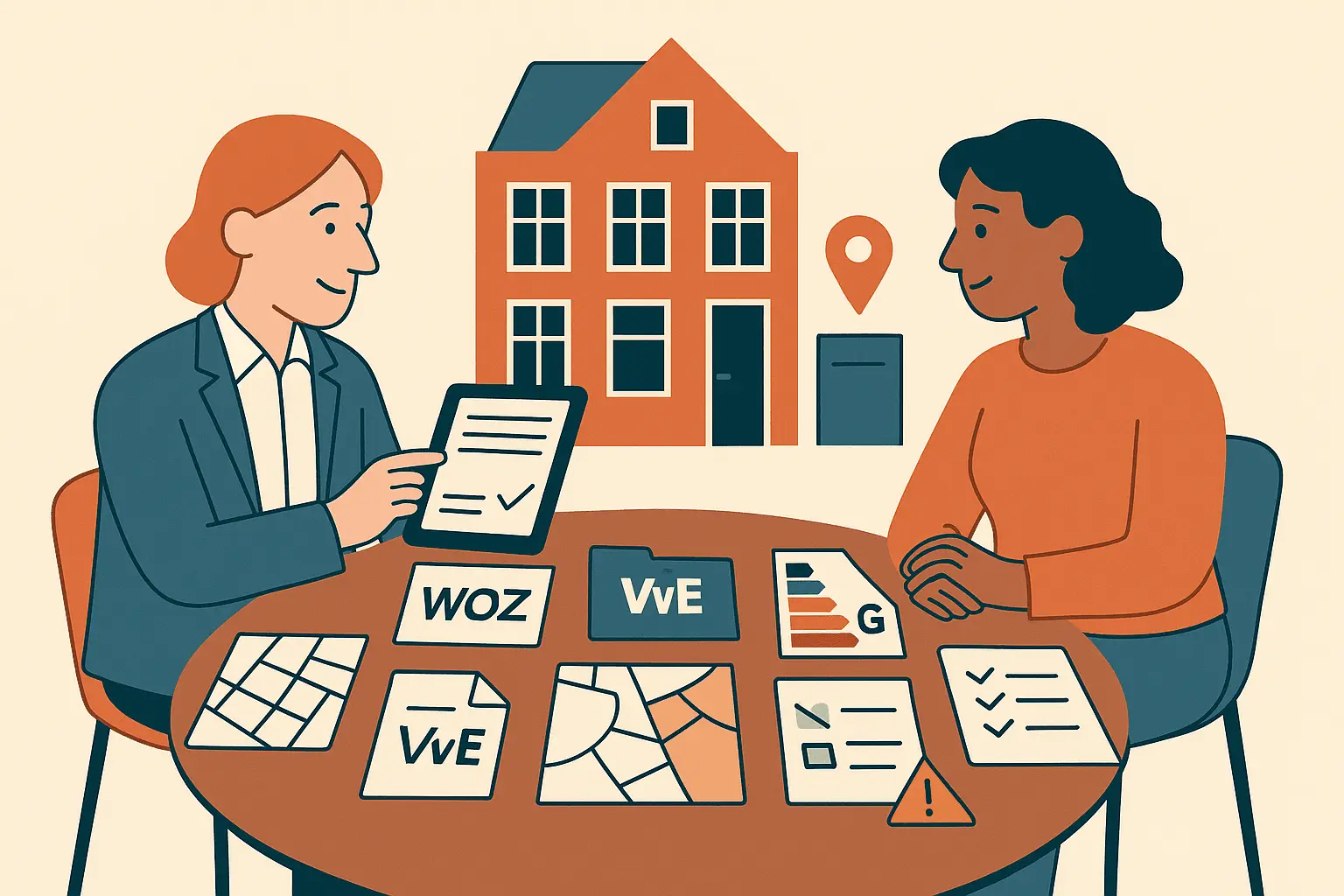
What a pre-bid property report should include

When you are preparing to bid on a Dutch home, the problem is usually not a lack of opinions. It is a lack of clear, address-specific facts before the offer deadline.
A good pre-bid property report helps you slow the decision down. It should show what is known, what is unclear, which documents matter, and which questions to ask before you commit to a price or conditions.
In short: it should help you check a Dutch property before you bid.
Before you offer: check the address in Huisscan. You can also view a sample report to see how a Huisscan pre-bid report turns one Dutch address and uploaded documents into available property data, risk signals, document analysis, and buyer questions.
What is a pre-bid property report in the Netherlands?
A pre-bid property report is a practical summary of the key information you should review before making an offer on a home.
For buyers and expats, a useful pre-bid property report Netherlands should not only repeat the listing text. It should combine Dutch property data, available public sources, uploaded documents, and clear explanations of possible risks.
It should help you answer questions such as:
- Is the property legally and practically what the listing says it is?
- Are there issues that could affect maintenance costs, financing, resale, or use?
- Which documents are missing or need professional review?
- Should I adjust my bid, add conditions, ask questions, or walk away?
It is not a valuation report, legal opinion, building inspection, mortgage advice, or notarial check. It is a pre-bid decision tool.
The Dutch property data your report should show
A strong report starts with the basic facts about the address. These are often found in Dutch public registers or official documents.
Useful data points include:
- BAG data: the Dutch register for addresses and buildings. This can show the official address, building year, use function, and registered surface area. It is useful, but it does not prove the condition of the home.
- Kadaster information: cadastral data about the plot or apartment right. This can help clarify boundaries, apartment rights, and certain registered rights.
- WOZ value: the municipal tax value. This is not the same as market value, but it can provide context.
- Energy label: a registered indication of energy performance. It can affect comfort, running costs, renovation plans, and sometimes the financing discussion.
- Monument or protected status: for example, a national monument, municipal monument, or protected cityscape. This can affect renovation options.
- Omgevingsplan / bestemmingsplan: zoning and planning rules. “Bestemmingsplan” is the older term many buyers still see; “omgevingsplan” is now used under the Environment and Planning Act. These rules can affect use, extensions, and nearby developments.
- Environmental signals: for example flood sensitivity, soil information, noise, or nearby industrial activity, where available.
- VvE information for apartments: the homeowners’ association, called Vereniging van Eigenaars in Dutch.
The report should also explain where information comes from and whether it is complete, outdated, or needs confirmation.
Documents to analyse before you decide your bid
A pre-bid property report should not stop at public data. The most important signals are often hidden in documents from the selling agent, seller, or VvE.
Key documents to review include:
- Vragenlijst: the seller’s questionnaire. This may mention leaks, asbestos, disputes, renovations, permits, foundation issues, or defects.
- Lijst van zaken: the list of items included or excluded from the sale, such as flooring, curtains, appliances, or garden items.
- Eigendomsbewijs or akte van levering: the deed of transfer from the current owner’s purchase. This can contain clauses, rights, obligations, or restrictions.
- Concept koopovereenkomst: draft purchase agreement. This may include clauses that affect risk allocation.
- Energy label and reports: useful for understanding insulation, heating, and possible improvements.
- Measurement report or floor plans: ideally using NEN 2580, the Dutch measurement standard for usable living area.
- Building inspection report, if available. If not available, you may consider whether to request one or include an inspection condition.
- Erfpacht documents, if the property is leasehold. Erfpacht means you may own the home but not the land, and there may be ground rent or conditions.
- VvE documents for apartments:
- splitsingsakte and splitsingsreglement
- annual accounts
- budget
- minutes of meetings
- service charge overview
- reserve fund information
- MJOP, or meerjarenonderhoudsplan, which is the long-term maintenance plan
For apartments, VvE documents are especially important. A low monthly service charge can look attractive, but if the VvE has major planned maintenance and limited reserves, your real future costs may be higher.
Risk signals that can change your offer
A report should translate information into practical pre-bid risk signals. Not every signal means you should stop, but it should help you decide what to ask and how to bid.
Common property risks in the Netherlands include:
| Risk signal | Why it matters before bidding | Possible pre-bid action |
|---|---|---|
| Foundation concerns | Older homes in some areas may have foundation or settlement issues | Ask for reports, consider specialist inspection, adjust your risk buffer |
| Poor VvE reserves | Future maintenance may lead to extra contributions | Review MJOP, minutes, accounts, and ask about planned works |
| Erfpacht | Ground lease conditions can affect long-term costs and mortgage review | Ask a notary or mortgage advisor to review the terms |
| Unclear renovations | Extensions, roof terraces, or layout changes may need permits | Ask for permits and check municipal information |
| Moisture, leaks, or roof issues | Repairs can be expensive and may not be visible during a viewing | Ask follow-up questions and consider a building inspection |
| Asbestos mention | Older materials may require care during renovation | Ask where it may be present and seek specialist advice if needed |
| Soil or environmental concerns | May affect renovation, garden use, or future works | Check available environmental data and ask the municipality if relevant |
| Conflicting surface areas | Listing, BAG, floor plan, and measurement report may differ | Ask which measurement standard was used |
The point is not to create fear. The point is to price uncertainty calmly.
If a risk is clear and manageable, you may still bid. If it is unclear and potentially expensive, you may lower your maximum price, add a condition, ask for more documents, or decide not to bid.
Practical checklist: what a pre-bid property report should include
Use this checklist when reviewing any pre-bid property check in the Netherlands.
- Address, building year, use function, and registered surface area
- Cadastral or apartment-right information
- Asking price context and WOZ value, with clear limitations
- Energy label and possible comfort or renovation implications
- Monument, protected status, zoning, or planning signals
- Leasehold / erfpacht check, if applicable
- VvE check for apartments, including finances, minutes, MJOP, and service charges
- Review of the seller’s questionnaire
- Review of the list of included and excluded items
- Review of deeds, clauses, rights, or obligations where available
- Building, maintenance, foundation, moisture, roof, or asbestos signals
- Environmental signals such as soil, water, noise, or nearby development
- Missing documents clearly listed
- Contradictions between listing, documents, and public data flagged
- Practical questions for the selling agent, buyer agent, mortgage advisor, inspector, notary, or lawyer
- Clear next steps before bidding
A good report should make uncertainty visible. “No information found” is not the same as “no risk exists.”
How to use the report before making an offer
The report should support one decision: what to do before the bid.
You might decide to:
- Bid as planned because the available information matches your expectations.
- Lower your maximum bid because there are extra costs, weak VvE finances, or uncertainty.
- Ask questions before the deadline about documents, permits, defects, VvE decisions, or leasehold terms.
- Add conditions where possible, such as financing or building inspection conditions. In Dutch these are often called ontbindende voorwaarden.
- Wait for professional review if the issue is legal, technical, financial, or notarial.
- Walk away if the risk is too large or the information is too incomplete.
For example, if an apartment looks well priced but the VvE minutes mention upcoming roof works and the reserve is limited, your bid strategy may change. You may ask whether extra contributions are expected, ask your buyer agent to assess the pricing, or include more room in your budget.
For expats buying a house in the Netherlands, the report is also useful because it explains Dutch terms that may not be obvious during a fast bidding process.
What Huisscan can help you check
Huisscan is built for the pre-bid moment: one address, one clearer report.
With a Dutch address and uploaded documents, a Huisscan pre-bid report can help you review:
- available Dutch property data for the address
- risk signals connected to the property, building, location, or legal structure
- documents such as the seller questionnaire, deeds, VvE files, leasehold information, and draft clauses
- contradictions or missing information
- practical buyer questions to ask before placing an offer
Huisscan helps you structure the information so you can have better conversations with your buyer agent, mortgage advisor, building inspector, notary, or other professional.
It does not replace those professionals. It helps you prepare before you need to make a fast decision.
FAQ: pre-bid property report Netherlands
Is a pre-bid property report the same as a building inspection?
No. A building inspection focuses on the physical condition of the property. A pre-bid report is broader. It can include property data, documents, legal-style signals, VvE information, environmental signals, and buyer questions. If there are technical concerns, ask a qualified building inspector.
Can a pre-bid property report tell me what to bid?
It should not pretend to know the perfect bid. Instead, it helps you understand facts and risks that may affect your maximum price, conditions, or decision to stop. For pricing advice, speak with a buyer agent or appraiser.
Which documents matter most for an apartment?
For an apartment, focus on the VvE documents: annual accounts, meeting minutes, budget, MJOP, reserve fund, service charges, splitsingsakte, and house rules. These can reveal upcoming maintenance, disputes, or extra costs.
What if some information is missing?
Missing information is itself useful. Before bidding, ask the selling agent for the missing documents or clarification. If the issue is important and cannot be clarified in time, consider adjusting your bid, adding a condition, or not bidding.
Do expats need a different type of report?
The property risks are the same, but expats often benefit from plain-English explanations of Dutch terms such as VvE, erfpacht, WOZ, Kadaster, and ontbindende voorwaarden. A good report should make those terms understandable before the offer.
Is Huisscan legal, mortgage, or building advice?
No. Huisscan is a pre-bid intelligence tool. It helps you check available data, documents, and risk signals before bidding. For legal, mortgage, tax, building, appraisal, or notarial advice, use a qualified professional.
Check the address before you bid.