
WOZ value vs asking price: what the gap means
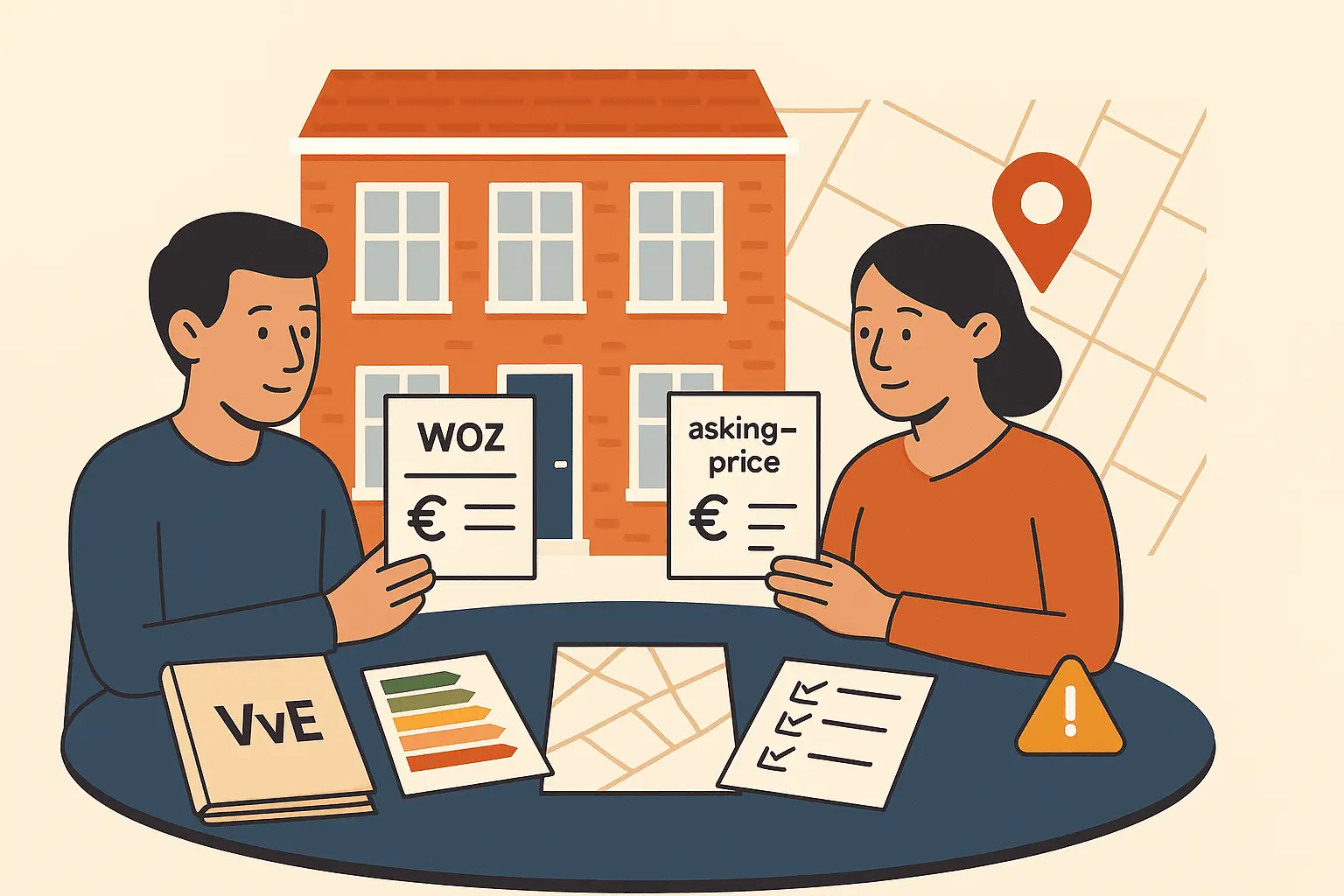
You find a Dutch home you like. The asking price is €525,000, but the WOZ value is €430,000. Is the seller overpricing it? Or is the WOZ simply behind the market?
If your question is “WOZ value vs asking price Netherlands”, the practical answer is: use the gap as a signal, not as a shortcut. A large difference can be normal, but it should push you to check the address, documents, comparable sales, and risks before you bid.
Considering an offer? Use Huisscan to check one Dutch address before bidding and turn available property data, uploaded documents, risk signals, and buyer questions into a clear pre-bid report.
What WOZ value and asking price actually measure
The WOZ value is the municipality’s estimated value of a property under the Dutch Wet waardering onroerende zaken. It is mainly used for municipal and other tax-related purposes.
Important points:
- The WOZ value has a valuation date in the past.
- It is based on available data and comparable properties.
- It may not fully reflect current market pressure, recent renovations, defects, or bidding competition.
- For many homes, the WOZ value can be checked through the WOZ-waardeloket. The owner may have more detailed WOZ documents, such as the valuation report.
The asking price — in Dutch, vraagprijs — is chosen by the seller and selling agent. It is not an official valuation. It may be set high, low, or strategically to attract interest.
The market value — marktwaarde — is what the property is likely worth in the current market. For a mortgage, a lender usually relies on a professional appraisal, not simply the WOZ value or the asking price.
So the gap between WOZ value and asking price is not proof that a home is cheap or expensive. It is a reason to investigate.
Why the gap can be large in the Netherlands
A large gap between WOZ value and asking price can have several explanations.
Common reasons include:
- Market movement: the WOZ value may lag behind current buyer demand.
- Renovations or extensions: a new kitchen, dormer, insulation, extension, or energy upgrade may not be fully reflected yet.
- Seller strategy: the asking price may be deliberately low to attract bids, or high to test the market.
- Location differences: streets, views, noise, parking, and public transport access can affect current demand.
- Property condition: roof, foundation, moisture, asbestos, installation quality, or overdue maintenance can affect real value.
- Apartment risks: a weak VvE can change the financial picture.
- Erfpacht: leasehold land can make price comparisons harder.
- Data errors: living area, plot size, building year, or property boundaries may be recorded differently across sources.
For buyers and expats buying a house in the Netherlands, the key is to avoid treating the WOZ value as a bid formula. It is one piece of Dutch property data, not the final answer.
How to read common WOZ-vs-asking-price situations
Asking price is much higher than the WOZ value
This is common in some markets, but it still needs explanation.
Check:
- Has the property been renovated since the WOZ valuation date?
- Are similar homes nearby selling at this level?
- Is the living area correct?
- Is the energy label better than older comparable homes?
- Are there hidden costs, such as VvE maintenance, erfpacht, or overdue repairs?
A higher asking price can be justified. But if the premium is based only on “market heat” and not on evidence, you may want a stricter maximum bid or stronger conditions.
Asking price is close to the WOZ value
This can feel reassuring, but it does not automatically mean the price is fair.
Still check:
- Comparable recent sales.
- Building condition.
- Energy performance.
- VvE documents for apartments.
- Legal or practical restrictions.
- Whether the WOZ data itself looks accurate.
A close match may simply mean the municipal estimate and seller strategy are aligned. It is not a substitute for a pre-bid property check in the Netherlands.
Asking price is below the WOZ value
This can look like a bargain, but be careful.
Possible explanations include:
- The seller wants to create bidding competition.
- The property needs serious maintenance.
- There are VvE, erfpacht, foundation, or permit issues.
- The market for this type of home has cooled.
- The WOZ value is based on data that does not match the actual property.
If the asking price is below WOZ, ask what explains it before assuming you have found a discount.
Data and documents to compare before you bid
To understand WOZ value vs asking price, combine public data with the seller’s documents.
Useful sources and documents include:
- WOZ value and valuation date: check the WOZ-waardeloket where available.
- WOZ valuation report: ask whether the seller can share the underlying WOZ information.
- Kadaster data: ownership, parcel information, and registered property details.
- BAG data: official building data such as function, year built, and surface area.
- Energy label: useful for comparing running costs and renovation needs.
- Sales brochure and measurement report: check whether the living area is clearly supported.
- Questionnaire from the seller: in Dutch, often called the vragenlijst.
- List of items: the lijst van zaken, showing what stays or goes.
- VvE documents: for apartments, review the owners’ association finances, meeting minutes, service charges, reserve fund, and maintenance plan.
- Erfpacht documents: if the home is on leasehold land, check the ground rent, conditions, and future changes.
- Permit and zoning information: check whether extensions, use, or future plans around the property may matter.
- Building inspection information: especially for older homes or properties with visible maintenance issues.
The goal is not to collect documents for the sake of it. The goal is to explain the price gap before you decide how much risk to accept.
Practical checklist: using the gap in your bid decision
Before making an offer, work through this checklist.
- Find the WOZ value and check the valuation date.
- Calculate the gap in euros and percentage.
- Compare the asking price with similar nearby homes, not only with WOZ.
- Check whether the property was renovated, extended, or improved after the WOZ date.
- Verify the living area, plot size, and building year across sources.
- Review the energy label and likely future improvement costs.
- For apartments, read the VvE documents carefully.
- Check for erfpacht, monument status, protected cityscape, or other restrictions.
- Look for property risks Netherlands buyers often need to consider, such as foundation, water, soil, noise, or overdue maintenance.
- Ask what could affect your mortgage if the appraisal is lower than your bid.
- Decide your maximum bid before emotions take over.
- Decide which conditions you need, such as financing or building inspection, and discuss wording with a qualified professional.
A useful pre-bid decision is not always “bid lower”. Sometimes it is “bid, but with conditions”. Sometimes it is “ask more questions first”. Sometimes it is “walk away”.
Questions to ask before making an offer
Use the WOZ gap to ask sharper questions.
Ask the selling agent:
- Which recent comparable sales support the asking price?
- Have there been renovations, extensions, or energy upgrades since the WOZ valuation date?
- Is the measured living area supported by a measurement report?
- Are there known defects or maintenance issues?
- Why is the asking price significantly above or below the WOZ value?
Ask about documents:
- Can the seller provide the WOZ valuation report?
- Is there a complete seller questionnaire?
- Are there permits for extensions or major works?
- Is there erfpacht, and what are the current and future conditions?
- For apartments, are VvE minutes, accounts, reserves, and the maintenance plan available?
Ask your own advisor where relevant:
- Could a lower appraisal affect the mortgage?
- Do the risks justify a building inspection condition?
- Is the bid still affordable if extra repair or improvement costs appear?
- Are there legal, notarial, tax, or mortgage points that need specialist review?
What Huisscan can help you check
Huisscan is built around one practical promise: Check a Dutch property before you bid.
With one Dutch address, and with any documents you upload, a Huisscan pre-bid report can help you organise the information that matters before an offer.
Huisscan can help you review:
- Available Dutch property data for the address.
- WOZ context and other price-related signals where available.
- Potential mismatches in property details.
- Risk signals linked to the property, building, ownership, or surroundings.
- Uploaded documents such as the sales brochure, seller questionnaire, VvE documents, erfpacht information, inspection reports, or other files.
- Buyer questions to ask the selling agent, buyer agent, mortgage advisor, inspector, or notary.
Huisscan does not replace a professional appraisal, building inspection, mortgage assessment, legal review, or notarial advice. It helps you see the price context and risk signals more clearly before you decide whether and how to bid.
FAQ
Is the WOZ value the same as market value?
No. The WOZ value is a municipal valuation used for tax-related purposes. Market value is about what the property may be worth in the current market. They can be close, but they are not the same thing.
Should I base my bid on the WOZ value or the asking price?
Use both as context, but do not base your bid on either number alone. Also compare recent sales, property condition, location, VvE or erfpacht details, mortgage implications, and your own risk tolerance.
What does it mean if the asking price is far above the WOZ value?
It may reflect market movement, renovations, location, or seller strategy. It may also mean the asking price needs stronger evidence. Check comparable sales and documents before accepting the gap.
What does it mean if the asking price is below the WOZ value?
It may be a deliberate low asking price strategy, or it may point to condition, legal, VvE, erfpacht, or market issues. Treat it as a reason to investigate, not as proof of a bargain.
Can the WOZ value affect my mortgage?
A lender usually focuses on the appraised market value, not just the WOZ value. If you bid above the appraised value, this may affect how much you can finance. Ask a mortgage advisor before relying on assumptions.
Where can I find the WOZ value?
For many homes, you can check the WOZ value through the WOZ-waardeloket. The owner may also have a WOZ assessment or valuation report with more detail. If the public data is missing or unclear, ask the selling agent or your advisor what is available.
Check the address before you bid.